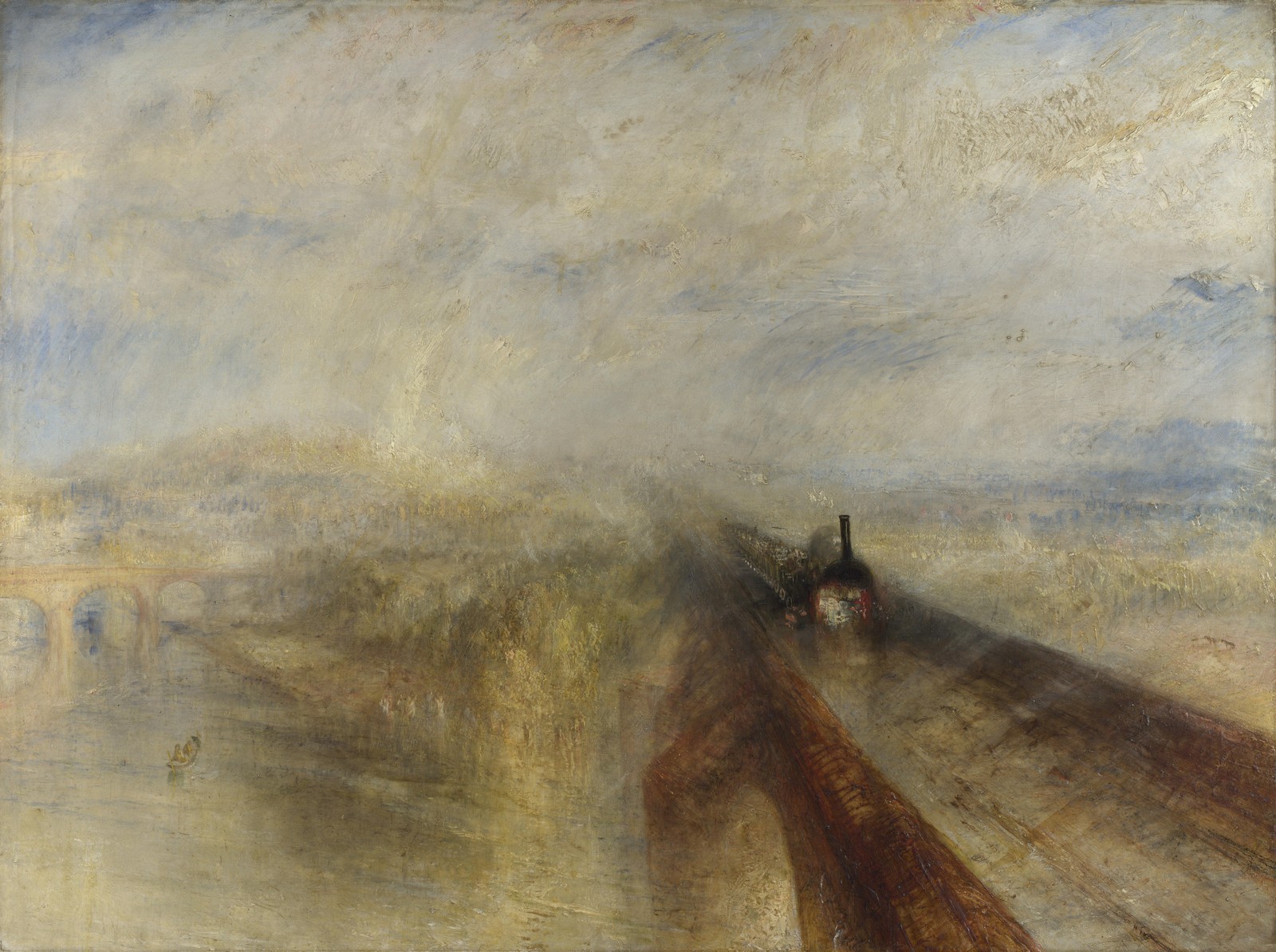
A study against the weather record
J. M. W. Turner
Rain, Steam and Speed – The Great Western Railway
A real bridge, a later storm story, and rain mixed with sunlight. Can the records date the sky Turner constructed?
Painted day unknownLocal weather unknown
The Nephos method
How this study was read
The method in fullWhat is written
The exhibition supplies a firm date in May 1844. The painted shower has no established date. April is selected only as the preceding complete month.
exhibited 1844
Judy Egerton, The British Paintings (2000), NG538, catalogue heading.6 May — 27 July
Royal Academy Summer Exhibition: A Chronicle, 1844, exhibition dates.real rain, behind which is real sunshine
W. M. Thackeray, May Gambols; or, Titmarsh in the Picture-Galleries, Fraser’s Magazine 29 (June 1844), p. 712.
Records of those days
- Oxford daily rainfall, released by Stephen Burt46.9 km from the bridge using approximate site coordinates. All 30 dated entries for April 1844 are summed as monthly context; early entries may span several days.
- Thackeray’s exhibition review and Lady Simon’s later accountA contemporary response to the canvas is distinguished from a retrospective journey story. Neither is a local gauge reading.
Not found or not yet searched
- No dated observation or preparatory sky study has been tied to this canvas in the sources checked.
- No accepted observation at Maidenhead identifies the pictured shower.
- Lady Simon gives no day of the month and identifies her fellow passenger retrospectively.
Each claim tested
- Does the night-journey story establish the painting’s weather? No. The window scene is at Bristol; her storm is over at Swindon. The canvas shows daylight and rain at Maidenhead, with a train travelling west.
- What was the month before the exhibition like at Oxford? Oxford’s April 1844 entries sum to 6.0 mm, rank 9 from driest among 192 Aprils (1828–2019). This is regional context before the May exhibition. Neither the gauge nor Lady Simon’s later story dates the rain at Maidenhead.
- Does a dry Oxford month contradict the painted rain? No. The depicted day is unknown, April is not a creation date, and a remote monthly total cannot exclude a local shower.
Verdict
Oxford’s April 1844 entries sum to 6.0 mm, rank 9 from driest among 192 Aprils (1828–2019). This is regional context before the May exhibition. Neither the gauge nor Lady Simon’s later story dates the rain at Maidenhead.
- UnknownThe date and local weather of the painted shower The exhibition date is secure; no document connects a particular day’s local weather to the canvas.
- UnknownTurner as Lady Simon’s fellow passenger Her later identification is not independently established.
What this cannot tell you. Pre-1853 entries can include multi-day accumulations. The release includes estimates and corrections without per-value flags. No wet-day count, storm date or rainfall at Maidenhead is inferred. The rainfall rank describes this released series, not a measurement of the atmosphere in the painting. The Oxford daily release ends in January 2020, so it cannot supply a full 1991–2020 April normal. Rain-gauge exposure, observation hours and the precise 1844 gauge position have not been reconstructed here.
Step 1 · The picture and the bridge
Maidenhead, made into an image of speed
The train approaches across Brunel’s Maidenhead Railway Bridge. The National Gallery identifies the view as looking east towards London, with the train travelling west. The older road bridge appears on the left. This is a recognisable place, but Turner altered its presentation: he compressed the double railway track into a narrow line and exaggerated the bridge’s recession into the distance. The approaching engine becomes the focus of the composition.
Historic England dates the railway bridge’s construction to 1837–39. Its two unusually flat brick arches allowed the railway to cross the Thames on a nearly level route while leaving space for river traffic. The first London line reached the east bank at Taplow in 1838; the bridge was in railway use from July 1839. It carried two broad-gauge tracks. The structure seen today includes the widening of 1890–93 for four tracks, with new outer faces closely following Brunel’s design. That later bridge should not be mistaken for every detail of the one Turner knew.
The title names rain, yet the atmosphere is not uniformly dark. Thackeray’s review of the exhibition describes rain with sunshine behind it. He is responding to an effect in paint, not reporting the weather at Maidenhead. The painting’s foreground thrust and obscured distance are part of its construction; no wind speed, rain intensity or cloud classification is measured from them.
“real rain, behind which is real sunshine”
W. M. Thackeray, May Gambols; or, Titmarsh in the Picture-Galleries, Fraser’s Magazine 29 (June 1844), p. 712.
Step 2 · Test the remembered journey
A night at Bristol is not a dated sky at Maidenhead
Jane O’Meara, later Lady Simon, recalled travelling towards London in June 1843. In her account, written for Ruskin long afterwards, an elderly fellow passenger leaned out of a window during a storm at Bristol. She did not identify him at the time. She concluded that he was Turner after seeing the painting at the Academy, and later also associated him with a portrait of the artist.
Her own sequence matters: by Swindon the storm was over, and she watched a bright dawn on the way to Paddington. The picture instead places a westbound train in daylight and rain at Maidenhead. Those differences prevent a literal equation of the window episode and the canvas. They do not prove that the journey never happened, or that it could not have supplied an idea.
The editors of Ruskin’s Works already questioned the identification; Judy Egerton’s National Gallery catalogue treats direct inspiration from this journey as conjectural. The recollection supplies no day of the month. No candidate rainy day is selected from the weather series to complete the story.
“on a certain day of June”
Jane O’Meara (later Lady Simon), retrospective account in Ruskin’s Dilecta; Works 35 (1908), p. 598.
“the storm by then over”
The same retrospective account, at Swindon; Works 35, p. 600.
Step 3 · A documented exhibition, a limited weather window
The month before the exhibition was dry at Oxford
The catalogue dates the painting by its exhibition in 1844. The Royal Academy exhibition opened on 6 May. That supplies a firm public date, not a date for the depicted shower or the start of painting. 1–30 April 1844 is selected here solely as the last complete calendar month before that opening. Neither April 1844 nor the anecdote’s June 1843 is adopted as the month of the painted scene.
At the Radcliffe Observatory in Oxford, approximately 46.9 km from the bridge using modern site coordinates, the released April entries sum to 6.0 mm. This ranks 9 from driest among 192 Aprils, 1828–2019, calculated in the same way. It was a dry month in that Oxford series. The number is not a measurement of rainfall at Maidenhead, nor evidence that Turner worked there that April.
All 30 dated entries have numeric values. That does not mean each is an independently observed day’s total. The provider warns that some entries before 1853 can contain several days’ rain. The release also includes estimates and corrections, without flags identifying each estimated value. For that reason, only monthly sums and their rank are interpreted here. Counts of wet days and a date for a storm remain unset.
Every April used in the comparison
| Year | April sum, mm |
|---|---|
| 1828 | 60.2 |
| 1829 | 91.3 |
| 1830 | 67.2 |
| 1831 | 38.7 |
| 1832 | 57.5 |
| 1833 | 55.3 |
| 1834 | 14.7 |
| 1835 | 38.7 |
| 1836 | 55.6 |
| 1837 | 33.2 |
| 1838 | 18.1 |
| 1839 | 42.4 |
| 1840 | 16.0 |
| 1841 | 53.6 |
| 1842 | 7.4 |
| 1843 | 51.4 |
| 1844 | 6.0 |
| 1845 | 26.5 |
| 1846 | 100.0 |
| 1847 | 25.6 |
| 1848 | 64.2 |
| 1849 | 79.4 |
| 1850 | 63.1 |
| 1851 | 29.8 |
| 1852 | 14.5 |
| 1853 | 54.9 |
| 1854 | 18.3 |
| 1855 | 9.8 |
| 1856 | 59.4 |
| 1857 | 46.8 |
| 1858 | 82.5 |
| 1859 | 58.7 |
| 1860 | 13.6 |
| 1861 | 16.3 |
| 1862 | 52.7 |
| 1863 | 34.9 |
| 1864 | 40.6 |
| 1865 | 22.9 |
| 1866 | 51.3 |
| 1867 | 65.0 |
| 1868 | 39.0 |
| 1869 | 29.2 |
| 1870 | 13.4 |
| 1871 | 65.8 |
| 1872 | 47.2 |
| 1873 | 12.1 |
| 1874 | 31.8 |
| 1875 | 36.8 |
| 1876 | 72.0 |
| 1877 | 54.0 |
| 1878 | 58.4 |
| 1879 | 62.1 |
| 1880 | 48.7 |
| 1881 | 19.9 |
| 1882 | 99.7 |
| 1883 | 25.7 |
| 1884 | 40.2 |
| 1885 | 45.0 |
| 1886 | 59.0 |
| 1887 | 29.1 |
| 1888 | 39.5 |
| 1889 | 79.0 |
| 1890 | 25.8 |
| 1891 | 24.0 |
| 1892 | 19.5 |
| 1893 | 1.5 |
| 1894 | 46.9 |
| 1895 | 46.4 |
| 1896 | 17.5 |
| 1897 | 53.5 |
| 1898 | 36.0 |
| 1899 | 48.8 |
| 1900 | 22.8 |
| 1901 | 53.2 |
| 1902 | 30.6 |
| 1903 | 58.5 |
| 1904 | 20.4 |
| 1905 | 49.0 |
| 1906 | 9.0 |
| 1907 | 57.4 |
| 1908 | 109.4 |
| 1909 | 50.2 |
| 1910 | 73.0 |
| 1911 | 29.6 |
| 1912 | 0.6 |
| 1913 | 96.8 |
| 1914 | 29.8 |
| 1915 | 21.0 |
| 1916 | 25.2 |
| 1917 | 41.5 |
| 1918 | 81.5 |
| 1919 | 57.1 |
| 1920 | 78.5 |
| 1921 | 23.2 |
| 1922 | 71.2 |
| 1923 | 58.3 |
| 1924 | 67.3 |
| 1925 | 56.6 |
| 1926 | 68.8 |
| 1927 | 44.1 |
| 1928 | 22.5 |
| 1929 | 34.3 |
| 1930 | 55.1 |
| 1931 | 75.8 |
| 1932 | 62.1 |
| 1933 | 25.3 |
| 1934 | 53.0 |
| 1935 | 91.8 |
| 1936 | 41.8 |
| 1937 | 66.9 |
| 1938 | 2.7 |
| 1939 | 76.8 |
| 1940 | 45.2 |
| 1941 | 26.3 |
| 1942 | 26.0 |
| 1943 | 25.7 |
| 1944 | 36.2 |
| 1945 | 32.6 |
| 1946 | 34.4 |
| 1947 | 46.9 |
| 1948 | 42.6 |
| 1949 | 33.4 |
| 1950 | 54.4 |
| 1951 | 64.8 |
| 1952 | 41.2 |
| 1953 | 53.0 |
| 1954 | 10.1 |
| 1955 | 16.6 |
| 1956 | 48.1 |
| 1957 | 9.9 |
| 1958 | 27.5 |
| 1959 | 52.2 |
| 1960 | 16.9 |
| 1961 | 75.9 |
| 1962 | 50.7 |
| 1963 | 50.4 |
| 1964 | 59.5 |
| 1965 | 49.4 |
| 1966 | 81.7 |
| 1967 | 40.4 |
| 1968 | 46.1 |
| 1969 | 37.0 |
| 1970 | 75.9 |
| 1971 | 44.8 |
| 1972 | 45.8 |
| 1973 | 42.4 |
| 1974 | 4.2 |
| 1975 | 46.9 |
| 1976 | 8.1 |
| 1977 | 40.7 |
| 1978 | 45.2 |
| 1979 | 38.9 |
| 1980 | 14.1 |
| 1981 | 43.9 |
| 1982 | 27.4 |
| 1983 | 89.5 |
| 1984 | 1.6 |
| 1985 | 32.7 |
| 1986 | 70.4 |
| 1987 | 51.4 |
| 1988 | 30.2 |
| 1989 | 63.8 |
| 1990 | 20.4 |
| 1991 | 56.3 |
| 1992 | 57.7 |
| 1993 | 69.2 |
| 1994 | 52.0 |
| 1995 | 18.9 |
| 1996 | 49.3 |
| 1997 | 15.8 |
| 1998 | 107.7 |
| 1999 | 57.6 |
| 2000 | 137.2 |
| 2001 | 72.7 |
| 2002 | 43.0 |
| 2003 | 36.8 |
| 2004 | 68.6 |
| 2005 | 50.2 |
| 2006 | 36.3 |
| 2007 | 1.8 |
| 2008 | 47.6 |
| 2009 | 32.0 |
| 2010 | 25.5 |
| 2011 | 0.5 |
| 2012 | 143.0 |
| 2013 | 24.9 |
| 2014 | 50.2 |
| 2015 | 22.7 |
| 2016 | 53.2 |
| 2017 | 5.4 |
| 2018 | 52.8 |
| 2019 | 29.9 |
The April 1844 entries: recorded dates, not identified storm dates
An early entry may include an accumulation from preceding days. Zero in this released column does not rule out an unrecorded trace.
| Entry date | Released rainfall, mm |
|---|---|
| 1 April | 0.0 |
| 2 April | 0.0 |
| 3 April | 0.0 |
| 4 April | 0.0 |
| 5 April | 0.0 |
| 6 April | 0.8 |
| 7 April | 0.0 |
| 8 April | 0.0 |
| 9 April | 0.0 |
| 10 April | 0.0 |
| 11 April | 0.0 |
| 12 April | 1.2 |
| 13 April | 4.0 |
| 14 April | 0.0 |
| 15 April | 0.0 |
| 16 April | 0.0 |
| 17 April | 0.0 |
| 18 April | 0.0 |
| 19 April | 0.0 |
| 20 April | 0.0 |
| 21 April | 0.0 |
| 22 April | 0.0 |
| 23 April | 0.0 |
| 24 April | 0.0 |
| 25 April | 0.0 |
| 26 April | 0.0 |
| 27 April | 0.0 |
| 28 April | 0.0 |
| 29 April | 0.0 |
| 30 April | 0.0 |
Step 4 · What the comparison can decide
The rain in the picture remains undated
A dry month at Oxford cannot contradict a shower in an undated view of Maidenhead. The gauge measures a different place, and the chosen month belongs to the exhibition’s calendar. It does not establish how much rain Turner experienced, when he saw the bridge, or when he painted this sky. The evidence supports a picture built around a real modern railway and a carefully shaped effect of motion. It does not support presenting the canvas as a report of Lady Simon’s night storm.
A dated letter, drawing or independently corroborated itinerary tied to this canvas could narrow the question. A weather record for that place and interval would then be needed. No such link is established in the sources checked. No verified Maidenhead weather witness is used here; unread newspaper pages are an evidence gap, not proof that no storm occurred. The published Oxford file ends in January 2020, so no incomplete 1991–2020 April normal is substituted for a full reference period.
Sources
Every source on this page
Weather values and quoted phrases are rebuilt from the fingerprinted sources below (sha256). The Historic England receipt records a saved browser extraction; the other receipts identify downloaded files. Fingerprints preserve the evidence used here; they do not independently validate its historical interpretation.
- National Gallery, NG538, object record
sha256 e1efca6fe390b6a34da5a8f349a912f850da7c33813f56c1b04c9dbacb1eb134 - Judy Egerton, The British Paintings (2000), NG538
sha256 4dd163c2e48781cf5213b057580cf5fc16d73564dd63d6afcfb4ceaa2d5dd81b - Royal Academy Summer Exhibition: A Chronicle, 1844
sha256 82ffd2885617223f1dcdff7131b25863191dfebf272c85faad166f6129ef14ff - W. M. Thackeray, May Gambols, Fraser’s Magazine 29 (June 1844)
sha256 1303c58adfcbb7455aa64124befe6a0ad757f94250193aa29dd26763178615e8 - Fraser’s Magazine, June 1844, p. 712, scan
sha256 202e3080f09a6f73322f5f9d3f72092648ae4744ad1f9e9c0ee30c40bbce48f9 - Lady Simon’s retrospective account, Ruskin, Works 35 (1908), p. 598
sha256 e12497d6ee82336c22e584ec23f591c46816a0f30d628b5556756d6b16f1d055 - Lady Simon’s retrospective account, Ruskin, Works 35 (1908), p. 600
sha256 2f1cf60b5a78b4038b93800721edf805a68196fee7df756a24ae7171bacbc6c4 - Lady Simon’s retrospective account and editors’ note, Works 35 (1908), p. 601
sha256 e5cdd55de1560f96b9f578d886dbb4407a34fcb94ff0c54d27b19ee4a1ed75b8 - Oxford Radcliffe daily dataset, Stephen Burt, updated January 2020
sha256 949953f14f6cc0a75ac81268345cf480663b95fe078ceb59b249d9d534861264 - Stephen and Tim Burt, documentation for Oxford daily weather
sha256 9b87b0dc0b56f61f5b2322c2a2ff61d38c368dbce5cc97d44793ca7e729051a4 - Stephen Burt, Oxford daily weather, dataset metadata, DOI 10.6084/m9.figshare.11956239
sha256 523ce2a0f8fbd55a6cce469481509931c5d1fe8abfafcdf9acced16c8e1fd7a8 - Met Office, Oxford historic station header
sha256 7bd7f15c624736b0685c6c4ee1e2442f6805544f9b68de58981ff2f137b4d7e3 - OpenStreetMap, Maidenhead Railway Bridge, way 511816111
sha256 bd6146a792aaa0019826d1c54ca8f42605886553be40007c0fb35aff0157b8ef - Historic England, Maidenhead Railway Bridge, list entry 1125021
sha256 ee6f09a97cda16a7176f3f5ae9f33eecf923552ff17644d5c47169db4e232204 - Wikimedia Commons, rights for the NG538 reproduction
sha256 79d5e9e008532807bfe311b815bef5dedb0518579c915debaab17d063f9f5570 - Turner, Rain, Steam and Speed, NG538; original Commons reproduction
sha256 b391ff3e06a23557c8afd006691236ab1d68d2a4357d9b0944bb97d2389fda85


