A study against the weather record
Thomas Moran
The Grand Canyon of the Yellowstone
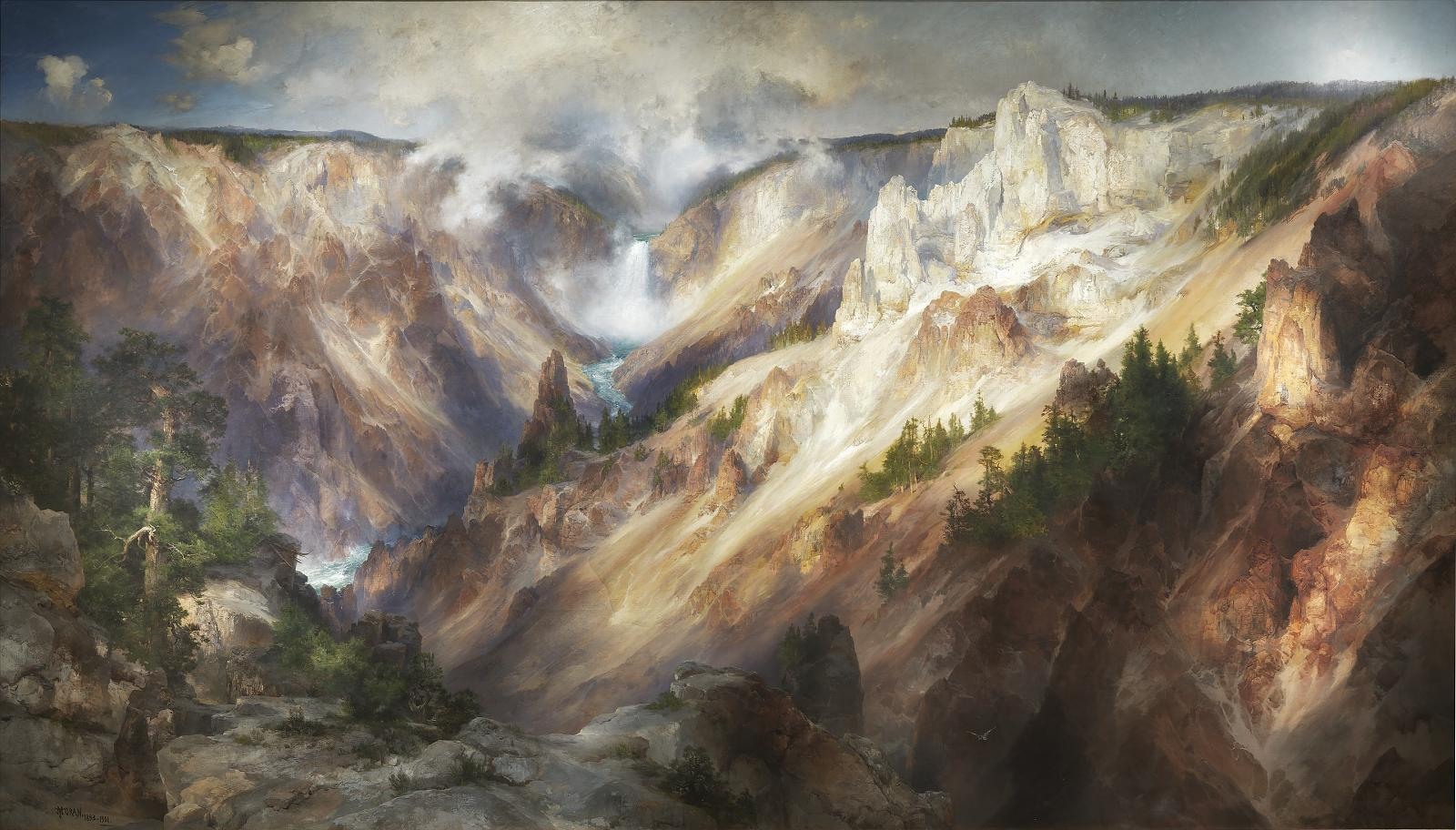
After his 1892 return, Moran removed the figures and changed the light. What can the records tell us about the later picture?
Records at MammothPainted weather unknown
The Nephos method
How this study was read
The method in fullWhat is written
Moran returned in 1892. Two inscribed canyon sketches date to 26 and 31 July; he visited other parts of the park between them. This is a fieldwork window for a later studio painting.
Records of those days
- Fort Yellowstone daily register, July 189212 maximum/minimum readings across 6 dates, manually transcribed from the Army form. Mammoth context; no canyon thermometer.
- Letters, inscribed sketches and contemporary reviewsThe NGA chronology transcribes Moran’s letters and 1892 studio reports; Cooper Hewitt supplies the dated inscriptions.
Not found or not yet searched
- No document identifies a day represented by the canvas.
- The selected rain cells are blank; the form has no cloud column.
- The original letters and newspapers were not inspected; their published transcriptions were.
Each claim tested
- Did Moran simply repeat the earlier painting? No. The NGA identifies removed figures, smaller framing trees and looser handling. A contemporary review contrasts morning and afternoon effects.
- What can the daily record establish? At Fort Yellowstone the daily maxima range from 62 to 86 °F, and minima from 38 to 48 °F. These are post temperatures, not canyon weather.
- Do the records confirm the painted atmosphere? Unknown. Neither a depicted day nor matching local observations have been established.
Verdict
A changed composition after a documented return. Daily temperatures give context at Mammoth; they cannot date or validate the painted spray and sky.
- UnknownPainted weather at the canyon No depicted day, local cloud record or measured spray is established.
What this cannot tell you. The span between sketches is not continuous canyon residence. Blank rain cells are not zero rainfall. No 1871–1892 climate trend, climatic rank or modern anomaly is calculated. The review describes the 1892 exhibited state; the precise changes associated with the final 1901 date remain unresolved.
Step 1 · Return and revision
A second look, a different picture
Moran’s later Grand Canyon of the Yellowstone is more than a repeat of the 1872 canvas. Nancy K. Anderson’s NGA catalogue identifies the changes: the foreground figures disappear, the framing trees shrink, and looser brushwork gives colour greater emphasis. These are changes in pictorial construction, not measurements of environmental change.
In his letter of 26 July 1892, Moran hoped to improve on his earlier picture after making new sketches. The NGA connects this canvas to that return and its showing at Chicago’s 1893 exposition. SAAM dates the work 1893–1901; the NGA chronology records work on the large Yellowstone canvas in the studio in October 1892. The dates describe different stages of its making. The precise revisions associated with 1901 have not been established here.
“I think I can paint a better picture”
Moran to Mary Nimmo Moran, 26 July 1892; NGA chronology (1997), p. 256, citing Bassford and Fryxell (1967), pp. 119–122.
Step 2 · What changed
From afternoon to a morning effect
A New York Herald review of 1 December 1892 describes the new canvas as a morning effect, with spray above the falls, and contrasts it with afternoon in the earlier picture. That is evidence of how the new composition was seen before its final dated state. It does not identify an observed morning, rainstorm or clearing event.
The comparison matters for environmental history. By the return visit, Moran’s letters mention hotels and a hired stage; Fort Yellowstone was part of the Army’s administration of the park. Our interpretation is that the removal of human figures deserves to be read alongside this growing infrastructure. An unpeopled composition is not evidence of an uninhabited landscape, or a record of what had been conserved.
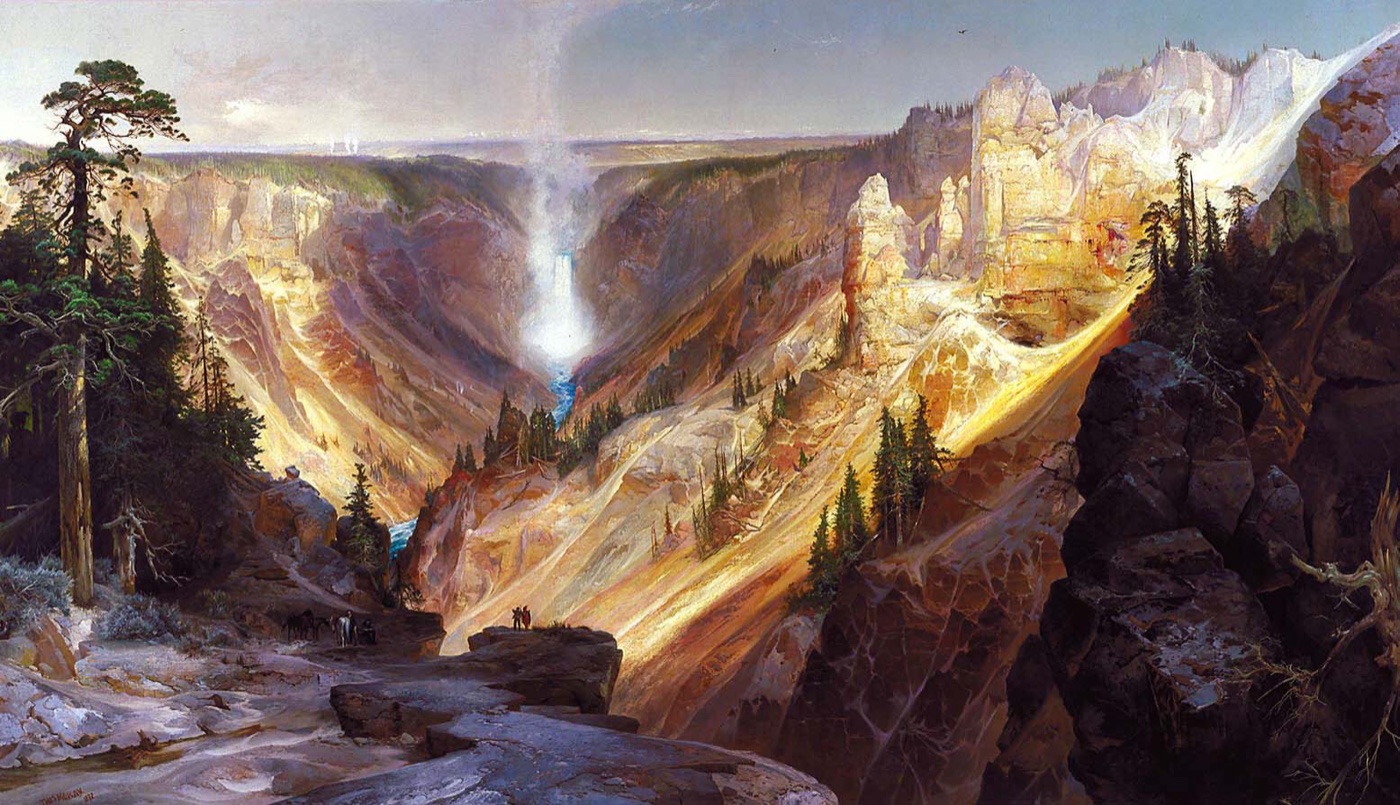
“a forenoon effect, with spray rising from the falls”
New York Herald, 1 December 1892, transcribed in the NGA chronology (1997), p. 257. A review of the exhibited state, not a weather observation.
Step 3 · The documented fieldwork
Two dated canyon sketches, with travel between
The published itinerary and letters put Moran at Mammoth on 20 July 1892. On 26 July he left the canyon for the lake; on 29 July he wrote from the Lower Geyser Basin. His West Wall of the Canyon is inscribed 26 July, and Moran’s Point is inscribed 31 July. The inscriptions, transcribed by Cooper Hewitt, anchor our 26–31 July comparison window. It includes travel elsewhere in the park and is not the duration of a single canyon stay, the entire trip, or a painting session.
“T. M. July 26th 1892.”
Moran’s inscription, West Wall of the Canyon, Cooper Hewitt 1917-17-19; museum transcription.
“July 31st, 1892. T. M.”
Moran’s inscription, Moran’s Point, Cooper Hewitt 1917-17-51; museum transcription.
Step 4 · The weather record and its limit
A thermometer at Mammoth, not a sky at the canyon
The Army’s Fort Yellowstone register, signed by surgeon Charles M. Gandy, preserves 12 maximum and minimum readings across these 6 dates. Daily maxima range from 62 to 86 °F; minima range from 38 to 48 °F. Each daily pair agrees with the form’s separate range column. These are temperatures at the post at Mammoth, not at Moran’s canyon viewpoint.
The rain cells for these dates are blank. We retain them as unknown, not dry days. The sheet supplies no cloud column, and does not state thermometer exposure or reading/reset hours. It cannot verify the painting’s spray, cloud, illumination or time of day. A temperature contrast between the 1871 expedition and this fixed post would also mix places and observing practices; we make no climate-change calculation from the two visits.
| Date | Maximum | Minimum | Range | Rain cell |
|---|---|---|---|---|
| 26 July | 81 | 48 | 33 | Blank |
| 27 July | 62 | 45 | 17 | Blank |
| 28 July | 72 | 38 | 34 | Blank |
| 29 July | 78 | 45 | 33 | Blank |
| 30 July | 80 | 44 | 36 | Blank |
| 31 July | 86 | 47 | 39 | Blank |
The records establish a return to the subject and a changed composition. They supply daily weather context at Mammoth. The canyon’s weather on those days, and the day represented in the finished painting, remain unknown.
Sources
Every source on this page
Each file was downloaded and given a fingerprint (its sha256). The page is rebuilt from these files and will not build if a fingerprint changes, so every number above comes from them rather than being typed in.
- SAAM object 1928.7.1 and public-domain media declaration
sha256 c1bbf4439f3f44a271ea8f340c77953501ba6ff30881e4d89e68d57721dfb7d5 - Nancy K. Anderson et al., Thomas Moran (NGA, 1997)
sha256 e8d39c3dd3942588a996e2b1e8294507ff17c9d9f135d56e6c9e085790521760 - NGA comparison of the 1872 and later canvases
sha256 c56ace17be3d5fedbec03d97f9da69c8baad247ad6e173a3b6365c0cd8881e48 - NGA chronology: July 1892 letters and drawings
sha256 cb21384e7c6f5904e6da1e8b1b0d49e7edf7c798ad758b6265115f9f8148b850 - NGA chronology: 1892 studio reports
sha256 d9544bb709870cccaca48a7ff13ef0a940ae2a63daf6b5c90369c4a2f82d579a - Cooper Hewitt, West Wall of the Canyon, 1917-17-19
sha256 11c5bfc4fb7962c5ffd3c0740bea71a4060060f08f8f74d63ac638beefaf76e6 - Cooper Hewitt, Moran’s Point, 1917-17-51
sha256 66c826921e997961635d490d14cbf6e6cae9026873defc248a06ed0af9d85d99 - US Army, Fort Yellowstone meteorological register, July 1892
sha256 586a30424fb21962143342ac1e7c1639d8d4c2e2e1bb23300be38999976e344f - Nephos transcription of six Fort Yellowstone daily rows
sha256 d9bbe2a1ed238194f2f2d1ded49e5719259c1ee35732e45edc28597d72ab41cf - National Park Service, Fort Yellowstone
sha256 32bcafc6d49bd5b53375372946e4272235c06193b95d8919c99297844884925a - SAAM public-domain reproduction, 1928.7.1
sha256 f412213939ac916ae0fc8cdb9b0b7419fa1e3551fe499c4e84d606eccf0e400d