A study against the weather record
Thomas Moran
The Grand Canyon of the Yellowstone
Moran sketched the Lower Falls from 28 to 30 July 1871 and painted the canvas in his studio afterwards. What did the survey’s instruments record around the canyon that week?
The bright sky partially agreesDay unknown
The Nephos method
How this study was read
The method in fullWhat is written
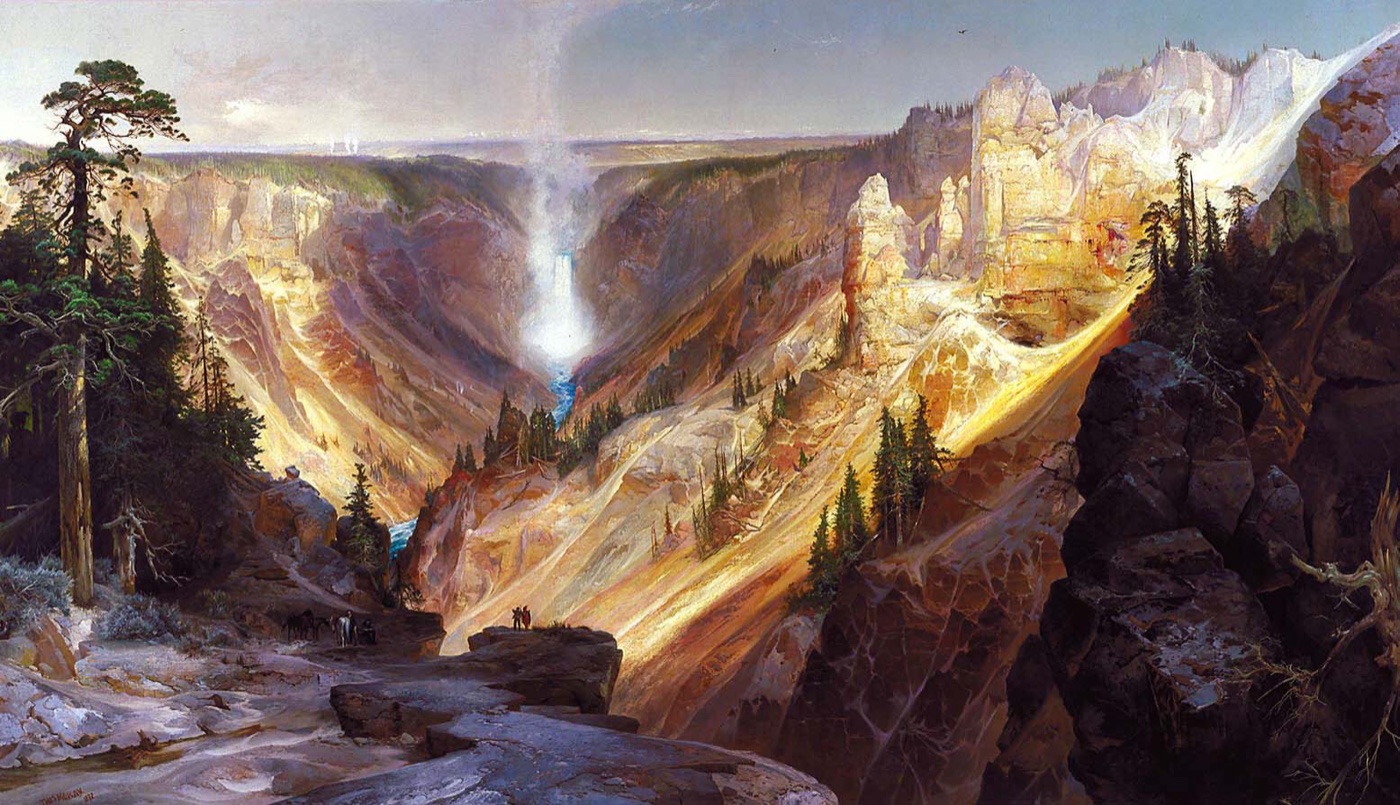
Painted in the studio and completed in 1872, from sketches Moran made at the Lower Falls between the evening of 27 July and the morning of 31 July 1871, with the Hayden survey.
July 28. Sketching & photographing about the Falls. July 29 photographing & sketching around the Falls & Canon July 30 still at the Falls.
Thomas Moran, diary, 1871 (NPS transcription)I did not wish to realize the scene literally, but to preserve and to convey its true impression.
Moran, in G. W. Sheldon, American Painters (1879)
Records of those days
- J. W. Beaman’s camp logThe survey meteorologist read a barometer and an open-air thermometer two to four times a day at each camp, with wind, cloud and the share of clear sky. Transcribed by Nephos from the printed tables.
- Boteler’s Ranch base stationThe same survey’s fixed station in the Yellowstone valley, 4,925 feet, four to six readings a day with wet and dry bulbs.
- Fort Ellis post surgeon’s registerThree readings a day, cloud and rain, 110 km from the falls.
- Lake Yellowstone and the Canyon snow stationLate-July temperatures today, 1991–2020, 19 km and 1.1 km from the falls.
Not found or not yet searched
- No instrument stood at the canyon on 28–30 July: the survey’s camp left Cascade Creek, 2.4 km from the falls, on the morning of the day Moran arrived.
- No one measured rain; rain appears only in remarks.
- Captain Barlow’s parallel instrument record was destroyed in the Chicago fire of October 1871.
Each claim tested
- The painting’s sunlit canyon under a bright sky, as Nephos reads the canvas. On 28–30 July the plateau camps logged about half the sky clear by day (5.6 of 10 on average) and 8 to 10 of 10 in the evenings; the valley station 6.4 of 10 by day. Beyond showers on the night of 27–28 July, no rain was remarked through the 30th; a storm stood in the northeast on the evening of the 29th.
- “a gale was blowing”, Captain Barlow on the summit of Mount Washburn, 26 July 1871. That afternoon Beaman logged the strongest wind of the week at Cascade Creek below the mountain: south-west, force 4, a stiff breeze on his 0–10 scale.
- “frosts occur every night”, Barlow on the plateau. Beaman remarked frost once, on the night of 26–27 July at Cascade Creek (42° at 6 a.m.); the next dawns read 42½° to 51°.
- The day and the sky of the canvas itself. A studio composite; Moran said the relations of the parts “are not always preserved”.
Verdict
The week Moran sketched the canyon was fair high-plateau summer: frosty dawns in the low 40s, afternoons near 70°, the sky about half clear by day and clearing at dusk, one storm on the horizon and no measured rain. The instruments had moved up-river the day he arrived, so the canyon itself went unmeasured.
- Partially agreesThe bright sky Fair days on the survey’s logs, 13–20 trail miles from the canyon; nothing measured at the falls.
- Partially agreesBarlow’s gale on Mount Washburn The windiest reading of the week, below the mountain; the summit was not measured.
- Partially agrees“frosts occur every night” Frost is remarked on one night of five; the thermometer was read after dawn, not at the coldest hour.
- UnknownThe day painted A studio composite from several days’ sketches and photographs.
What this cannot tell you. Beaman’s readings are single spot readings at irregular hours, not daily highest and lowest, with unknown exposure. The plateau camps moved every day or two between 7,400 and 7,800 feet; the valley station is 2,500 feet lower and 63 trail miles away. The modern averages are context only: Beaman’s single readings at odd hours from moving camps are not daily highs and lows, so they cannot show that 1871 was like today.
Step 2 · Records of those days
The thermometer left the canyon the day Moran arrived
The Hayden survey’s meteorologist, J. W. Beaman, read a barometer and an open-air thermometer at every camp two to four times a day, and noted the wind, the kind of cloud and how many tenths of the sky were clear. The party camped at Cascade Creek, 2.4 km from the Lower Falls, on the night of 26–27 July and moved up-river that morning. Moran, travelling a day behind the main party, reached the falls that evening. For the three days he sketched there, the nearest readings are from the Mud Volcano and Yellowstone Lake camps, 13 to 20 trail miles south. A second observer kept a base station in the Yellowstone valley at Boteler’s Ranch, 63 trail miles away, and the Army surgeon at Fort Ellis, 110 km away, read his thermometer three times a day. Nobody measured rain.
- 42°
- at 6 a.m. on 27 July at Cascade Creek, 2.4 km from the falls, after “Frost at night”
- 5.6
- tenths of the sky clear by day, on average, at the plateau camps on 28–30 July
- 94°
- the valley station’s highest reading, 31 July, in the shade
- 4
- the strongest wind of the week on Beaman’s 0–10 scale, a stiff breeze, 26 July at Cascade Creek
Every reading at the plateau camps, 25–31 July 1871
| 1871 | Time | Camp | °F | Wind | Clouds | Clear sky, of 10 | Remark |
|---|---|---|---|---|---|---|---|
| 25 July | 8.00 a.m. | Small Creek | 61.5 | N. 1 | 10 | Smoky east. | |
| 25 July | 3.30 p.m. | Tower Creek | 78 | 0 | Cu., cir.-cu | 8 | |
| 25 July | 7.15 p.m. | Tower Creek | 61 | 0 | Cir.-cu | 9 | |
| 26 July | 7.00 a.m. | Tower Creek | 49 | S.W. 1 | Cir.-cu | 8 | |
| 26 July | 3.30 p.m. | Cascade Creek | 72.5 | S.W. 4 | Cir.-cu., cu | 7 | |
| 26 July | 7.15 p.m. | Cascade Creek | 60 | S.W. 1 | Cir.-str., cir.-cu | 9 | |
| 27 July | 6.00 a.m. | Cascade Creek | 42 | E. 1 | Cir.-cu | 5 | Frost at night. |
| 27 July | 3.15 p.m. | Mud Volcano | 73.5 | S.W. 3 | Cir.-cu., cu | 9 | |
| 27 July | 7.30 p.m. | Mud Volcano | 60 | N.E. 3 | 10 | ||
| 28 July | 6.00 a.m. | Mud Volcano | 42.5 | N.E. 3 | Cir.-cu., cu-str | 6 | Showers during the night. |
| 28 July | 12.45 p.m. | Yellowstone Lake | 59 | S. 3 | Cu., cir-cu | 5 | |
| 28 July | 3.30 p.m. | Yellowstone Lake | 60.75 | S. 3 | Cir.-cu., cu | 6 | |
| 28 July | 7.15 p.m. | Yellowstone Lake | 56 | N.W. 1 | Cir.-cu., cu.-str | 8 | |
| 29 July | 8.00 a.m. | Yellowstone Lake | 51 | S.E. 1 | Cir.-cu | 6 | |
| 29 July | 12.00 m. | Yellowstone Lake | 70 | S.E. 3 | Cu., cir.-cu | 5 | |
| 29 July | 3.30 p.m. | Yellowstone Lake | 68.5 | S.S.E. 2 | Cu., cu.-str | 5 | |
| 29 July | 7.15 p.m. | Yellowstone Lake | 64 | S.E. 3 | Cu.-str., cu | 8 | Storm in the northeast. |
| 30 July | 9.30 a.m. | Yellowstone Lake | 64 | S.S.E. 2 | Cu.-str., cir.-cu | 6.5 | |
| 30 July | 7.15 p.m. | Yellowstone Lake | 65 | S.S.E. 1 | 10 | ||
| 31 July | 6.45 a.m. | Yellowstone Lake | 50.5 | N.N.E. 1 | Cir.-cu | 4 | |
| 31 July | 12.20 p.m. | Yellowstone Lake | 68.5 | S.S.E. 3 | Cu.-str., cu | 8 | |
| 31 July | 2.30 p.m. | Yellowstone Lake | 71 | S.S.E. 3 | Cu., cir.-cu | 8 | |
| 31 July | 8.00 p.m. | Yellowstone Lake | 60.5 | W. 2 | 10 | Smoky north. |
Every reading at Boteler’s Ranch, 26–31 July 1871
| 1871 | Time | Dry bulb, °F | Wet bulb, °F | Wind | Clouds | Clear sky, of 10 | Remark |
|---|---|---|---|---|---|---|---|
| 26 July | 5.50 a.m. | 49.5 | 44.5 | S.W. 1 | 10 | ||
| 26 July | 9.00 a.m. | 67 | 54 | N.E. 1 | 10 | ||
| 26 July | 3.10 p.m. | 82.5 | 57.5 | S.W. 4 | Cu | 5 | |
| 26 July | 7.25 p.m. | 69 | 53 | W.S.W. 1 | Cir | 9 | |
| 27 July | 5.15 a.m. | 49 | 44.5 | W.S.W. 2 | Cu., cir | 9 | Heavy wind, and rain at night. |
| 27 July | 9.00 a.m. | 88 | 66.5 | S.W. 2 | 10 | ||
| 27 July | 12.10 p.m. | 92 | 61.5 | S.W. 4 | Cu | 9 | |
| 27 July | 3.00 p.m. | 88 | 58 | S.W. 4 | Cu | 7 | |
| 27 July | 7.15 p.m. | 73.5 | 51.5 | S.S.W. 4 | Cu.-str., nim | 4 | |
| 28 July | 6.30 a.m. | 66.5 | 52.5 | W.S.W. 4 | Cu., cir.-cu | 8 | |
| 28 July | 9.10 a.m. | 77.5 | 59 | S.S.W. 4 | Cu., cir.-cu | 5 | |
| 28 July | 12.30 p.m. | 86 | 63 | S.S.W. 4 | Cir.-cu., cu.-str | 4 | |
| 28 July | 3.15 p.m. | 74.5 | 56 | S.S.W. 4 | Cu.-str., cu | 3 | |
| 28 July | 6.55 p.m. | 67.5 | 55.5 | S.S.W. 3 | Cu.-str., cu | 8 | |
| 29 July | 7.45 a.m. | 79 | 60.5 | N.E. 1 | Cu., cir | 9 | |
| 29 July | 9.10 a.m. | 80 | 61.5 | E. 1 | Cir.-cu | 9 | |
| 29 July | 12.00 m. | 86.5 | 65.5 | N.E. 2 | Cu | 8 | |
| 29 July | 2.15 p.m. | 84 | 64.5 | N.E. 2 | Cir.-cu., cu | 7 | |
| 29 July | 8.30 p.m. | 61.5 | 53.5 | N. 2 | Cu., cir | 8 | |
| 30 July | 6.00 a.m. | 59 | 52.5 | S.W. 1 | Cu., cu.-str | 7 | |
| 30 July | 9.00 a.m. | 82.5 | 58 | S.S.W. 3 | Cu., cu.-str | 6 | |
| 30 July | 12.00 m. | 93.5 | 64.5 | S.W. 4 | Cu., cir.-cu | 8 | |
| 30 July | 2.45 p.m. | 82.5 | 56 | S.W. 4 | Cu | 8 | |
| 30 July | 7.30 p.m. | 70 | 54.5 | W. 1 | 10 | ||
| 31 July | 6.30 a.m. | 72.5 | 55.5 | S.S.W. 3 | 10 | ||
| 31 July | 9.25 a.m. | 91.5 | 62.5 | S.S.W. 3 | 10 | ||
| 31 July | 12.15 p.m. | 94 | 63.5 | S.S.W. 4 | 10 | ||
| 31 July | 3.00 p.m. | 92.5 | 60.5 | S.S.W. 4 | Cu | 9 | |
| 31 July | 7.45 p.m. | 66.5 | 51.5 | S.W. 1 | 10 |
Step 3 · The claims tested
Frosty dawns, fair afternoons, a storm on the horizon
The camp log records dawn readings in the 40s and low 50s and afternoon readings from about 60° to the low 70s, and by day the plateau sky was on average 5.6 tenths clear, with cumulus and cirro-cumulus building and clearing again by evening. Showers fell on the night of 27–28 July at the Mud Volcano camp; on the evening of the 29th Beaman saw a storm in the northeast. Down in the valley it was hot: 94° in the shade by 31 July. At Fort Ellis the surgeon entered no rain from 24 to 31 July. Captain Barlow of the Army Engineers, a day ahead of Moran, found a gale on the summit of Mount Washburn on 26 July; that afternoon Beaman’s strongest wind of the week, force 4, blew at Cascade Creek below. The modern averages below are context only: Beaman took single readings at odd hours from camps that kept moving, not daily highs and lows, so the two cannot be compared directly.
- 40.9°
- the average late-July night at Lake Yellowstone today (27–31 July, 1991–2020), 19 km from the falls
- 73.8°
- the average late-July afternoon there
- 7%
- of those nights reach frost
- 39.5°
- the average late-July night at the Canyon snow station, 1.1 km from the falls
“Frost at night.”
Beaman’s remarks, Cascade Creek, 27 July, 6.00 a.m.
“Showers during the night.”
Beaman’s remarks, Mud Volcano, 28 July, 6.00 a.m.
“Storm in the northeast.”
Beaman’s remarks, Yellowstone Lake, 29 July, 7.15 p.m.
“Smoky north.”
Beaman’s remarks, Yellowstone Lake, 31 July, 8.00 p.m.
“Heavy wind, and rain at night.”
Beaman’s remarks, Boteler’s Ranch, 27 July, 5.15 a.m.
“a gale was blowing at the time that I found it utterly impossible to use my drawing materials.”
Captain J. W. Barlow, on the summit of Mount Washburn, 26 July 1871: Report of a Reconnaissance of the Basin of the Upper Yellowstone (1872)
“frosts occur every night during the year.”
Barlow, on the plateau at about 7,000 feet, the same report
“The amount of rain which fell was slight in nearly every case.”
J. W. Beaman, summary of the survey’s weather, Hayden 1872, p. 518
Step 4 · Why the verdict stops at the week
A studio picture, by Moran’s own account
Moran’s diary records where he was each day at the falls but not the weather. He painted the canvas in his studio afterwards from his sketches and memory, completing it in 1872, and later said he had moved parts of the view. What Nephos sees in it is sun raking across the canyon’s walls, a bright sky with thin high cloud, spray standing above the falls and the foreground in shadow: weather the survey’s logs show was common that week, but no single hour of it can be matched to the painting.
“July 27 Left Tower Falls. Halted at noon on Mt. Washburne. Arrived at Yellowstone falls in the evening.”
Thomas Moran, diary, 1871 (Yellowstone National Park collection, NPS transcription)
“July 28. Sketching & photographing about the Falls. July 29 photographing & sketching around the Falls & Canon July 30 still at the Falls.”
The same diary
“July 31st Left the falls reached crater Hill.”
The same diary
“the gorgeous display of color that impressed itself upon me.”
Moran on the motive of the picture, in G. W. Sheldon, American Painters (1879), p. 125
“I did not wish to realize the scene literally, but to preserve and to convey its true impression.”
The same
“Every form introduced into the picture is within view from a given point, but the relations of the separate parts to one another are not always preserved.”
The same, pp. 125–126
“these beautiful tints were beyond the reach of human art.”
F. V. Hayden, on Moran at the canyon, Preliminary Report (1872), p. 84
“His aim was to not necessarily capture a topographically accurate scene but rather the sublime experience nature provides.”
U.S. Department of the Interior, blog, 25 September 2020
Sources
Every source on this page
Each file was downloaded and given a fingerprint (its sha256). The page is rebuilt from these files and will not build if a fingerprint changes, so every number above comes from them rather than being typed in.
- U.S. Department of the Interior Museum, Thomas Moran & the “Big Picture”
sha256 e875ddb5b2a4b82e68af642c8d8aeb8bdd241d851e0a3dfb03272d879751c232 - U.S. Department of the Interior, Thomas Moran and the Big Pictures (Internet Archive copy)
sha256 3e7f22ad2dec7f674a3ed91dcb487d9919a8600cbcdb44efa5ae1753b9cf9c22 - Wikimedia Commons, The Grand Canyon of the Yellowstone (1555 × 895 px)
sha256 93e00cacab92f3820e1c06cd0d2892260204c8d39ff08cbbc60a762e459c4398 - Beaman, Observations taken on the Yellowstone Lake trip, Hayden 1872, p. 512 (page image)
sha256 821d2ad423abe160ffd46a65519529c397791d2447f40f5d87a07607075f2445 - The same table, p. 513
sha256 3453ab7255e943e6911df47cacb273f06ceeb6188c2a0839c6e77610bff58090 - Beaman, Observations taken at Boteler’s Ranch, Hayden 1872, p. 508
sha256 910a7b0db8f8248546efe9267f28a662f2f8c3107e6673743d24ffb31f858406 - The same table, p. 509
sha256 bf3d5593fd65c68d0a8f06236afb15f4ac88b67aee03acc4d6007849db60f144 - F. V. Hayden, Preliminary Report of the United States Geological Survey of Montana (1872), full text
sha256 20de918876752b5cdc943c2a20e9f1fc5a23610ba687d86b8a6850869e4e590d - Meteorological Register, Fort Ellis, Montana Territory, July 1871
sha256 04cb250098e83ad7a3fdd6643734f847d618c9098c23a79b9a6bf78971fd4cef - Thomas Moran’s 1871 diary, NPS transcription, page 4
sha256 889d3328619002260daf238adce200275d8041b4c272c123642dc41809bfa09b - Thomas Moran’s 1871 diary, NPS transcription, page 5
sha256 aa1d891bbdbd122f56c985ceeb47fd73659d5b9d27aca36c0dec3b11b0808b7e - J. W. Barlow, Report of a Reconnaissance of the Basin of the Upper Yellowstone in 1871 (1872), full text
sha256 09e8b08574e839bac818e3001ebfd29179397daff48ea291159c1470fb94c275 - G. W. Sheldon, American Painters (1879), full text
sha256 356fe5fcca3a640d14633bb093c239f0615689256424d92f912122cb3910ede2 - GHCN-Daily, Lake Yellowstone, Wyoming (USC00485345)
sha256 6f4373d3a2caf682f8335ce469ec908d3cc0996ab4a394ac97eeefed0579e882 - GHCN-Daily, Canyon snow station, Wyoming (USS0010E03S)
sha256 d512dbe69b99aad7dd904384badf18601b049a9fe8d8b05ed704188117372ca5 - Wikidata: Lower Falls of the Yellowstone River (Q105337493)
sha256 4187256b08610f7cd5554758b13bc0b3e5673b233c42011f03066b1a43c24996


