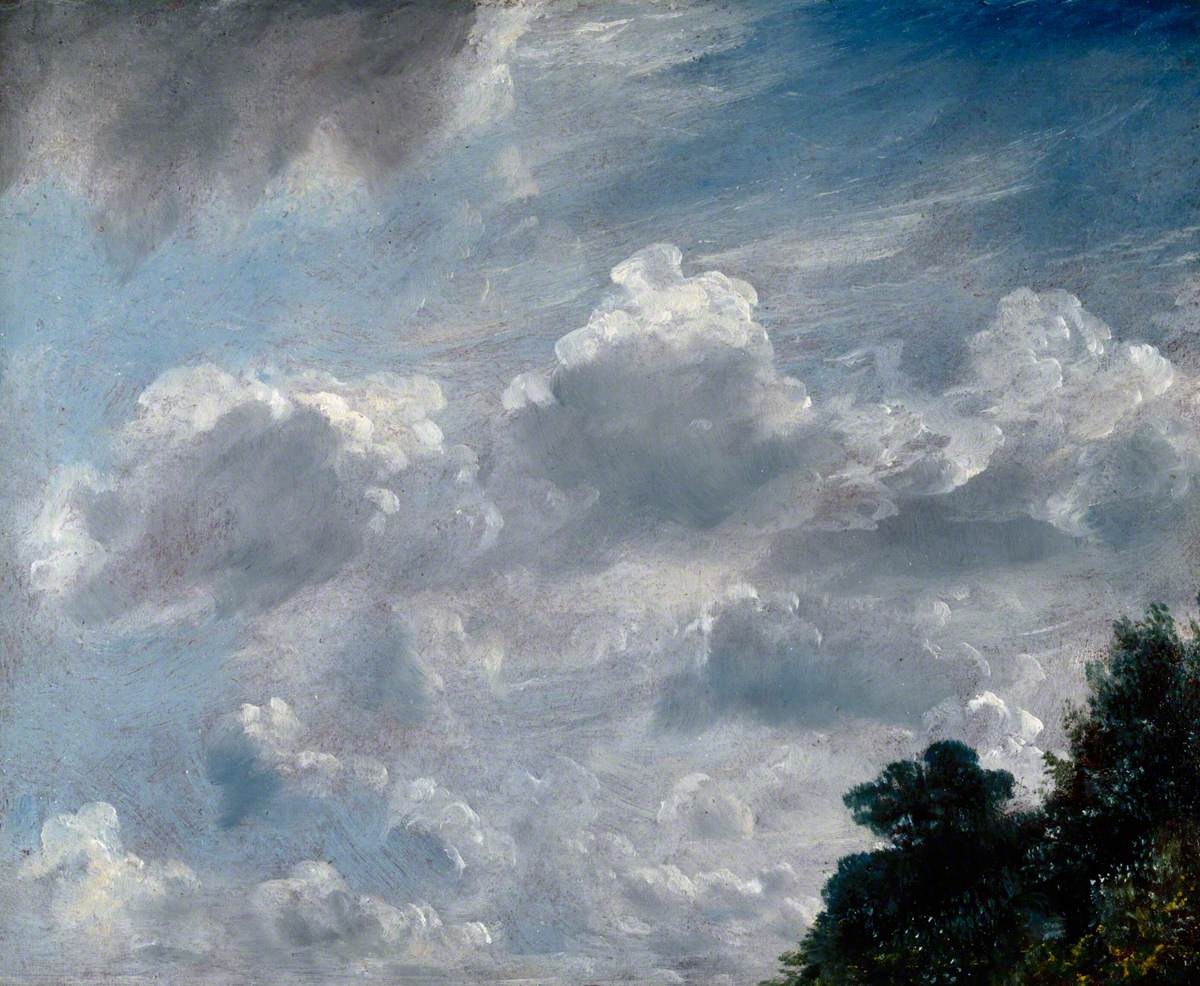

A study against the weather record
John Constable
Two cloud studies, 1821–22
One inscribed morning and one undated storm. The surviving words determine what each painted sky can tell us about the weather.
Dated morning: partial agreementSunset: storm unknown
The Nephos method
How this study was read
The method in fullWhat is written
One sketch has an inscribed morning; the other has a two-year catalogue interval. Each painting has its own study and limits.
Hampstead, Sepr 11, 1821. 10 to 11.
Constable’s inscription, transcribed by the National Gallery of Australia, 2006.This oil sketch is not visibly annotated
Philip Conisbee (2000), National Gallery of Art object record, 1998.20.1.
Records of those days
- Howard’s daily registerUsed to test the dated inscription on Tree at Right.
- Met Office HadCETDaily regional context for the inscribed morning; complete monthly context for the undated sunset.
Not found or not yet searched
- Neither record measures the individual clouds painted at Constable’s position.
Each claim tested
- Tree at Right The fine, cloudy description finds support in Howard, while exact wind and sultriness remain qualified.
- Stormy Sunset The catalogue’s storm cannot be assigned a day; regional temperature does not authenticate it.
Verdict
The difference in dating evidence controls what each comparison can say.
- Partially agreesTree at Right: broad weather description The daily comparison has both support and limits.
- UnknownStormy Sunset: a datable storm The surviving documentation supplies no day.

What this cannot tell you. Use the separate painting pages for the records, source receipts and the alternative metadata-date comparison.
Two painting studies
What a date lets the records test
Constable’s cloud sketches preserve choices about light, movement and paint. Their written evidence survives unevenly. Read each painting with the records its dating permits.
Cloud Study, Hampstead, Tree at Right
Royal Academy, 03/455. The inscription supplies 11 September 1821, 10–11am. Howard’s fine, cloudy day supports the broad description, while the wind directions differ. The writing extends beyond the painted morning to later rain.
The Google Arts & Culture entry for the Royal Academy gives 27 September 1821; the inscription is the date basis here. The painting study shows both dates from the same records.
Cloud Study: Stormy Sunset
National Gallery of Art, 1998.20.1. The holder supplies 1821–1822, with no readable date annotation. Its post-storm interpretation cannot be tied to a daily observation. The study presents the making of the sky and regional temperature context, with the storm left undated.
Sources
Every source on this page
Each file was downloaded and given a fingerprint (its sha256). The page is rebuilt from these files and will not build if a fingerprint changes, so every number above comes from them rather than being typed in.
- National Gallery of Australia, Constable exhibition (2006), Tree at Right
sha256 9229e8f12ea0170ab1318d24a2c84b47331b824aa98c5648af09abe6a2d0f8c6 - National Gallery of Art, 1998.20.1; Philip Conisbee (2000), captured web text
sha256 d2c49763aafbe6c127ceb7b4ac05bbd31a4049fbde910fbae70e3ad32454e9ae - Royal Academy of Arts on Google Arts & Culture: conflicting date metadata
sha256 ceb3f3fe930ed0228b43552c9ff270d717b090c2b740a0b1fb47b0bdd84add18 - Howard, The Climate of London (1833), vol. III, Table CLXXXIV, p. 60
sha256 94f31331517db9c42e73fd7b4109969587359f18c3d1be2826f237907aa67ad3 - Howard, notes and results, p. 61
sha256 e9a7f9ece12f5d7b8a64c96c6f2afb72a9cc656b3bde1c89b8358a487667169d - Met Office HadCET daily mean temperature; Parker, Legg & Folland (1992)
sha256 c6948508f8d4b1cff2b302c83d6506244c804abc2d088a743ef8ab6c630184cc - Met Office HadCET monthly mean temperature; Parker, Legg & Folland (1992)
sha256 c17868e014c4cfcc284a41149e6217b1dec976d7fa22fa91ed515e675eac3304 - Wikimedia Commons image rights record, captured web text
sha256 f25925a88f4ed598a4d6ae72c7d51dcfa715ae5415b288ce67c7a4631d3ed44f - National Gallery of Art open-access image policy, captured web text
sha256 03aa4c5b30788f765891d3d53bc743f00fa02fe9bff9139aa7e22619a64181ef

