A study against the weather record
John Constable
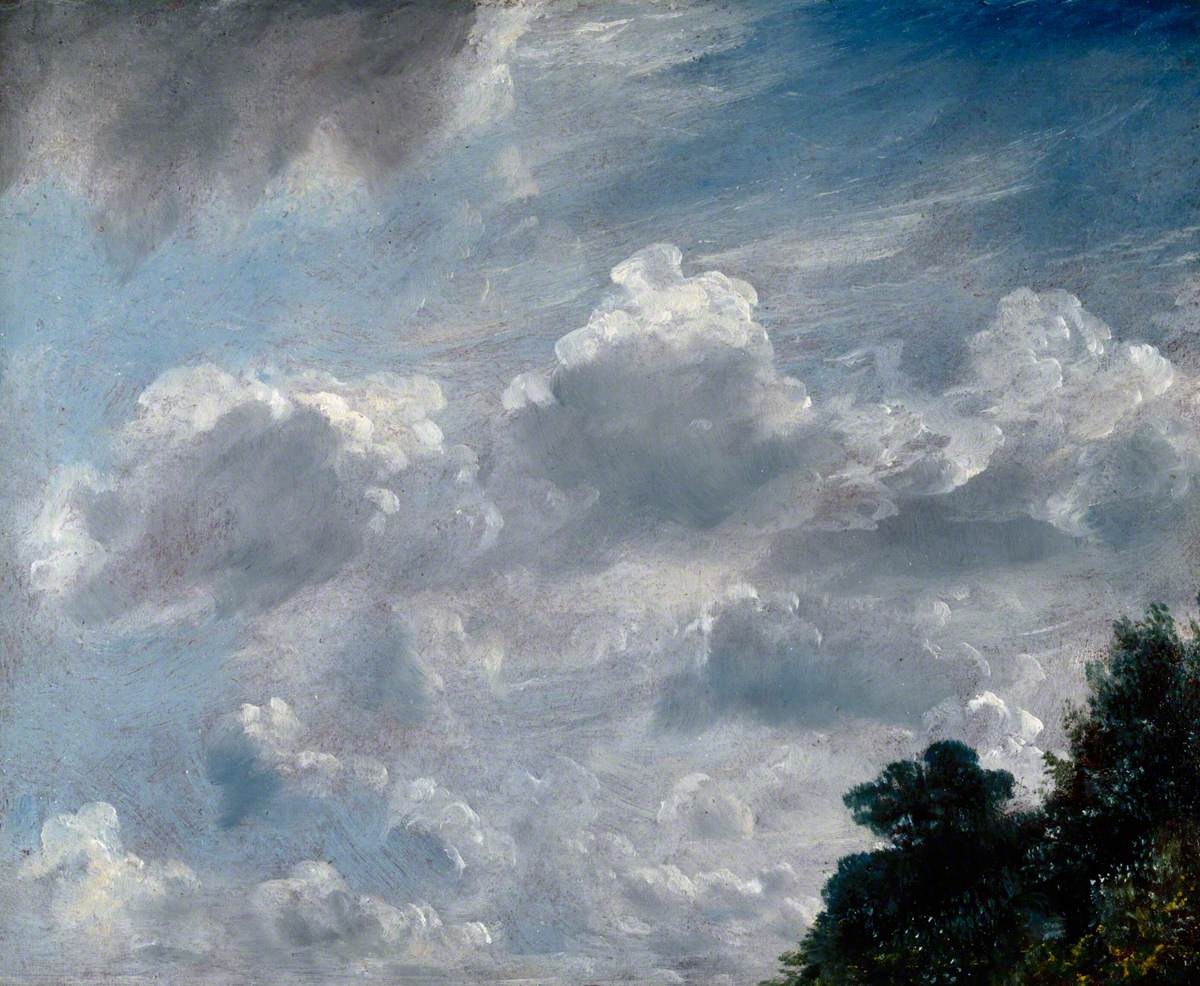
Cloud Study, Hampstead, Tree at Right
A morning sky, with a note that reaches into the following night. How far does the weather record support Constable’s written account?
Broad weather partially agrees
The Nephos method
How this study was read
The method in fullWhat is written
The inscription supplies 11 September 1821, 10–11am. It also mentions rain in the following night, extending the written account beyond the painted morning.
Hampstead, Sepr 11, 1821. 10 to 11.
Constable’s inscription, transcribed by the National Gallery of Australia, 2006.
Records of those days
- Howard’s London-area registerDaily first-thermometer range, wind and notes for the inscribed day and neighbouring days; the same sources also show the alternative metadata date.
- Met Office HadCETA regional daily mean, kept separate from Howard and from the unknown temperature at the easel.
Not found or not yet searched
- The original verso has not been inspected. Published transcriptions carry the inscription.
- Howard’s table does not identify its precise observing site. No hour-specific humidity at Hampstead is established.
Each claim tested
- Does the fine, cloudy description fit? Howard records a fine, cloudy day, between showers on the preceding day and the following morning. This supports the broad description.
- Does the wind match exactly? No. Howard’s W and Constable’s SW are neighbouring directions. Observation time and local exposure remain unresolved.
- Does the register confirm the later rain? The following morning is showery in Howard’s notes, but that cannot locate overnight rain at Hampstead.
Verdict
The broad description partially agrees. The painting fixes a morning view; the inscription records a longer change in the weather.
- Partially agreesFine day and broadly westerly wind Compatible broad description; the wind directions are not identical.
- UnknownSultriness and the individual painted clouds Daily regional entries do not establish humidity or cloud structure at the easel.

What this cannot tell you. The Royal Academy’s Google Arts & Culture entry gives 27 September 1821; the inscription is the date basis here, with both dates shown in the records. The weather comparison does not adjudicate the metadata conflict or establish that the clouds were painted without alteration.
Step 1 · The picture and its inscription
A morning sketch, a longer account
Small cumulus clouds catch the light above a margin of treetops. The National Gallery of Australia’s exhibition catalogue describes broad strokes in the upper right that express movement. This is a study in oil on paper, made at Hampstead; its inscription names a morning, then goes on to describe the day and the following night.
The catalogue reads the mention of later rain as evidence that the note was added after the painted morning. The picture and the writing therefore preserve different spans of time. That does not prove when every stroke was applied or that the painted sky was meteorologically altered.
“Hampstead, Sepr 11, 1821. 10 to 11. Morning under the sun - Clouds silvery grey, on warm ground Sultry. Light wind to the S.W. fine all day - but rain in the night following”
Constable’s verso inscription, as transcribed by the National Gallery of Australia, 2006
The original verso has not been inspected for this study. Clare Brant’s published transcription also gives 11 September, with minor punctuation differences.
The Google Arts & Culture entry for the Royal Academy gives 27 September 1821; the inscription is the date basis used here.
Step 2 · The daily records
Fine and cloudy, between showers
The Australian catalogue, citing Thornes (1999, pp. 224–25), reports good agreement between the inscription and London weather. The retrieved records allow a partial test of that assessment. Howard’s note for the inscribed day reads “Cloudy: fine.”; the preceding day has thunder and heavy showers, and the following morning is showery.
These are entries in Howard’s London-area register, not observations at Constable’s easel. The volume covers Tottenham and Stratford; this table does not name its precise site. The first thermometer’s daily minimum and maximum are kept separate from the second thermometer and from HadCET’s regional daily mean.
| Date | Howard wind | Howard min–max, °F | Howard’s daily note | HadCET mean, °C |
|---|---|---|---|---|
| 10 September | W | 50–70 | Some thunder about noon: heavy showers: lunar halo. | 14.3 |
| 11 September | W | 52–71 | Cloudy: fine. | 13.2 |
| 12 September | SW | 51–71 | Showery morning: cloudy. | 15.2 |
Howard: Table CLXXXIV, p. 60. HadCET: Met Office Hadley Centre, a regional series covering central England. Neither temperature column measures Hampstead at 10–11am. No blank rain cell is treated as a dry day.
Step 3 · What agrees, and what does not
A partial match to the written weather
The fine, cloudy description has support. The wind is less exact: Howard gives W (west), while Constable wrote S.W. These are neighbouring compass directions; different places and unresolved observing times limit the comparison. It is not an identical wind observation.
Howard’s first thermometer spans 52–71 °F (11.1–21.7 °C) for the day. That does not measure how sultry the air felt at the easel. The catalogue’s humidity interpretation cannot be independently checked from the values transcribed here. Nor does a showery following morning independently confirm rain during the preceding night at Hampstead.
Step 4 · The limit
The register cannot recover these clouds
The records support the broad written weather, with qualifications about wind, place and time. They do not reproduce the individual cloud arrangement, the light on the cloud tops or the painter’s sensation of sultriness. The sketch’s morning view and its later written account remain distinct kinds of evidence.
Sources
Every source on this page
Each file was downloaded and given a fingerprint (its sha256). The page is rebuilt from these files and will not build if a fingerprint changes, so every number above comes from them rather than being typed in.
- National Gallery of Australia, Constable exhibition (2006), Tree at Right
sha256 9229e8f12ea0170ab1318d24a2c84b47331b824aa98c5648af09abe6a2d0f8c6 - Clare Brant, A Cloud (2019), inscription transcription
sha256 64ed07872a96217d601515578e52d9909fd0a3a52d7dbd145680fe6f37a9ecc1 - Royal Academy of Arts on Google Arts & Culture: conflicting date metadata
sha256 ceb3f3fe930ed0228b43552c9ff270d717b090c2b740a0b1fb47b0bdd84add18 - Howard, The Climate of London (1833), vol. III, Table CLXXXIV, p. 60
sha256 94f31331517db9c42e73fd7b4109969587359f18c3d1be2826f237907aa67ad3 - Howard, notes and results, p. 61
sha256 e9a7f9ece12f5d7b8a64c96c6f2afb72a9cc656b3bde1c89b8358a487667169d - Nephos transcription of four Howard rows; scans pp. 60–61
sha256 d72784912bf0b5f970304ab230dd662746041efacad5efcf5d2535ed3e86a766 - Howard, vol. III, OCR: station context in contents
sha256 028b1ced78a27989871dadcb60698f9cbee71cc428f20dc2c3d1df2c71f40774 - Met Office HadCET daily mean temperature; Parker, Legg & Folland (1992)
sha256 c6948508f8d4b1cff2b302c83d6506244c804abc2d088a743ef8ab6c630184cc - Met Office HadCET regional series documentation
sha256 aa659d386a08aea95919142ddc082bc25d57e23cdaabcd2d9074f396740e65e0 - Met Office HadCET terms and requested citation
sha256 1feded3fa5d97b621aa234f3f6ec21be1cfbf0629b3d7da321593833420c4b6b - Wikimedia Commons image rights record, captured web text
sha256 f25925a88f4ed598a4d6ae72c7d51dcfa715ae5415b288ce67c7a4631d3ed44f - Royal Academy, Tree at Right, reproduction linked by Commons
sha256 07cc7e984d88f24fb46dfe76c0a663dfc7aa71274c3911be01895efd6810123f


