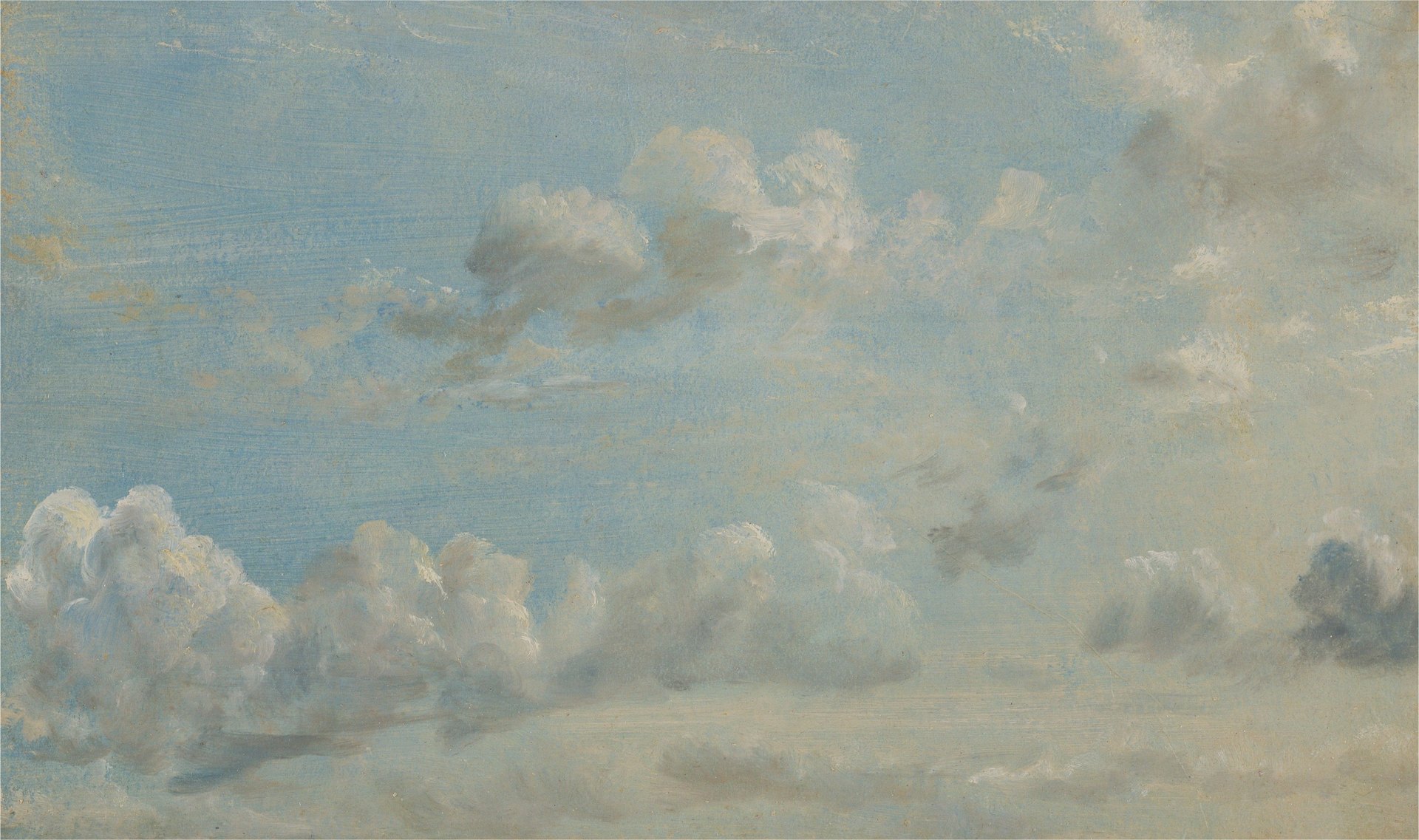
Object research · John Constable · Yale Center for British Art · B1981.25.116
Cloud Study
21 September 1822, half past one · Hampstead, assumed
“Sep[br] 21. 1822. | ½ p’s[t] one o clock. | looking south. | wind very fresh at East, but warm.”
Yale’s catalogue transcription of the inscription, which is on a label fixed to the stretcher. Y1 Each phrase is underlined in its verdict and links to its row.
Finding · Nephos analysis · version 2026-09-07
The regional wind sources are compatible with an easterly flow, but neither measured Constable’s assumed site. The computed Sun is consistent with early afternoon, yet the horizonless picture cannot test the stated time or southward view. The day lay in a mild spell, but its daily mean was slightly below the long-run calendar-date average, so “warm” remains open.
The Nephos method
How this study was read
The method in fullWhat is written
21 September 1822, ½ p’s[t] one o clock.
Sep[br] 21. 1822. ½ p’s[t] one o clock. looking south. wind very fresh at East, but warm.
Yale Center for British Art, B1981.25.116, as the museum transcribes it
Records of those days
- Luke Howard’s registerPrinted daily wind, thermometer and notes, The Climate of London. Kept at Tottenham or Stratford, not Hampstead.
- 20th Century ReanalysisA modern reconstruction for a 1° cell about 111 by 68 km, estimated from pressure, not observed.
- Central England TemperatureA regional daily mean for the Midlands, not a Hampstead reading.
- The computed sunPosition of the sun for the written hour at the assumed place.
Each claim tested
- “Sep[br] 21. 1822.” A second inscription by Constable gives the same date.
- “½ p’s[t] one o clock.” The computed Sun at 13:30 is consistent with early afternoon, but a horizonless pure sky supplies nothing against which to test the stated time.
- “looking south.” Consistent, but untested.
- “wind very fresh at East,” For the assumed Hampstead site, Constable wrote East; Howard’s 21 September cell reads NE at his station.
- “but warm.” The day sat inside a mild spell that fell sharply by the 26th, yet its 11.6°C daily mean was slightly below the prior 50-year average for 21 September, about 12.6°C.
Verdict
The regional wind sources are compatible with an easterly flow, but neither measured Constable’s assumed site.
- Partially agrees“wind very fresh at East,”
- Unknown“Sep[br] 21. 1822.”, “½ p’s[t] one o clock.”, “looking south.”, “but warm.”
01 · The evidence
Five claims, four witnesses, one verdict each.
Each phrase of the inscription is a claim. Each column is a witness that never saw the painting, with its own place, scale and limit.
How to read itRead across one row: the phrase Constable wrote, what each witness can say about it, and the verdict on the right. A dash means that witness has nothing to offer on that claim.
| Claim | Howard's registerPrinted table · London area · Y6 | Weather reconstruction20th Century Reanalysis · one grid cell · Y4 | The sunComputed · Hampstead assumed · Y3 | ThermometersCentral England daily mean · Y5 | Verdict · Nephos |
|---|---|---|---|---|---|
| “Sep[br] 21. 1822.” Unknown |
Row 21The table has a row for the 21st. Nothing in it names a painter. | — | — | — | A second inscription by Constable gives the same date. This is internal consistency between two notes from the same hand, not confirmation from a separate observer. Y7 Link to claim · Suggest a correction |
| “½ p’s[t] one o clock.” Unknown |
—Day-level entries; no hour recorded. | 13:00 UTCNearest stored hour; three-hourly samples. | 35.3° alt · 210.3° azAt 13:30 local mean time. 13:00 and 14:00 samples span 37.3° to 32.6°. | — | The computed Sun at 13:30 is consistent with early afternoon, but a horizonless pure sky supplies nothing against which to test the stated time. Y2 Link to claim · Suggest a correction |
| “looking south.” Unknown |
— | — | SSW, to the rightFor a south-facing painter the sun stood high to the right. No horizon or landmark fixes the painted bearing. | — | Consistent, but untested. He painted no horizon and no landmark, so there is nothing to measure a bearing against. Nephos leaves this one open rather than invent a number. Y2 Link to claim · Suggest a correction |
| “wind very fresh at East,” Partially agrees |
NEThe row for the 21st, checked against the page image. Adjacent sector; Howard's station, not Hampstead. “17–21. Fine.” | ENE, 57° · 5.9 m/s13:00 UTC, cell about 111 × 68 km. Direction spread 14° to 86°; “very fresh” has no scale. | — | — | For the assumed Hampstead site, Constable wrote East; Howard’s register gives NE for 21 September at his station. They are adjacent sectors, not identical readings. The reanalysis reconstructs ENE between them; strength is compatible only at grid scale. Y2 Y6 Link to claim · Suggest a correction |
| “but warm.” Unknown |
65° / 49°FFirst thermometer, max and min for the day, at Howard's station. | 14°C2 m air, 13:00 UTC, spread about ±1.7°C. | — | 11.6°CDaily mean, 21 September; prior 50-year average for the date about 12.6°C; 9.5°C by the 26th. | The day sat inside a mild spell that fell sharply by the 26th, yet its 11.6°C daily mean was slightly below the prior 50-year average for 21 September, about 12.6°C. No source defines “warm,” and none measures Constable’s position. Y2 Y5 Link to claim · Suggest a correction |
Described. Words used by a person in a particular context: the inscription, Howard's “Fine”. A felt quality cannot be converted into a threshold, and strength words have no shared numerical scale.
Measured. Instrumental records with their own location and time coverage: Howard's thermometer and wind vane, the Central England series.
Estimated. Model outputs and derived calculations with stated assumptions: the reanalysis cell, the computed sun, and the capture-specific paint segmentation.
What this record will not say: that a weather cell about 111 × 68 km speaks for the assumed Hampstead site, that 33 points of uncertainty round down to certainty, or that consistent values confirm subjective words.
02 · The witnesses
Four records of the afternoon, none of them the painting.
The values behind the table, each in its own units and with its own reach. Anything measured from the image was measured on one museum photograph, and describes paint, not the sky of 1822. Y2
The sun, computed
The afternoon sun
35.3° altitude
210° azimuth
At half past one, local mean time, for an assumed easel at 51.56° N, 0.165° W. Altitude 37.3° to 32.6° across the 13:00 to 14:00 band. Computed with Skyfield 1.55 and the JPL DE440 ephemeris.
The study shows only sky, with no horizon or shadow, so the sun’s direction cannot be measured in the paint and is not compared.
Weather reconstruction
A weather record that never saw the painting
ENE, from 57°
5.9 m/s at 13:00 UTC over the 1° cell nearest London, about 111 × 68 km. Likely range of direction (one standard deviation): 14° to 86°.
61 ± 33 % cloud
Ensemble mean and spread. The capture segmentation measured 58% opaque cloud: compatible within wide uncertainty, not a match.
Regional context, not an observation at the assumed site. The cloud spread is comparable to its mean.
Thermometers · Howard and CET
“But warm”
65° / 49°F
Howard's first thermometer, maximum and minimum, 21 September, at his station.
11.6°C
Central England daily mean. Prior 50-year average for the date about 12.6°C; the spell fell to 9.5°C by the 26th. Reanalysis 2 m air 14°C at 13:00 UTC.
Neither source defines “warm,” and neither measures conditions at Constable’s position.
The museum photograph
What the photograph holds
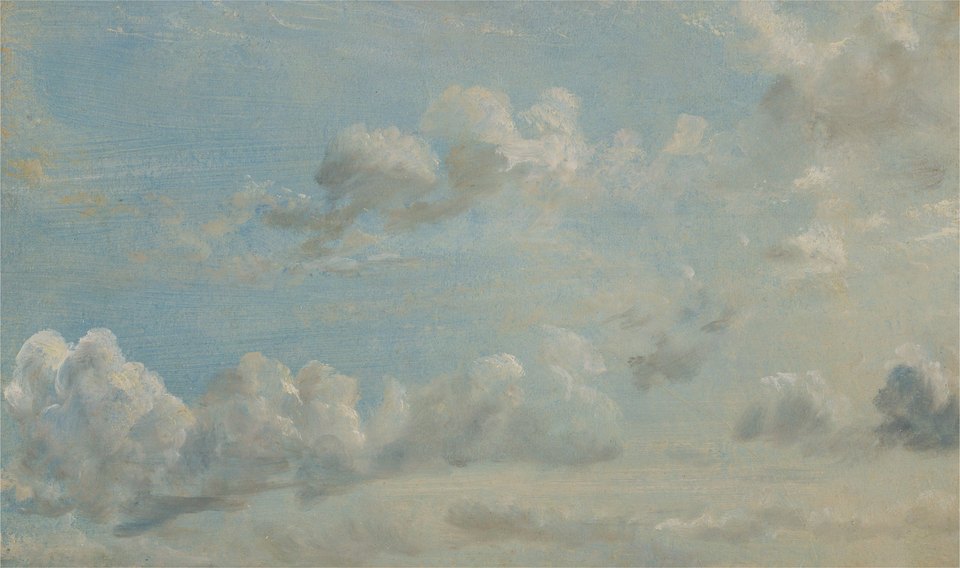

58 % opaque cloud
Measured by sorting the photograph’s pixels by how blue they are: 17% thin veil, 25% clear blue. The photograph used is identified in the analysis file.
It measures paint in one photograph, not the sky of 1822. A second capture of the same object could measure differently.
03 · Making the artwork
The sky passed through an artist's decisions.
Production uncertainty is separate from weather uncertainty. The located sources do not establish every stage of this object's making, and “unknown” is not evidence that a stage did not happen.
- Locationpartly known
- Hampstead is where the series as a whole is placed; the exact easel position is assumed for the calculations. Affects the view and solar comparisons. Y1
- Date evidencesecurely dated inscription
- The date is carried through a museum catalogue transcription, not an independently timed observation of execution. Y1 · Affected claim
- Outdoor executionunresolved
- The evidence assembled here does not establish that every passage was executed outdoors in the stated interval. Affects whether the inscription claims can be tested against depicted light or cloud forms.
- Preparatory work and later changesunknown
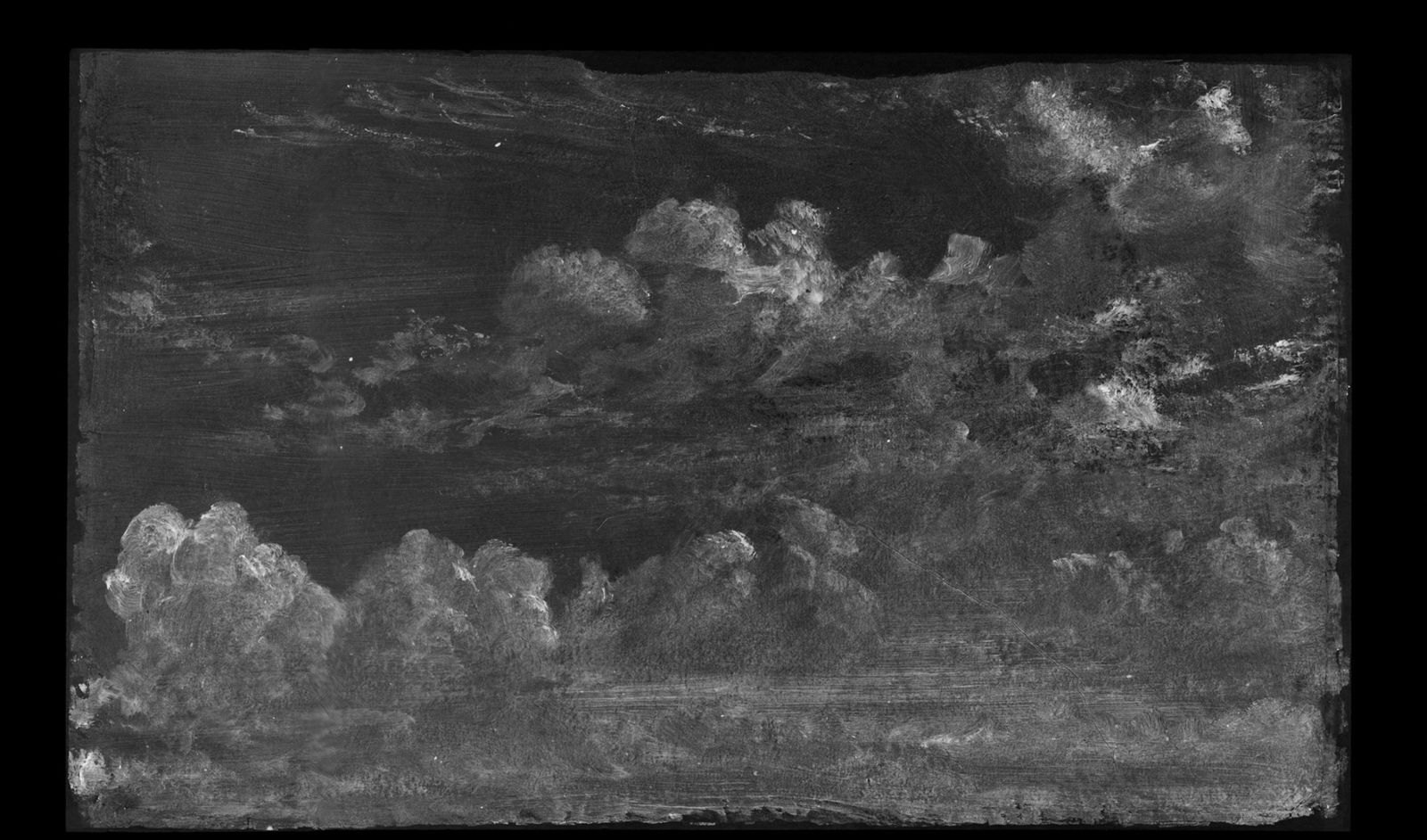
- The retained analysis includes an x-radiograph, but it does not establish a complete sequence or timing of working sessions. No preparatory-sketch sequence is established here. Y2
04 · Revisions
How the reading changed.
Source verification and a change of conclusion are different events. Both are kept.
- Original claim
- Nephos first read Howard's wind for the 21st as NE by machine text recognition (OCR) and counted it as agreeing with Constable's East. The reading was marked to be checked against the page image before it could be cited.
- Conflicting evidence
- Direct inspection on 18 August 2026 established that Howard's cell reads NE, not E; it is also from a different London location than the assumed Hampstead site.
- Conclusion now
- Partially agrees Direct inspection established the transcription; the source distance and the non-identical directions lowered the comparison from the agreement presented before 18 August 2026 to partial agreement. The machine record from before the page check carries the NE reading with its OCR caveat and no comparison label.
- Retained versions
- Machine record before the page check, with its OCR caveat Verified machine record Howard page image

- Original claim
- The Yale capture segmentation measured 58% opaque cloud while the 20th Century Reanalysis ensemble mean was 61% cloud, with ±33 percentage points of ensemble spread, over the London-area grid cell.
- Conflicting evidence
- The 61% mean carries ±33 points of spread over a regional 1° cell, while 58% is a capture-specific paint segmentation rather than an atmospheric observation.
- Conclusion now
- Partially agrees The three-point difference is treated as compatible within wide uncertainty, not as a match. Recorded in the discrepancy packet; exact change date not retained.
- What changed
- The page was redesigned twice on 7 September; the evidence, values and verdicts did not change. Earlier versions are kept: morning of 7 September and 6 September. Their dates name the saved copies, not exact editing times.
05 · Take this into your work
A record you can cite, print or embed.
Cite individual claims by their link, and cite museum and historical sources directly when using their statements. Nephos analysis is independent of the holding institution; image licences are separate from the research text. Inscription as transcribed by Yale: “Sep[br] 21. 1822. | ½ p’s[t] one o clock. | looking south. | wind very fresh at East, but warm.”
Machine-readable
For the Yale Center for British Art: this record is for B1981.25.116. If it is right, link it from your object page; if anything is wrong, write to Nephos and it will be corrected the same day.
The museum’s catalogue remains the authority. Nephos does not claim endorsement.
06 · Sources
Follow every claim.
- Y1Yale Center for British Art: John Constable, Cloud Study, B1981.25.116; metadata, capture and CC0 status; current LIDO record: catalogue inscription and stretcher-label provenance.https://collections.britishart.yale.edu/catalog/tms:627
- Y2Nephos verified machine record: capture measurements, solar table, weather values, uncertainty and query receipts.https://nephos-mocha.vercel.app/data/constable-analysis.json
- Y3Skyfield 1.55 with JPL DE440: solar computation method used by the verified analysis.https://rhodesmill.org/skyfield/
- Y4NOAA-CIRES-DOE 20th Century Reanalysis v3: regional ensemble description.https://www.psl.noaa.gov/data/gridded/data.20thC_ReanV3.html
- Y5Met Office Hadley Centre: Central England Temperature daily means and prior 50-year calendar-date average.https://www.metoffice.gov.uk/hadobs/hadcet/data/meantemp_daily_totals.txt
- Y6Luke Howard, The Climate of London, 2nd ed., vol. III, Table CXCVI, p. 90: verified page image; wind, thermometer and notes transcribed in howard-1822-09.json.https://archive.org/download/in.ernet.dli.2015.48048/page/n96.jpg
- Y7Courtauld Gallery: the distinct same-day Cloud Study, P.1952.RW.69.https://gallerycollections.courtauld.ac.uk/object-p-1952-rw-69