Nephosthe weather behind the paintings

Comparison · 21 September 1822 · Hampstead

Ninety minutes apart.

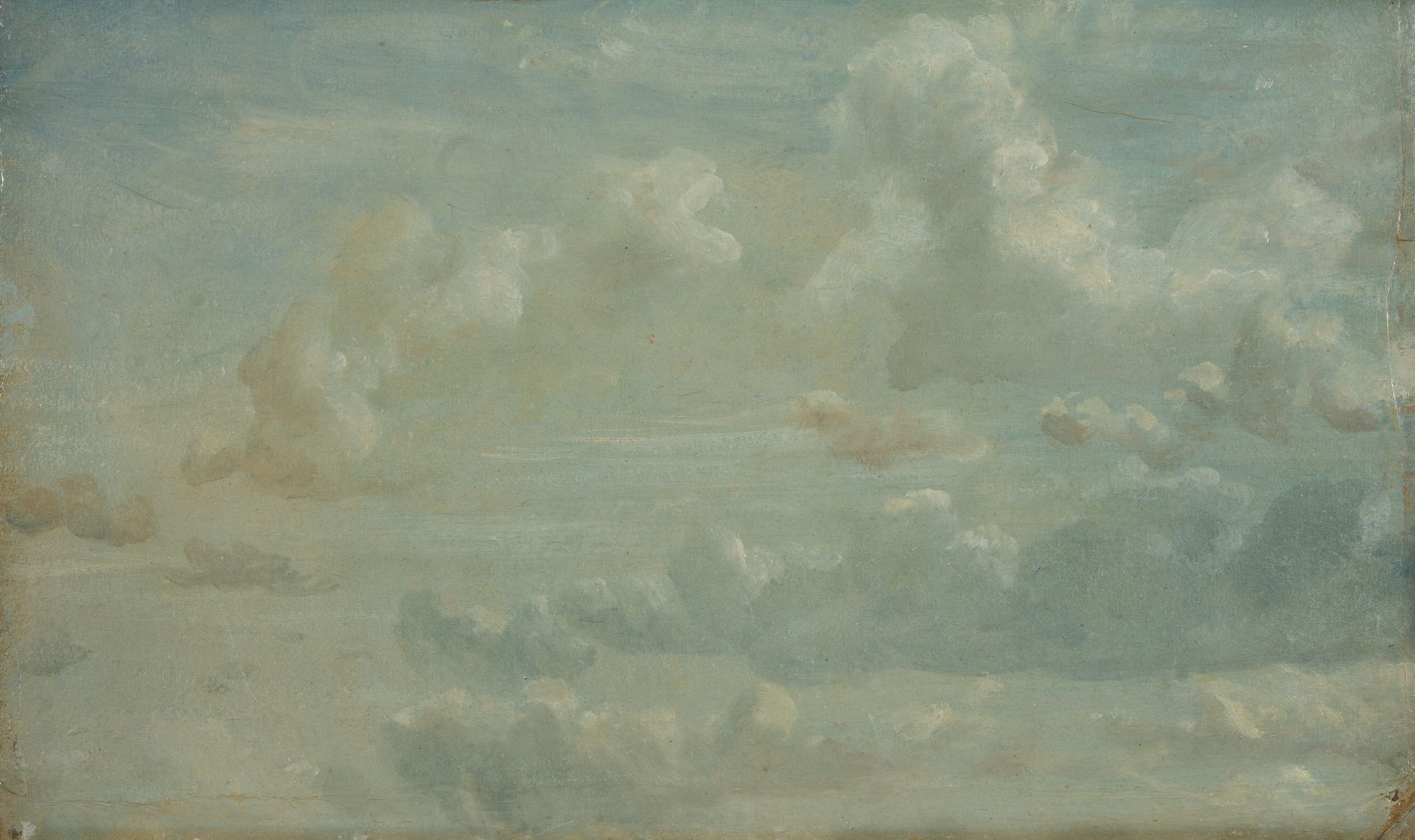
Two cloud studies by John Constable carry the same date. Yale's label says half past one; the Courtauld's verso says three o'clock. Both say looking south, an east wind, and warm. This page reads the two notes against the independent record of that afternoon: Luke Howard's printed register, a weather reconstruction that used no painting, and the computed sun. It compares the notes and their context, not the cloud forms.

What is being tested

When an artist wrote the weather on a painting, how far do independent sources from the same day support each word? The question is not whether the painting is an accurate picture of the sky.

What the witnesses are

The inscriptions are described evidence. Howard’s register is measured and described, the regional reconstruction and computed sun are estimated, and each source keeps its own place, scale and limits.

What a verdict means

Verdicts are labels, not scores. “Partially agrees” means compatible but not identical, while “Unknown” means no located source can test the claim.

The Nephos method

How this study was read

The method in full
  1. What is written

    Hampstead, 21 September 1822, two notes ninety minutes apart in Constable’s hand.

  2. Records of those days

    • Luke Howard’s registerDay 21 reads NE; the note for the 17th to the 21st is “Fine.” Kept at Tottenham or Stratford, not Hampstead.
    • 20th Century ReanalysisENE at about 6 m/s at both hours, for a cell about 111 by 68 km; estimated, not observed.
    • Central England TemperatureA daily mean of 11.6 °C, slightly below the average for the date.
    • The computed sun35.3° high at 13:30 and 25.9° at 15:00.
  3. Each claim tested

    • The wind, “very fresh at East” and “brisk wind to east”. Easterly in every source, but Howard writes NE and the reanalysis ENE, and none stood on Hampstead Heath.
    • The hours, half past one and three. The sun drops 9.4° and swings 24° west between them; neither sheet has a horizon to test it against.
    • “warm”. Howard’s thermometer reached about 18.3 °C and the Central England mean was 11.6 °C; nothing defines “warm”.
    • The date and “looking south”. Both notes agree, but both are Constable’s; no second observer names the painter or the view.
  4. Verdict

    Two notes by one hand agree with each other, and the regional records fit an easterly, mild day. That is internal consistency, not a second witness.

    • Partially agreesThe easterly wind Adjacent sectors from records kept elsewhere.
    • UnknownThe hours, the view, “warm” and the date Nothing in a horizonless sky or a regional record can test them.

What this cannot tell you. Both notes are Constable’s; their agreement is not confirmation by another observer. No cloud-to-cloud comparison is made. The reanalysis cell cannot reproduce Hampstead.

01 / The two sheets

Two notes,
one hand.

Each inscription is given as its museum transcribes it. Each sheet is identified by its museum and accession number, not by title or date: these are two objects, not two views of one. The paintings are displayed at equal widths for reading, not at physical scale.

John Constable, Cloud Study, Yale Center for British Art, B1981.25.116 Yale Center for British Art · B1981.25.116
“Sep[br] 21. 1822. ½ p’s[t] one o clock. looking south. wind very fresh at East, but warm.”

Yale’s catalogue transcription of the inscription, which is on a label fixed to the stretcher; the verso is now covered by a conservation backboard. K1 K2

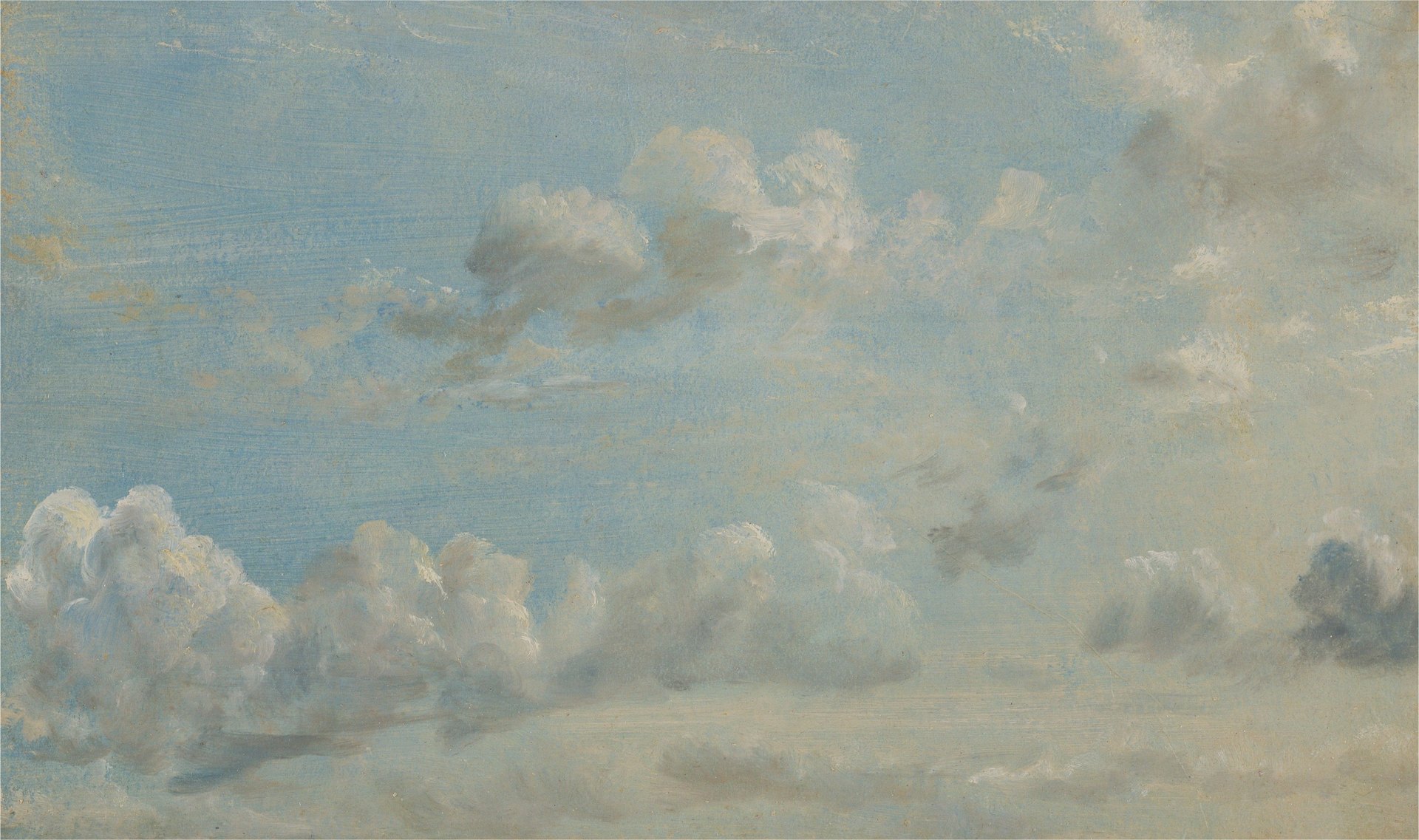
John Constable, Cloud Study, Courtauld Gallery, P.1952.RW.69 Courtauld Gallery · P.1952.RW.69
“Sepr.21.1822. Looking South, brisk wind to east, warm and fresh. 3 o’cl. afternoon”

Courtauld catalogue transcription of the inscription on the verso. K3

02 · The time instrument

Two hours on one axis.

15:00 local mean time
S · 180° SW · 225° W · 270° 40° 30° 20°
Sun altitude
25.9°
Sun azimuth
234.1°
Regional model
63% cloud ±34 From 54°, on the NE/ENE boundary · 6.0 m/s · 13.9°C · 15:00 UTC

The Courtauld’s inscribed hour. Model values for 15:00 UTC; sun from JPL Horizons, as on the Courtauld record.

Local mean time · Hampstead 51.56° N, 0.165° W Sun altitude, 20° to 40° · arc drawn through the four computed positions 40° 35° 30° 25° 20° 13:00 · 37.3° · AZ 201° 13:30 · 35.3° · AZ 210° 14:00 · 32.6° · AZ 219° 15:00 · 25.9° · AZ 234° 13:00 13:30 · YALE 14:00 14:30 15:00 · COURTAULD

The model’s whole day

The reanalysis never saw either painting. Its five three-hourly samples for the London-area cell show cloud cover with its ensemble spread, and the model’s wind direction and speed. The two inscribed hours are marked. K7 K8

13:30 YALE 15:00 COURTAULD 51% ±39 NE 37° · 3.5 m/s · 9.3°C 06:00 UTC 57% ±38 ENE 60° · 5.4 m/s · 12.4°C 09:00 UTC 60% ±32 ENE 59° · 5.8 m/s · 14.0°C 12:00 UTC 63% ±34 NE 54° · 6.0 m/s · 13.9°C 15:00 UTC 57% ±34 NE 47° · 4.6 m/s · 11.8°C 18:00 UTC

Bars are ensemble-mean total cloud cover on a 0 to 100% scale; the pale band behind each bar is one ensemble spread either side, clipped at the scale. Arrows point where the wind blows; the label gives where it blows from. Temperatures are the 2 m ensemble means, converted from kelvin. The 13:00 UTC reading used on the Yale record (61%, 57°, 5.9 m/s) lies between the 12:00 and 15:00 samples.

03 / The register

What Howard
wrote down.

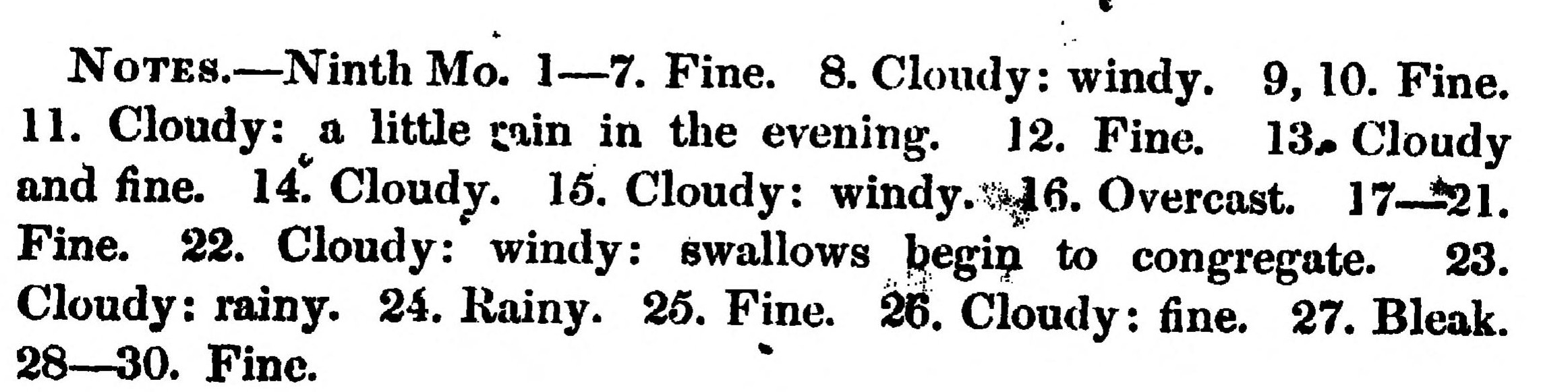
Luke Howard’s printed table for September 1822, from the page image checked on 18 August 2026. Day 21 reads NE. His note for the 17th through the 21st is one word.

Column headings of Howard's Table CXCVI: 1822, Wind, By Clock max and min, Temp max and min, T. No. 2, Evap, Hygr., Rain Rows 19 to 22 of Howard's September 1822 table: 19 E, 20 SE, 21 NE, 22 E, with barometer and temperature readings Howard's notes for the ninth month, including 17 to 21 Fine and 22 Cloudy, windy, swallows begin to congregate
Luke Howard, The Climate of London, 2nd ed., vol. III (1833), Table CXCVI, p. 90. Crops from the archive.org page scan. K6

21 · NE. Barometer 29.87 and 29.80 inches; temperature 65 and 49 degrees Fahrenheit by the first thermometer. The day before reads SE, the day after E. K6

“Fine.” That is the whole note for the 17th through the 21st. Then, for the 22nd: “Cloudy: windy: swallows begin to congregate.” K6

The table page does not label its station, and Howard’s registers for these years were kept at Tottenham and Stratford, not Hampstead. His NE is a day-level London-area reading from another location. Constable wrote East on both sheets. Adjacent sectors, different places: Nephos rates this “Partially agrees”, not a match. K7

Central England’s daily mean for the 21st was 11.6°C, slightly below the 12.6°C average of the prior fifty 21 Septembers, inside a mild spell that fell to 9.5°C by the 26th. Nothing in the series defines “warm”. K9
04 / Read against each other

Claim by claim.

The two notes, the outside witnesses, and the verdict each record already carries. Both notes are Constable’s, so agreement between them is internal consistency, not confirmation by another observer.

ClaimYale13:30 · K1Courtauld15:00 · K3Howard’s registerLondon area · K6Reanalysis20CRv3 · K8The sunComputed · K10ThermometersHoward and CET · K9Verdict
Date“Sep[br] 21. 1822.”Yale label“Sepr.21.1822.”Courtauld versoHoward’s table has a row for the 21st; nothing in it names a painter. No separate observer confirms the date of either sheet.———Unknown
Time“½ p’s[t] one o clock.”“3 o’cl. afternoon”——Computed sun 35.3° at 210° for 13:30 and 25.9° at 234° for 15:00: a drop of 9.4° and a swing of 24° toward the west. Both are early-to-mid afternoon positions, but neither sheet has a horizon or a landmark, so no painted hour can be tested.—Unknown
View“looking south.”“Looking South,”——At both hours the sun stood to the right of a south-facing painter, lower and further right by three o’clock. Consistent, and untested: a pure sky gives nothing to measure a bearing against.—Unknown
Wind“wind very fresh at East,”“brisk wind to east,”NEFor the day, at Howard’s station.ENE, 57° at about 5.9 m/s for the 13:00 target and 54° at 6.0 m/s at 15:00, on the NE/ENE boundary, for a cell about 111 × 68 km. Easterly across every source, but the labels differ and none of the witnesses stood on Hampstead Heath. Strength is compatible only at grid scale.——Partially agrees
Warmth“but warm.”“warm and fresh.”65°F / 49°FGrid-cell air 14.0°C at the 13:00 target and 13.9°C at 15:00, spread about 1.7 K.—Howard’s thermometer at his station reached about 18.3°C. Central England daily mean 11.6°C, slightly below the calendar-date average. No source defines “warm” or “fresh”, and none measures Constable’s position.Unknown
Same dayBoth notesBoth notesEasterly dayThe regional records fit an easterly, mild afternoon whose modelled sky barely changed between the two hours.Ninety minutes apartThe warmth claim stays open.Partially agreesThe two inscriptions agree on date, southward view, east wind and warmth. No cloud forms are compared.

What changed between the two notes: the sun, by 9.4° of altitude and 24° of azimuth. What the model says changed: almost nothing, 61% to 63% cloud and a wind still from about 55°, between NE and ENE. That steadiness is the finding, and it is a finding about the regional record, not about the pictures.

05 / What this comparison will not say

The limits, beside the findings.

  • No cloud-to-cloud comparison. The paintings are compared through verified metadata and inscriptions only. No capture-to-capture measurement was performed, and similarity of cloud forms is not claimed.
  • One observer. Both notes are Constable’s. Their agreement is internal consistency between two notes from one hand, not confirmation from a separate observer.
  • Howard was not on the Heath. His table does not label its station; the registers for these years were kept at Tottenham and Stratford. His NE is day-level, London-area context.
  • A cell, not a hilltop. The reanalysis cell is about 111 × 68 km with ±33 to ±34 points of cloud spread. It gives context for direction, broad strength, temperature and cloud amount; it cannot reproduce Hampstead.
  • “Warm” has no instrument. Neither the reanalysis nor the Central England series defines the adjective or measures Constable’s position.
  • Four computed positions. Only four computed sun positions are shown; the arc between them is drawn, not computed, and the hours are catalogue readings of handwriting, not clock records.
06 / Bottom line

What this comparison shows.

On one afternoon Constable wrote two weather notes ninety minutes apart, and they agree with each other on the date, the view, the wind and the warmth. Because both are his, that agreement is internal consistency, not confirmation by a second observer. The regional records fit an easterly, mild day whose modelled sky hardly changed between half past one and three, while the sun dropped nine degrees and swung a quarter of the way toward the west. The wind claim partially agrees with Howard's NE and the reconstruction's ENE; the hour, the bearing and the word "warm" stay open, because nothing in a horizonless sky can test them. This is the pattern the whole project reports: near-agreement where the sources reach, and honest silence where they do not.