A study against the weather record
Vincent van Gogh
“The days of mistral and rain”
Van Gogh wrote the weather into his letters. Do the records of those days bear him out?
The rain contradictsThe mistral partially agrees
The Nephos method
How this study was read
The method in fullWhat is written
Four letters, dated by the Van Gogh Museum and Huygens edition of the letters: Arles, June and July 1888; Saint-Rémy, September and October 1889.
Rain now and then in a morning or afternoon, but infinitely less than at home.
Letter 653, to Willemien van Gogh, Arles, 31 July 1888the people here are complaining a great deal that it’s not the same as usual.
Letter 653, the same pageIt’s very windy, though, and a very nasty, nagging wind, the mistral
Letter 653, the same pageafterwards, when the days of mistral and rain came, I preferred the canvas done from life
Letter 806, to Theo van Gogh, Saint-Rémy, 28 September 1889, on his two versions of the Reaperwhen the weather’s cold and sad
Letter 806, the same paragraph
Records of those days
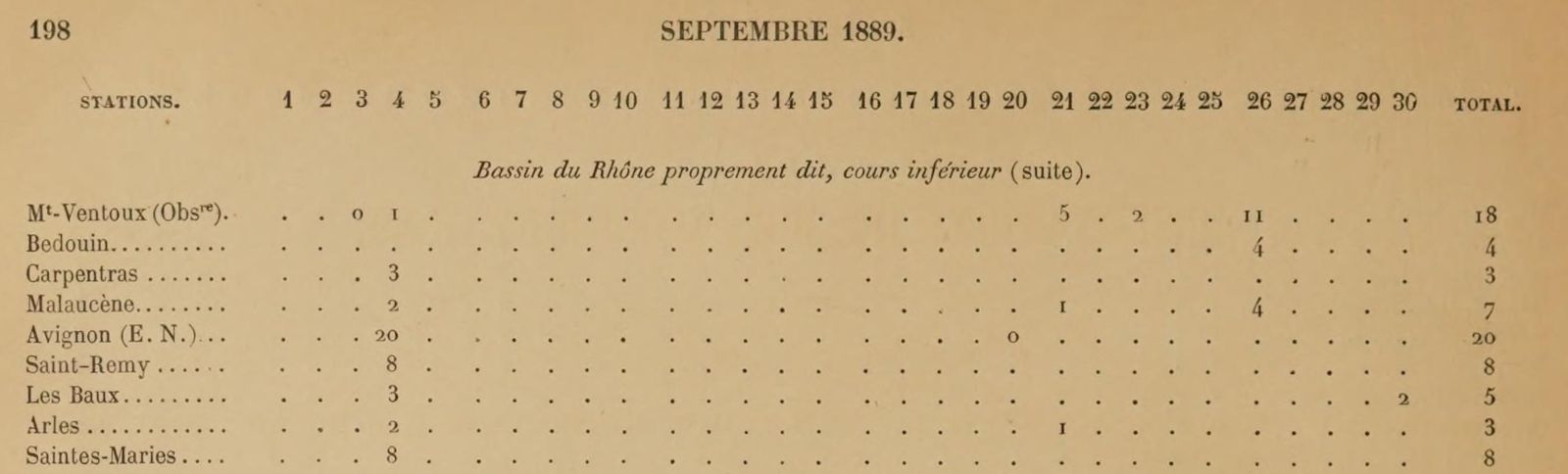
- Saint-Rémy rain gaugeDaily rain in whole millimetres, printed in Pluies en France 1889. The volume does not say where in the town; the town centre is 1.4 km from the asylum.
- Arles, Tour de la RoquetteMétéo-France daily rain, lowest and highest temperature. 0.5 km from Arles, 20.4 km from the asylum.
- Beaucaire and AramonMétéo-France daily rain, 16.0 and 17.6 km from the asylum.
- Marseille ObservatoireWind direction and force six times a day, printed in the Annales du Bureau central météorologique. 74 km from Arles, 69 km from the asylum.
Not found or not yet searched
- No wind was measured at Arles or Saint-Rémy in 1888 or 1889; Météo-France wind records there begin in 1949.
- No sunshine or cloud record for Arles or Saint-Rémy has been found.
- The painting sessions the letters describe are undated.
Each claim tested
- “Rain now and then in a morning or afternoon”. Arles recorded rain on 6 of the 31 days of July 1888, 3 of them with at least 1 mm. Daily totals cannot show mornings or afternoons, and no Dutch record was used for “less than at home”.
- “not the same as usual”. June and July 1888 were the wettest, 225.1 mm, and by afternoon highs the coolest of 17 summers at Arles, 1882–1898. A typical (median) summer had 64.7 mm.
- “a very nasty, nagging wind, the mistral”. No wind was measured at Arles. At Marseille, 8 days of July 1888 meet the Nephos mistral rule (at least three of the six daily readings from north to west-north-west at force 3 or more on the observatory’s scale), the last on 28 July.
- “the days of mistral and rain”, after the repetition was finished on 5 or 6 September. Saint-Rémy’s gauge printed a point, no rain, on every day from 5 to 30 September 1889, after 8 mm printed for the 4th. Les Baux, Beaucaire and Aramon were dry from 5 to 28 September; Arles, 20 km away, had 0.8 mm on the 21st. At Marseille, 14, 15, 21 and 26 September meet the mistral rule.
- “cold and sad”. At Arles the lowest readings fell from 13.8–20.5 °C before 16 September to 7.2–13.5 °C after it; afternoons still reached 18.9–28.0 °C.
- “out in the mistral”, “the day in the full sun” (letter 633) and the canvas laid flat or the easel buried in stones (letters 653 and 809). The sessions are undated or describe a habit, and no wind or sunshine was recorded where he worked.
Verdict
Saint-Rémy’s own rain gauge stayed dry from 5 to 30 September 1889, the weeks letter 806 remembers as “days of mistral and rain”.
- Contradicts“the days of mistral and rain”: the rain The town’s gauge recorded no rain in those weeks. The verdict rests on the edition’s dating of letters 800 and 806.
- Partially agrees“the days of mistral and rain”: the mistral Mistral-type days at Marseille fit; no wind was measured at Saint-Rémy.
- Partially agrees“Rain now and then” A few July days had rain at Arles; the time of day and the comparison with home cannot be tested.
- Partially agrees“not the same as usual” The wettest and coolest summer in 17 years at Arles; the complaint does not say what was unusual.
- Partially agrees“a very nasty, nagging wind, the mistral” Mistral-type days at Marseille fit; no wind was measured at Arles.
- Partially agrees“cold and sad” Nights turned cold after 16 September at Arles; “sad” cannot be tested.
- Unknown“out in the mistral”, “the day in the full sun”, the canvas laid flat, the easel in the stones Undated sessions and habits, with no wind or sunshine record where he worked.
What this cannot tell you. Marseille stands in for a regional mistral, not the wind where Van Gogh stood. The mistral rule is a Nephos reading of the printed tables, not an official definition; a different rule would count different days. Letter 806’s date and the finishing of the repetition come from the edition’s reconstruction. If either moved by more than a few days, the rain verdict would fall to Unknown. The Saint-Rémy and Marseille figures were read by eye from page images and checked twice; the Arles, Beaucaire and Aramon figures come from Météo-France files.
Step 2 · Records of those days
September 1889 around Saint-Rémy
Letter 800 has Van Gogh finishing the large repetition of the Reaper on 5 or 6 September; letter 806, dated by the edition to 28 September, says that afterwards, when the days of mistral and rain came
, he preferred the canvas done from life. Each column below is one day of that month; each row is a record. A point is a day with no rain, as the 1889 tables print it.
Step 3 · The claims tested
Arles, the summer of 1888
On 31 July 1888 Van Gogh wrote to his sister of Rain now and then in a morning or afternoon
, of a wind, the mistral
, and of locals complaining that it’s not the same as usual
. Arles recorded rain on 6 days in July, 3 of them with at least 1 mm. At Marseille, 8 days meet the mistral rule.
Step 4 · Why the rain verdict could change
A contradiction with conditions
The verdict holds only as far as its dates do. The edition dates letter 806 from its remark that canvases are leaving today
and from letters 802, 807 and 808, and dates the finishing of the repetition from letter 800. If either date moved by more than a few days, the rain verdict would fall to Unknown, never to agreement. Nine days before letter 806, Van Gogh himself wrote of fine weather.
“The weather outside has been splendid for a very long time”
Letter 804, to Willemien van Gogh, 19 September 1889
“whereas later in the letter (l. 314) it appears to be finished. Taking this into account, we have dated the letter to Thursday, 5 and Friday, 6 September 1889.”
The edition’s note on dating letter 800
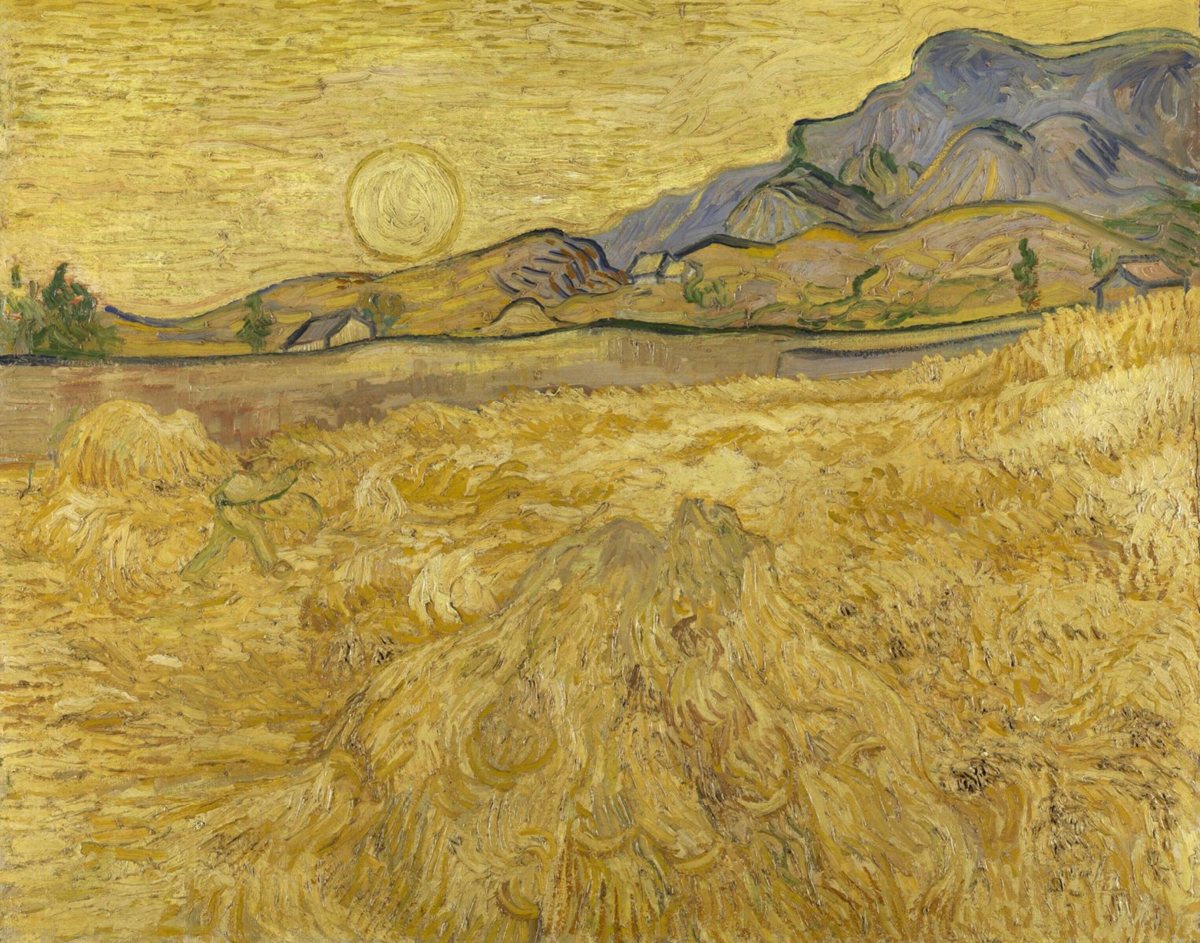
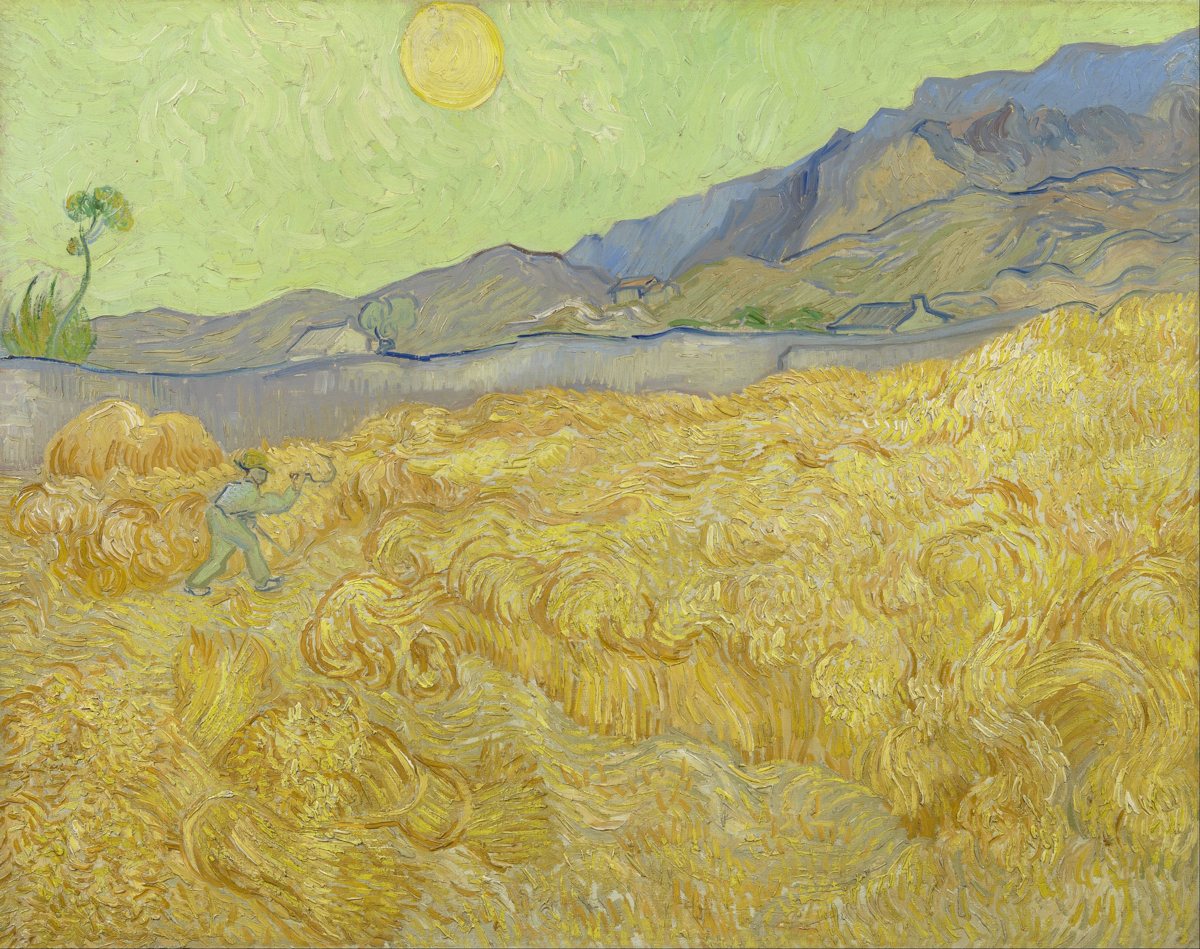
“The version painted from nature is Reaper (F 617 / JH 1753); the repetition is Reaper (F 618 / JH 1773).”
The edition’s note 18 to letter 806
Sources
Every source on this page
Each file was downloaded and given a fingerprint (its sha256). The page is rebuilt from these files and will not build if a fingerprint changes, so every number above comes from them rather than being typed in.
- Météo-France daily climatological data, Bouches-du-Rhône, before 1949
sha256 a09dcfcf7f72106bde54bcde24925130fd94f5e932d252615e3502c4b56972fd - Météo-France daily climatological data, Gard, before 1949
sha256 11d3f4ab7a8106fe73952db91e929340a3b5e87a3a80c2eccce4cc14760144c3 - Annales du Bureau central météorologique de France 1889, tome III, Pluies en France, page 198
sha256 7246c2cbe7e5f33a990403cce97816b856ab2db5e81ecc3efb66738ebce09a49 - Annales du Bureau central météorologique de France 1889, tome II, page A.165, Marseille, September
sha256 793f7c1727248f592e6505adf6fcc278498bb2991ed6fa18743d88d5177bb6e5 - Annales du Bureau central météorologique de France 1888, tome II, page A.165, Marseille, July (Gallica)
sha256 32d1cfa0a6595839f8a46f34aaf1da0d82ef4cccbca2bdca7db939f82299df9e - Van Gogh Museum and Huygens ING, Vincent van Gogh: The Letters, letters 633, 653, 800, 804, 806 and 809
- Wikidata coordinates for Arles, Saint-Rémy-de-Provence and Saint-Paul-de-Mausole
- Vincent van Gogh, Reaper (F 617), Kröller-Müller Museum, via Wikimedia Commons
sha256 de32ed652735726f53e21550c4a1ad2a0755e86266a1260e65b30ea51310c663 - Vincent van Gogh, Wheatfield with a Reaper (F 618), Van Gogh Museum, via Wikimedia Commons
sha256 8ac2bd0b283ef9d67c3d32a0b07b4b00e45b639978611481cf835dd210709ecb


Look closer
Painting in the wind, in his words
The four letters read closely: how the wind changed where he knelt, how fast he worked and which version he preferred. It reads the letters; this page tests their weather.