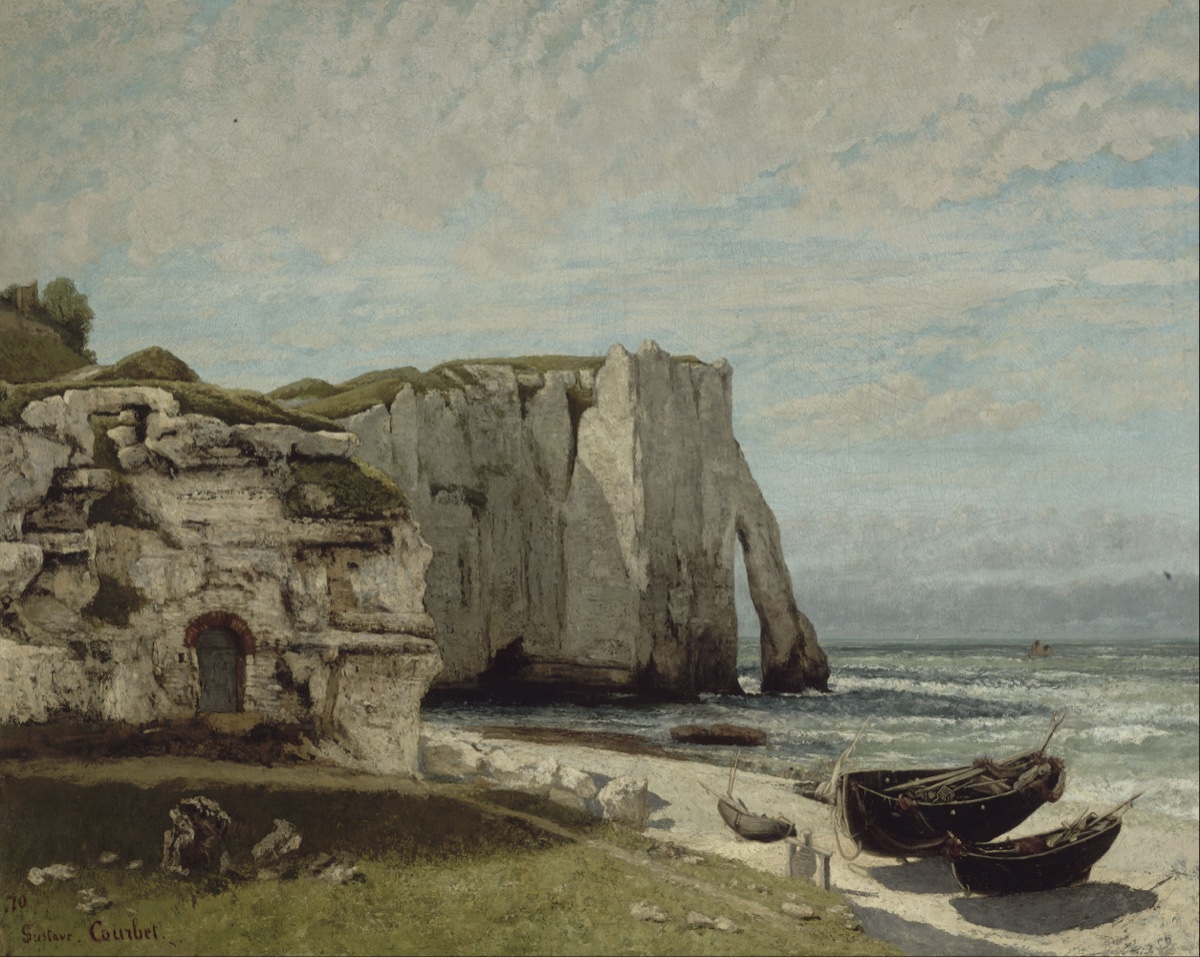
A study against the weather record
Gustave Courbet
La Falaise d’Étretat après l’orage
Courbet spent August and September 1869 at Étretat and titled this canvas after a storm. Was there a storm on this coast while he was there?
A storm mid-stay partially agreesDay unknown
The Nephos method
How this study was read
The method in fullWhat is written
Begun at Étretat, where Courbet stayed in August and September 1869; signed and dated ’70 and shown at the Salon of 1870.
The clarity of the air and the limpid light after the rain are magnificently caught.
Musée d’Orsay, on this paintingBy the time Courbet returned to Paris, he had painted twenty seascapes, with two of the largest views destined for the Salon of 1870
Sotheby’s, 2020, citing Courbet’s letters (ed. Chu, no. 69-9)
Records of those days
- The regional pressLa France, La Liberté, L’Abeille cauchoise and the Journal de Bolbec on the storm of 11–12 September 1869, read through Gallica.
- Paris-ObservatoireDaily rain and temperature for the whole stay, 183 km inland, the only open daily series for 1869 in the region.
- Maupassant’s recollectionCourbet painting at his window in the house against the Falaise d’Aval while a storm drove the sea at it, Gil Blas, 1886.
Not found or not yet searched
- Météo-France’s open daily data has no station anywhere in Seine-Maritime for August or September 1869.
- The Observatoire’s printed bulletin logged Le Havre each morning, but the Météo-France library licenses its scans for private use only, so only the storm mornings are cited, not the daily table.
- Courbet’s own letters are quoted only as Sotheby’s summarises them.
Each claim tested
- “after the rain”, Orsay on this canvas, and the storm in its title. On the night of Saturday 11 to Sunday 12 September 1869 a Channel storm struck Le Havre, Fécamp and Dieppe, the most violent at Le Havre since 1832. At 7 a.m. on the 12th the Observatoire’s bulletin logged Le Havre at 745 mm with a “tempête” and the sea “plus que furieuse”, and on the 13th reported the storm still blowing in the Channel. At Paris the afternoons cooled from 26.4° on the 9th to 18.5° on the 12th.
- “pour voir un ouragan”: Maupassant on Courbet painting The Wave at Étretat in a storm. A storm of that force is on record on this coast during Courbet’s stay, on 11–12 September 1869; Maupassant gives no year.
- The day and the storm of the canvas itself. The canvas is dated ’70, months after the stay; which storm, if any one, the title means is not recorded.
Verdict
Courbet’s stay at Étretat began in one of the driest Augusts on the Paris record and was broken, a month in, by the equinoctial storm of 11–12 September 1869, the worst at Le Havre in 37 years. On the coast, the Observatoire’s 7 a.m. bulletin logged a “tempête” at Le Havre on the morning of 12 September; the rest of the coastal evidence is the newspapers.
- Partially agreesA storm while Courbet was at Étretat A great Channel storm struck this coast mid-stay; nothing ties the canvas to it.
- Partially agreesMaupassant’s hurricane A storm of that force is on record in September 1869; his account is undated.
- UnknownThe day painted Dated ’70, months after the stay.
What this cannot tell you. Paris-Observatoire is 183 km inland; it can show the season, not the coast. Météo-France flags the 1869 Paris values as filtered, not yet validated. The storm is known from newspapers written in its aftermath, not from instruments at Étretat.
Step 2 · Records of those days
Paris every day, and the coast in a bulletin
Météo-France’s open daily records have no station anywhere in Seine-Maritime for August or September 1869. The nearest open daily record is the Paris Observatoire, 183 km inland, which can show the season but not the sea. It shows a very dry August, then a broken September. The Observatoire also printed a daily bulletin with a 7 a.m. line for Le Havre. The Météo-France library licenses its scans for private use only, so this page cites the storm mornings from it rather than reproducing the table. For the rest of the coast’s story, the record is the newspapers.
- 11.2
- mm total rain at Paris in August 1869; 1 day reached 1 mm; only 3 of 82 Augusts (1861–1949) were drier
- 0
- days of open weather data from any station in Seine-Maritime in August or September 1869
- 26.4°
- the Paris afternoon on 9 September; 18.5° by the 12th, as the storm passed
- 183
- km from the Falaise d’Aval to the Paris thermometer, the nearest open daily record
Every day at Paris-Observatoire, August and September 1869
| 1869 | Rain, mm | Highest, °C | Lowest, °C |
|---|---|---|---|
| 1 August | 10.0 | 22.9 | 17.0 |
| 2 August | 0.0 | 19.8 | 11.6 |
| 3 August | 0.2 | 20.6 | 10.5 |
| 4 August | 0.0 | 27.0 | 14.9 |
| 5 August | 0.0 | 22.0 | 16.0 |
| 6 August | 0.2 | 20.3 | 14.2 |
| 7 August | 0.0 | 19.3 | 11.0 |
| 8 August | 0.1 | 23.5 | 9.4 |
| 9 August | 0.2 | 21.8 | 12.7 |
| 10 August | 0.0 | 18.0 | 15.5 |
| 11 August | 0.0 | 18.0 | 11.6 |
| 12 August | 0.0 | 20.3 | 10.1 |
| 13 August | 0.2 | 23.5 | 9.3 |
| 14 August | 0.3 | 18.6 | 13.7 |
| 15 August | 0.0 | 18.6 | 12.6 |
| 16 August | 0.0 | 21.2 | 11.0 |
| 17 August | 0.0 | 19.4 | 13.3 |
| 18 August | 0.0 | 17.4 | 11.5 |
| 19 August | 0.0 | 18.5 | 12.0 |
| 20 August | 0.0 | 20.0 | 11.0 |
| 21 August | 0.0 | 22.7 | 11.4 |
| 22 August | 0.0 | 21.7 | 10.9 |
| 23 August | 0.0 | 19.9 | 12.3 |
| 24 August | 0.0 | 24.3 | 10.9 |
| 25 August | 0.0 | 27.4 | 13.2 |
| 26 August | 0.0 | 28.8 | 17.9 |
| 27 August | 0.0 | 28.6 | 18.6 |
| 28 August | 0.0 | 29.0 | 15.7 |
| 29 August | 0.0 | 30.5 | 15.5 |
| 30 August | 0.0 | 18.2 | 14.1 |
| 31 August | 0.0 | 20.4 | 10.3 |
| 1 September | 0.0 | 19.1 | 9.1 |
| 2 September | 0.0 | 15.7 | 9.9 |
| 3 September | 0.0 | 17.4 | 11.3 |
| 4 September | 0.0 | 24.3 | 10.1 |
| 5 September | 4.9 | 23.5 | 12.4 |
| 6 September | 1.6 | 21.4 | 13.6 |
| 7 September | 0.0 | 24.0 | 13.7 |
| 8 September | 0.0 | 25.3 | 14.2 |
| 9 September | 4.6 | 26.4 | 16.0 |
| 10 September | 11.6 | 22.4 | 16.2 |
| 11 September | 2.2 | 19.4 | 12.6 |
| 12 September | 0.0 | 18.5 | 14.4 |
| 13 September | 0.0 | 19.1 | 12.7 |
| 14 September | 0.0 | 20.4 | 11.6 |
| 15 September | 5.7 | 20.6 | 13.4 |
| 16 September | 0.0 | 18.2 | 12.7 |
| 17 September | 0.0 | 22.1 | 9.5 |
| 18 September | 0.0 | 26.0 | 11.3 |
| 19 September | 7.0 | 19.0 | 14.0 |
| 20 September | 12.9 | 14.8 | 8.8 |
| 21 September | 0.1 | 16.7 | 10.2 |
| 22 September | 0.0 | 16.7 | 10.2 |
| 23 September | 0.0 | 17.1 | 9.1 |
| 24 September | 0.0 | 18.9 | 12.1 |
| 25 September | 0.0 | 23.4 | 12.9 |
| 26 September | 0.0 | 19.6 | 14.4 |
| 27 September | 0.0 | 20.8 | 9.6 |
| 28 September | 0.0 | 21.3 | 13.3 |
| 29 September | 0.1 | 26.4 | 13.5 |
| 30 September | 3.5 | 22.7 | 16.6 |
Step 3 · The claims tested
The storm of 11–12 September 1869
A month into Courbet’s stay, on the night of Saturday 11 to Sunday 12 September, a Channel storm struck Le Havre, 25 km down the coast, and Fécamp, 14 km up it, and Dieppe beyond. Le Havre’s oldest inhabitants said they had seen nothing so violent since 1832. The wind rose at about eleven o’clock and, by one account, raged for forty-eight hours. At 7 a.m. on the Sunday the Observatoire’s own bulletin logged Le Havre with the barometer at 745 mm, a west-north-west wind at “tempête”, rain, and the sea “plus que furieuse”. The next morning the sea there was still “furieuse”, and the Observatoire reported the storm still blowing in the Channel. Inland at Bolbec, 25 km from Étretat, slates littered the streets and felled branches the fields. Seventeen years later Maupassant remembered finding Courbet at his window in the house against the Falaise d’Aval, painting while a hurricane drove the sea at it; he gives no year, but a storm of that force is on record while Courbet was there.
“un ouragan aussi violent que celui qui, la nuit dernière et ce matin, ont passé sur nos côtes, en portant partout la désolation.”
a hurricane as violent as the one that passed over our coasts last night and this morning, bringing desolation everywhere.
Le Havre’s papers, as reprinted in La France, 14 September 1869, p. 3: its oldest inhabitants had seen nothing like it since 1832
“C’est vers onze heures que le vent s’est mis à souffler avec une force terrible.”
It was at about eleven o’clock that the wind began to blow with terrible force.
The same report
“La tempête, amenée par cette bourrasque, continue dans la Manche”
The storm brought by this squall continues in the Channel
The Paris Observatoire’s summary for 13 September, printed in La France, 14 September 1869
“Tous les journaux sont pleins du triste spectacle des désastres occasionnés pendant une tempête des plus violentes, qui a sévi quarante-huit heures.”
Every newspaper is full of the sad sight of the disasters caused by a most violent storm, which raged for forty-eight hours.
Journal de Bolbec, 18 September 1869, p. 1
“A Dieppe, à Fécamp, les dégâts n’ont pas été moins terribles.”
At Dieppe and at Fécamp the damage was no less terrible.
The same
“Pendant toute une partie de la nuit de samedi à dimanche, et hier dimanche toute la journée, un vent venant de l'ouest n'a pas cessé de souffler en tempête.”
For part of the night from Saturday to Sunday, and all day yesterday, Sunday, a west wind never stopped blowing a gale.
La Liberté (Paris), 14 September 1869, p. 3, “La tempête du 12 septembre”
“vous êtes aux premières loges, ou à peu près, pour ressentir les effets et contre effets du grabuge équinoxial!”
you are in the front row, or nearly, for the effects and counter-effects of the equinoctial uproar!
A Paris correspondent to L’Abeille cauchoise (Yvetot), 15 September 1869, p. 1
“j'étais venu sur la plage, pour voir un ouragan.”
I had come down to the beach to watch a hurricane.
Guy de Maupassant, “La Vie d’un paysagiste”, Gil Blas, 28 September 1886, recalling Étretat “deux ou trois ans plus tard” than an earlier visit; no year given
“De temps en temps il allait appuyer son visage à la vitre et regardait la tempête.”
From time to time he would go and press his face to the window and watch the storm.
Maupassant, the same, on Courbet in his house against the Falaise d’Aval
“Or, cette œuvre devint « la Vague » et fit quelque bruit par le monde.”
That work became “The Wave” and made some noise in the world.
The same
Step 4 · Why the verdict stops at the season
Painted after a storm, not of one
Orsay reads the canvas as the clear, washed light after rain, the second half of a pair with The Stormy Sea. By Sotheby’s account of his letters, Courbet painted both large Salon seascapes at Étretat, but this canvas is signed and dated ’70, months after the stay. No letter or record says which storm, if any single one, the title looks back to, so the storm of September 1869 is the strongest candidate on record, not a date for the picture.
“In summer 1869, Courbet arrived in his turn in this small Norman town.”
Musée d’Orsay
“The clarity of the air and the limpid light after the rain are magnificently caught.”
Musée d’Orsay, on this painting
“The two canvases, painted about the same time, set up a dialogue as if they were describing successive phases of the same phenomenon.”
Musée d’Orsay, on this canvas and The Stormy Sea, both sent to the Salon of 1870
“Courbet painted this view looking out over the English Channel during a visit to Étretat along the coast of Normandy in August 1869.”
The Metropolitan Museum of Art, on Courbet’s The Calm Sea, 29.100.566
“By the time Courbet returned to Paris, he had painted twenty seascapes, with two of the largest views destined for the Salon of 1870”
Sotheby’s, 2020, citing Letters of Gustave Courbet, ed. Chu (1992), no. 69-9
Sources
Every source on this page
Each file was downloaded and given a fingerprint (its sha256). The page is rebuilt from these files and will not build if a fingerprint changes, so every number above comes from them rather than being typed in.
- Musée d’Orsay, Gustave Courbet, La Falaise d’Étretat après l’orage, MNR 561 (Internet Archive copy)
sha256 89fcaa964c8a3449e14baa49808b00413516472f171389947f1a845543b63881 - Wikimedia Commons, The Etretat Cliffs after the Storm (Google Art Project, 5022 × 4007 px)
sha256 26132d8640220ea7d81869f3762849dd3e5914ea68629186559e39cb965003c6 - Météo-France daily climatological data, Paris, before 1949 (Paris-Observatoire, 75114002)
sha256 04ccefd0095bb629f1e44434308eef0770693764fc533b96f5cc3ad4553d73f8 - La France, 14 September 1869, p. 3 (Gallica OCR)
sha256 d9605565f5a286e9370d16a3b163d27f0c0c0b9c981bd585e52b3425c214f606 - La Liberté, 14 September 1869, p. 3 (Gallica OCR)
sha256 0203922ea61d059f1ef2f84c6c03a56c157fc1a43286e3321b22f82e62c9c772 - L’Abeille cauchoise, 15 September 1869, p. 1 (Gallica OCR)
sha256 b6181a07fbc59014c53dd4eef4e09d38b5cd6af2e6dc4eaff228d55036d83235 - Journal de Bolbec, 18 September 1869, p. 1 (Gallica OCR)
sha256 909cc2829dbd712cd78d461cf7c2fd5804866b646477c996ade2c891531ad560 - Gil Blas, 28 September 1886, p. 1: Maupassant, “La Vie d’un paysagiste” (Gallica OCR)
sha256 9e5605756396fd06ef2f76d10987cbfff8fce11e67671d6827192ce28afc9ae8 - The Metropolitan Museum of Art, Gustave Courbet, The Calm Sea, 29.100.566 (Internet Archive copy)
sha256 f4653c5f0476f527c2eb9efdb72e3334a685822c4c1796be0abb4756d7c84529 - Sotheby’s, 19th Century European Art, 2020: Gustave Courbet, La Mer orageuse
sha256 270b21b19c26557e827107f4391a0127542c80c1127a21da68176f010637f390 - Bulletin international de l’Observatoire impérial de Paris, daily bulletins for September 1869 (Météo-France library scan)
sha256 8143563c0cb9e649143498c3c6d745b94738d9e2eb0fc7916cc44da649afa8ce - Météo-France daily climatological data, Seine-Maritime, before 1949: no station has any day in August or September 1869
sha256 576024d2f759975bc2f0fbc7d45d199861886e00146b8093ba88420492aacc28 - OpenStreetMap Nominatim: Falaise d’Aval, Étretat
sha256 b95367211350f44bab3479940179d1fafd8bfde0cdc315da4b14989e1b8b6aad - OpenStreetMap Nominatim: Le Havre
sha256 fcd3eb155268bae76dcb76c97726a96c585718d9c2ec836aa3cf2510ae9aa1d2 - OpenStreetMap Nominatim: Fécamp
sha256 f57ad7712337314b7238357dae13afde73666fb5122cebd4f7a438849b62323c - OpenStreetMap Nominatim: Bolbec
sha256 341cfc0dbefbdf24319707f52d1d44910cd4c050d46558c497f51b916c05189b
