A study against the weather record
John Constable
Weymouth Bay
Constable painted Bowleaze Cove during his honeymoon in the autumn of 1816. Was the larger version painted there too, or recalled later in London? What do the weather records of those six weeks say?
The storm on the spot partially agrees1816 or 1819 unknown
The Nephos method
How this study was read
The method in fullWhat is written
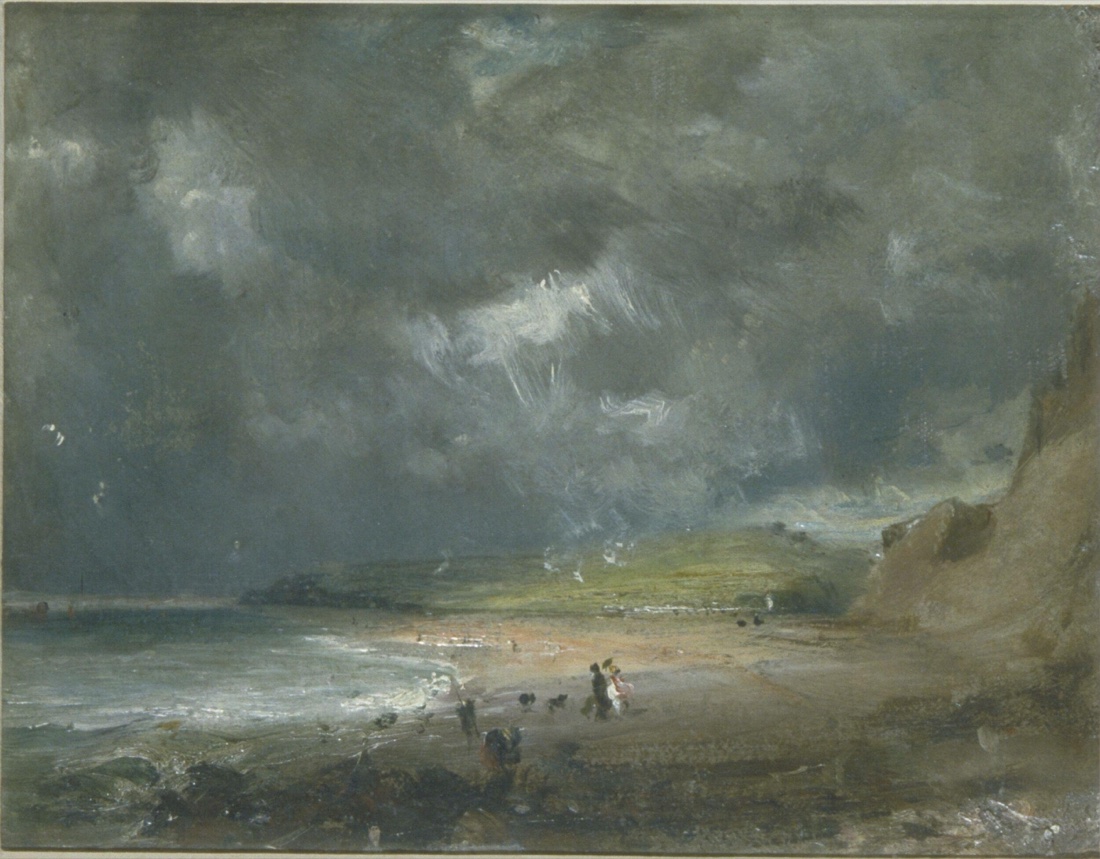
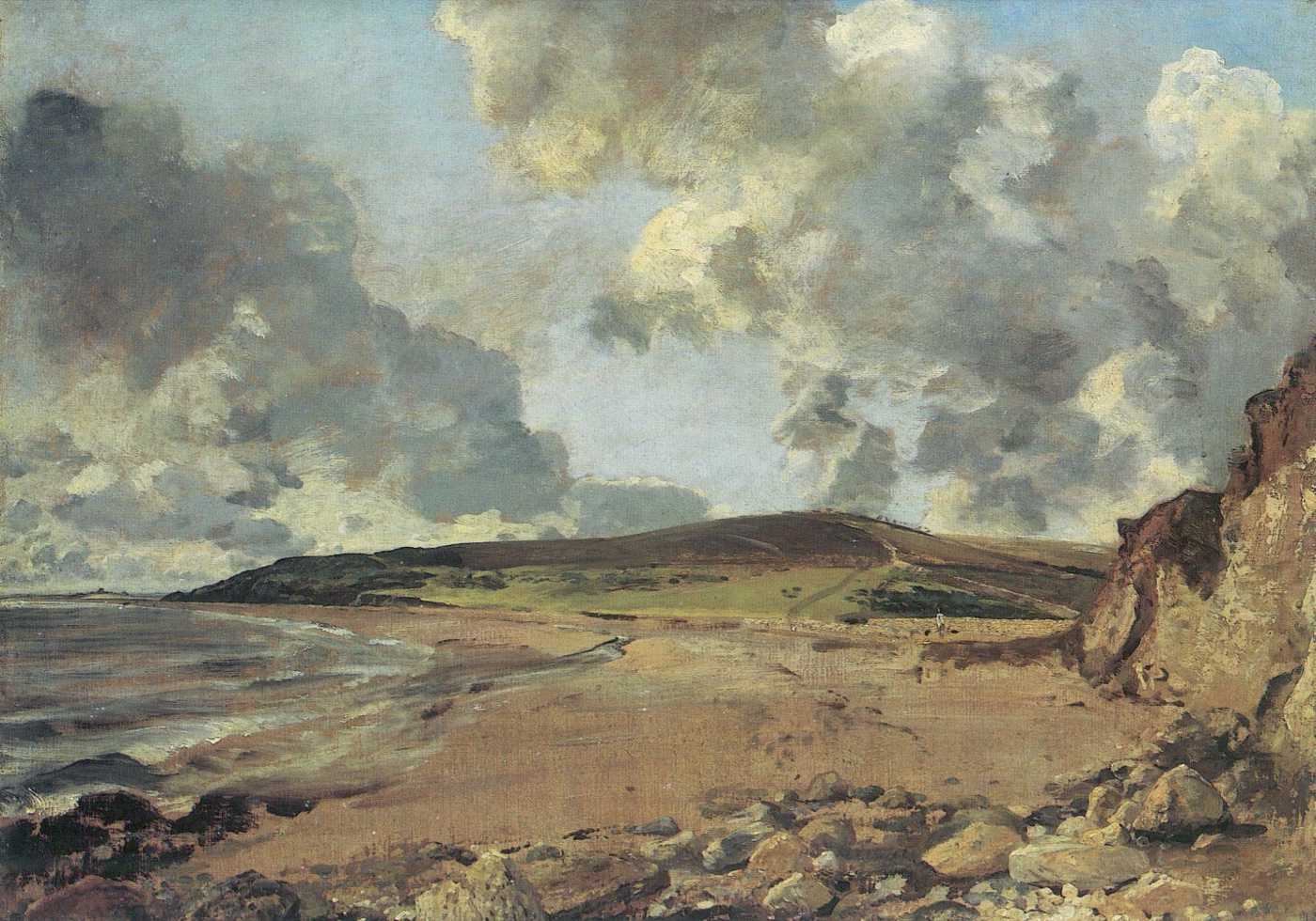
Two views of Bowleaze Cove from Constable's honeymoon at Osmington, about mid-October to the end of November 1816: a small oil sketch (V&A, 1816) and a larger canvas (National Gallery, 1816–17).
The artist must have painted this on the spot, during a sudden spell of stormy weather.
Victoria and Albert Museum, gallery label for Weymouth Bay, 330-1888Thick clouds scud across the bright winter sky as the Downs slope to the sandy cove and sea.
National Gallery, London, on NG2652
Records of those days
- Meteorological Diary kept at ExeterBarometer, thermometer and the weather in words three times a day, October and November 1816, printed in the Gentleman’s Magazine; 79 km west of the cove. Transcribed by Nephos.
- Central England TemperatureDaily means from 1772 and monthly from 1659, for ranking the honeymoon weeks against every autumn on record.
- Luke Howard’s London registerDaily notes on the weather in London for the same weeks, from The Climate of London (1833).
- Constable’s dated drawingsV&A drawings dated 11 October (Netley) and 7, 20 and 21 November 1816 (Osmington Bay, Portland, Preston), and Farington’s diary on his return.
Not found or not yet searched
- No weather record from Weymouth itself has been found for 1816; Exeter is 79 km west and London 195 km east.
- Neither painting is dated to a day.
- The full Tate dating argument and Reynolds’s catalogue entry were not accessible; the dating section distinguishes checked snippets from unverified claims.
Each claim tested
- “painted this on the spot, during a sudden spell of stormy weather”, the V&A on its sketch. The Exeter diary records two squally, rainy spells inside the stay, 26–31 October and 9–14 November 1816, and Howard’s London notes have rain and squalls on several of the same days. The sketch’s own day is not recorded.
- “Thick clouds scud across the bright winter sky”, the National Gallery on NG2652. Fair, cloudy, breezy days run through the diary, among them 20 and 21 November, when Constable dated drawings at Portland and Preston; nothing in the records conflicts with an autumn 1816 sky.
- The date of NG2652: painted at Osmington in 1816, or recalled later in London. The 1819 studio-recollection hypothesis supplies no outdoor session to test. The weather records cannot decide between the dates or explain Constable’s technique.
Verdict
Constable’s six weeks at Osmington ran from a mild October into one of the coldest Novembers on record, with two stormy spells and fair, cloudy, breezy days between hard frosts. The broad weather conditions fit that autumn, but the cloud perspective remains untested; the records cannot say whether the larger one was painted then or recalled later.
- Partially agreesThe V&A sketch’s storm, on the spot Stormy spells are on record inside the stay; the sketch is not dated to a day, and Exeter is 79 km away.
- Partially agreesThe National Gallery’s bright winter sky Fair, cloudy, breezy days are on record in the window; such skies are common in any autumn.
- Unknown1816 or 1819 Weather cannot test a picture recalled in a London studio.
What this cannot tell you. Central England Temperature describes the English Midlands, not the Dorset coast. The Exeter diary is transcribed from a worn scan; a few cells are unreadable and are left blank, and its observer and thermometer exposure are unknown. The National Gallery calls its canvas twice the size of the sketch; the V&A gives the sketch about 20 × 25 cm and the canvas is 53 × 75 cm.
Step 2 · Records of those days
Six weeks, in a diary kept at Exeter
Constable married Maria Bicknell on 2 October 1816, drew Netley Abbey on the way west on the 11th, and spent about six weeks with John Fisher at Osmington vicarage, about half a mile from the beach at Bowleaze Cove. He dated drawings around Weymouth on 7, 20 and 21 November and was back in London on 9 December. No weather record from Weymouth itself has been found. The closest is a diary kept at Exeter, 79 km west, and printed in the Gentleman’s Magazine: barometer, thermometer and a few words on the weather at morning, afternoon and night. Nephos transcribed October and November in full. Around it stand Luke Howard’s daily notes in London and the Central England Temperature series.
- 3.9°
- C, November 1816 in central England, the joint 21st coldest November of 367 (1659–2025)
- −3.6°
- C on 24 November, the coldest 24 November in the daily record since 1772
- 11
- days of the stay with a daily mean at or below 2 °C; the 1991–2020 average is 1.4
- 26
- of 50 days at Exeter with rain, a wet haze, showers, squalls, sleet or snow written in the diary
Every entry in the Exeter diary, October and November 1816
| 1816 | Morning °F | Morning | 3 p.m. °F | 3 p.m. | 10 p.m. °F | 10 p.m. |
|---|---|---|---|---|---|---|
| 1 October | 60 | Blowing hard with sm. rain. | 63.5 | Fair but windy | 61 | Wet haze & mod. |
| 2 October | 60.5 | Cloudy and blowing hard | 62 | Do. | 59 | Do. |
| 3 October | 55 | Very fine; at 12 small rain. | 58.5 | Small rain | 60 | Cloudy, mod sm. rain. |
| 4 October | 59 | Cloudy and gloomy | 61 | Do. | 59 | F. & C. |
| 5 October | 60 | Gloomy & hazy with sm. rain. | 60 | Gloomy and hazy | 60.5 | Fine. |
| 6 October | 60.5 | Gloomy & hazy with sm. rain | 61 | Gloomy with wet haze | 61 | F. & C. |
| 7 October | 62 | Gloomy and hazy; fine | 65 | Fine but cloudy | 60.5 | Cloudy, a little rain. |
| 8 October | 62 | Cloudy, fine | 63.5 | Fine with clouds | 60 | F. & C.; wind and rain. |
| 9 October | 62.5 | Cloudy, lowering | 62 | Do. | 64 | Rain. |
| 10 October | 63 | Cloudy and lowering | 65 | Do. | 58 | Fine. |
| 11 October | 58 | Fine. | 61 | Very fine. | 54 | Do. |
| 12 October | 52.5 | Very fine; after 12 cloudy. | 59 | Cloudy, lowering | 58 | F. & C; wet haze. |
| 13 October | 56.5 | Gloomy and hazy | 59 | F. & C | 56 | Do.; frosty. |
| 14 October | 51 | Fine though cloudy. | 60 | Do. | 51 | Do; frosty. |
| 15 October | 43 | Fog | 59 | Fine, with clouds | 53 | F. & C. |
| 16 October | Gloomy | 58 | Do.; lowering | 57 | Fine. | |
| 17 October | 52 | Very fine | 57 | Fine tho' cloudy. | 54 | F & C. |
| 18 October | 49 | Very fine | 52.5 | Do. | 51 | Fine |
| 19 October | 53.5 | Fine, aft. 10 sm. drops of rain. | 57.5 | F. & C. | 54 | F. & C. |
| 20 October | 49.5 | Fine; after 10 cloudy | 51.5 | F. & C. | 53 | Do. |
| 21 October | 49.5 | F. & C.; aft. 12 fine | 53 | Fine. | 48.5 | Do. |
| 22 October | 51 | Very fine; aft. 9 small showers. | 52 | Cloudy, with some sm. show. | 48.5 | Fine. |
| 23 October | 44.5 | Fine, frosty | 50.5 | F. & C. | 52 | Do. |
| 24 October | 49 | Rain; after 12 fair | 51 | Fine | 47 | Do.; rain. |
| 25 October | 49 | Rain; after 12 fair | 49 | Fine though hazy | 49 | Fine. |
| 26 October | 42 | Foggy, aft. 10 cloudy with wind & rain. | 52 | Cloudy with squalls | 47 | Small rain. |
| 27 October | 52.5 | Cloudy, lower. | 56 | Do. | 53 | Small rain. |
| 28 October | 53 | Squalls with rain | 54 | Do. | 54 | Some small rain. |
| 29 October | 53 | 55 | Showers, F & C | 52 | Do.; showers. | |
| 30 October | 54 | Showers; F & C | 54 | Do. | ||
| 31 October | 52 | Fine; a small shower | Do.: a small shower | 44.5 | Do. | |
| 1 November | 50 | Fine. | 51.5 | Do. | 45 | Do.; some sm. rain. |
| 2 November | 50.5 | Wet, haze & rain; aft. 10 fair. | 49 | F. & C. | 42 | Do.; frosty. |
| 3 November | 47 | Fine, frosty | 48 | Do. | 44 | Do. foggy. |
| 4 November | 49 | Fine, aft. 10 cloudy & gloomy. | 49 | Do. | 46 | Foggy. |
| 5 November | 51 | Fine, show. hazy | 50 | Cloudy and wet haze | 48 | Do. |
| 6 November | 46 | Thick fog & sm. ra. clear at 11 | 52 | Do. fine sharp frost | 48 | Do. |
| 7 November | 33 | Cold with sm. drifts of sleet | 40 | Fine sharp frost | Do. | |
| 8 November | 30 | Very fine, sharp frost | 43 | Fine sharp frost | 39 | Cloudy with small showers |
| 9 November | 42.5 | Clouds with frequent showers | 47 | Do. frequent showers | 45 | Squalls, wind and hail. |
| 10 November | 37.5 | Fine, frosty, drifts of sleet | 39 | Cloudy with some drifts of sleet. | 32 | Frosty |
| 11 November | Hard frost, some sleet; thaw. | 41 | Foggy, aft 5 rain and blowing hard. | 48 | Fair & blow. hard. | |
| 12 November | 48 | Cloudy & gloomy, more mod. | 49 | Do. Do. | 52 | Wind & some rain |
| 13 November | 53 | Cloudy & overcast; windy. | 50 | Cloudy with squalls of rain. | 52 | Fine but squally. |
| 14 November | 46 | Cloudy with sq. of rain & sleet | 44 | Do. Do. | 41 | Do.; snow & sleet. |
| 15 November | 34 | Cloudy, after 12 clear | 39 | Fine, frosty | 34 | Do.; sharp frost. |
| 16 November | 35 | Very fine, sharp frost. | 40 | Do. | Do. | |
| 17 November | 34 | Fine, sharp frost | 42 | Cloudy and frosty | 43.5 | F. & C. |
| 18 November | 41 | Fine with clouds | 45 | Cloudy with some very sm. showers | 42 | Do. Do. |
| 19 November | 45 | F. & C. | 50 | Do. | 49 | Small rain; F.&C. |
| 20 November | 51 | F. & C | 52 | Do. | 50 | Do. |
| 21 November | 47 | F. & C. | 48 | Do. | 46 | Do. |
| 22 November | 46 | F. & C. | 40 | Do. | 33 | Frost. |
| 23 November | 31 | Fine, sharp frost | 33 | Do. | 30.5 | Do. |
| 24 November | 27.5 | Fine, sharp frost | 39 | Fine. | 34 | Foggy. |
| 25 November | 31 | F. & C. | 45 | Wet haze and small rain | 46 | Small rain. |
| 26 November | 44 | Foggy, after 11 fine | 46 | F. & C. | 36 | Frosty. |
| 27 November | 39 | Frost ended | 43 | Do. | 43 | F. & C. |
| 28 November | Cloudy & foggy; aft. 12 more clear | 46 | Fine tho' cloudy | 44 | Do. | |
| 29 November | 42 | Fine though cloudy | 44 | Do. | 38 | Do.; fog. |
| 30 November | 39 | Very fine, frosty | 48 | Do. | 34 | Do. |
Step 3 · The claims tested
A sudden storm, and a bright winter sky
1816 was the year without a summer: July was the coldest in the English record since 1659. The autumn began mild and then turned hard. November 1816 was the joint 21st coldest of 367, and from 7 to 17 November the Exeter diary is a run of sleet, frost and squalls. The V&A’s small sketch shows a sudden storm, with figures fighting their umbrellas in the wind. The Exeter diary records two squally, rainy spells inside the stay, from 26 to 31 October and from 9 to 14 November, and Howard’s London notes have rain and squalls on several of the same days. The National Gallery’s larger canvas shows thick clouds over a bright winter sky. Fair, cloudy, breezy days run through the diary too: on 20 and 21 November, the days Constable dated drawings at Portland and Preston, Exeter wrote “F. & C.”, fair and cloudy, and Howard in London watched clouds form “rapidly” as the wind veered south.
“The artist must have painted this on the spot, during a sudden spell of stormy weather.”
Victoria and Albert Museum, gallery label for Weymouth Bay, 330-1888
“walking their dogs on the beach and battling their umbrellas against the wind”
The same label
“Thick clouds scud across the bright winter sky as the Downs slope to the sandy cove and sea.”
National Gallery, London, on Weymouth Bay: Bowleaze Cove and Jordon Hill, NG2652
“Snow this morning in the high lands: shower, with hail: snow again at night.”
Luke Howard, London, 7 November 1816, The Climate of London (1833), vol. 2
“Fair at 2 p. m.: Cumulostrati formed rapidly, and passed off at a great elevation, the wind veering S.”
Luke Howard, London, 20 November 1816, the same volume
“My house commands a singularly beautiful view, and you may study from your very window.”
John Fisher to Constable, from Osmington, August 1816, in C. R. Leslie, Life and Letters of John Constable (1896)
Step 3 · The scholarship tested
The case for 1816, and for 1819
The small V&A sketch is dated 1816 and treated as an outdoor study from the honeymoon, about mid-October to late November. The dispute concerns the larger National Gallery canvas. V&A collection record.
For 1816. Leslie Parris and Ian Fleming-Williams date the canvas 1816 in Constable (Tate, 1991), no. 85. Their entry compares its canvas size with another Weymouth view. Constable’s Clouds reports their view that it was painted substantially from nature. The full Tate argument was not accessible. The National Gallery now dates it 1816–17 and suggests work back at the vicarage, so an early date need not mean painting outdoors. Tate, pp. 173–174; Constable’s Clouds, p. 46; National Gallery.
For a later studio picture. Graham Reynolds’s reported 1819 date remains unverified here: his catalogue raisonné entry was not accessible. Constable’s Clouds cites his no. 19.10 and reports his interpretation of a studio work between the small sketch and the exhibition picture of 1819. That catalogue gives the National Gallery canvas a range, c.1816–19. The National Gallery identifies the 1819 exhibition picture as probably the Louvre version, so the exhibition does not date this canvas. Reynolds (1984); Constable’s Clouds (2000), no. 26.
A possible sky, or a new technique? John E. Thornes accepts 1816, describing lines of cumulus clouds rising at 45 degrees. He defends their plausibility through meteorologist J. B. Tyldesley’s account of a similar Dorset sky on 4 August 1966: clouds formed over high ground and streamed out over the sea, where the cooler surface limited their growth. This is an analogy, not an 1816 observation. Timothy Wilcox’s catalogue raises a different problem: the convincing depth of the clouds is so new in Constable’s work that casual observation or memory seems insufficient to explain it. That allows a later, composed picture as an interpretation; the passage checked does not establish that Wilcox dates it 1819. Thornes (1999), pp. 106–109; Wilcox (2000), p. 46.
What the records can test. Exeter records squally, rainy spells on 26–31 October and 9–14 November 1816, and fair, cloudy weather on 20–21 November. Howard records rapidly forming clouds at a great elevation on 20 November, with wind veering south. November CET is 3.9 °C. These support changeable autumn weather, but Exeter is 79 km away and Howard is 195 km away; CET describes central England. None records cloud streets or the land–sea temperature difference at Bowleaze Cove. Thornes’s sky is therefore possible, not confirmed by these records. The 1819 studio-recollection hypothesis supplies no outdoor session to test. Weather records cannot decide between the dates or answer Wilcox’s question about technique. Exeter and CET records; Howard’s account.
Questions for students
- What evidence would distinguish an 1816 painting from a later recollection?
- Does a similar sky seen in 1966 establish what Constable saw in 1816?
- Can convincing cloud perspective be evidence both of observation and of artistic construction?
Step 4 · Why the verdict stops at the season
1816, or 1819?
The National Gallery dates its canvas 1816–17 and suggests it was painted back at the vicarage. Was it, or was it recalled later in London? The records cannot settle that. The broad weather conditions fit the autumn of 1816; the cloud perspective remains untested. No document found places Constable in Dorset in 1819, and a picture recalled in a London studio supplies no outdoor session to test. The autumn of 1819 was in any case colder still: the same weeks were the 7th coldest of 254 in central England. What would decide it lies in the paintings and their papers, not in the weather.
“The National Gallery’s canvas is twice the size of the millboard sketch and may have been painted back at the vicarage, about half a mile from the beach.”
The same
“having returned to London yesterday with His wife after passing Six weeks with the Revd. John Fisher in Dorsetshire”
Joseph Farington’s diary, 10 December 1816
“Osmington Shore, near Weymouth”
Leslie on Constable’s two pictures at the British Institution in 1819; the National Gallery takes it to be the larger Louvre version
Sources
Every source on this page
The weather data and earlier quotations come from fingerprinted files (sha256), checked when the data is rebuilt. The dating literature below was read in accessible catalogue snippets; each entry states what was checked and what remains unread.
- Victoria and Albert Museum, John Constable, Weymouth Bay, 330-1888 (collection API record)
sha256 ee0a9f7cf3cb019ef80e1bc9d1c9febb0923b89adc0ad19960f349a25d8dac4d - National Gallery, London, John Constable, Weymouth Bay: Bowleaze Cove and Jordon Hill, NG2652
sha256 a5d83de794afc8fe12ef279e3d131bf9efa15b17350fc7be1a15d90685296d93 - Graham Reynolds, The Later Paintings and Drawings of John Constable (1984), catalogue raisonné, no. 19.10
- Leslie Parris and Ian Fleming-Williams, Constable (Tate Gallery, 1991), no. 85, pp. 173–174
- John E. Thornes, John Constable’s Skies: A Fusion of Art and Science (1999), pp. 106–109, plate 28
- Edward Morris (ed.), Constable’s Clouds (Edinburgh/Liverpool, 2000), no. 26, p. 46; catalogue by Timothy Wilcox
- Wikimedia Commons, Weymouth Bay (1816), Victoria and Albert Museum, from the museum’s online collection
sha256 09641ab2041886c607e7c5f92b1c386c3763bed3383e50081d2a8d72c0301e32 - Wikimedia Commons, Weymouth Bay, c. 1816 (National Gallery, NG2652), The Yorck Project
sha256 4178ca05e9df8a2527ad88f4f5c739c982e2818d83fc13716074ae8cdf127791 - Meteorological Diary kept at Exeter, October 1816, The Gentleman’s Magazine, vol. 86 pt 2, p. [482] (page image)
sha256 41a2a00222eba85c40d3a8a88cdfe92b9b5c5abefdcf630c5a10b77f00ea83c0 - The same diary, November 1816, p. [638]
sha256 b28002aad6cc7d41bf2159109374eca950542181f8b919e7a2e08b077104037a - Met Office Hadley Centre, Central England Temperature, daily mean, 1772 to date
sha256 c6948508f8d4b1cff2b302c83d6506244c804abc2d088a743ef8ab6c630184cc - Met Office Hadley Centre, Central England Temperature, monthly mean, 1659 to date
sha256 c17868e014c4cfcc284a41149e6217b1dec976d7fa22fa91ed515e675eac3304 - Met Office Hadley Centre, England and Wales precipitation, monthly, 1766 to date
sha256 202d0ba7360429539a0d3dd458b1c9b712d9b4dd8c386131d5d098740bb99739 - Luke Howard, The Climate of London, 2nd edition (1833), vol. 2, full text
sha256 7597c605e699090341911a6cc3e4c2bbcd8fb2d37cde273f4804f51ec045b431 - The Farington Diary, ed. J. Greig, vol. VIII, full text
sha256 625e87975334f7de914a44edfdeea2224867bc04bcce5528641bc2bb45de10e5 - C. R. Leslie, Life and Letters of John Constable (1896), full text
sha256 ca8addd9f3b61b666e1dcbef26f54545ffe8ce2151e6c77d8f2fe575700ad3ec - V&A 823-1888, Netley Abbey: the east window, dated 11/10/1816
sha256 bc74406ed7ed2bedd942924fd9d505e9ae5fb79b7320f1bce0bab70473ae9d1b - V&A 311-1888, Osmington Bay, inscribed “Novr. 7. 1816--Osmington Bay”
sha256 9cc9311e4ceb87ff59aa00f860a884278b859d2382490d1feec2285a35b2a93a - V&A 628-1888, Portland Island from Chesil Bank, inscribed “Portland Island Novr. 20. 1816.”
sha256 1c871ad579fad6262e843aca3c2a9ea83d2ad4fbd9ed3482378fb858f8d49b3c - V&A 303-1888, Preston Church near Weymouth, inscribed “21st. Novr. 1816.”
sha256 07e8fb043f83c467d7c8a0dd3f4bb60323d8f569526185d5e23ded43cd588bbe - OpenStreetMap Nominatim: Bowleaze Cove, Weymouth
sha256 72c7747512382ecbbba86bfb36513095aeb3a27bbf996a55addcc3014f236d0c - OpenStreetMap Nominatim: Bruce Castle, Tottenham
sha256 6d6f9dc6bb66838737d3d0a95352246d4a1235b1974c864acfded5ad7c8596b9 - OpenStreetMap Nominatim: Exeter Cathedral
sha256 88e6c53897f1e48cc080e2f81b7951d459c751506f0becb65b9c81747a44d18e

