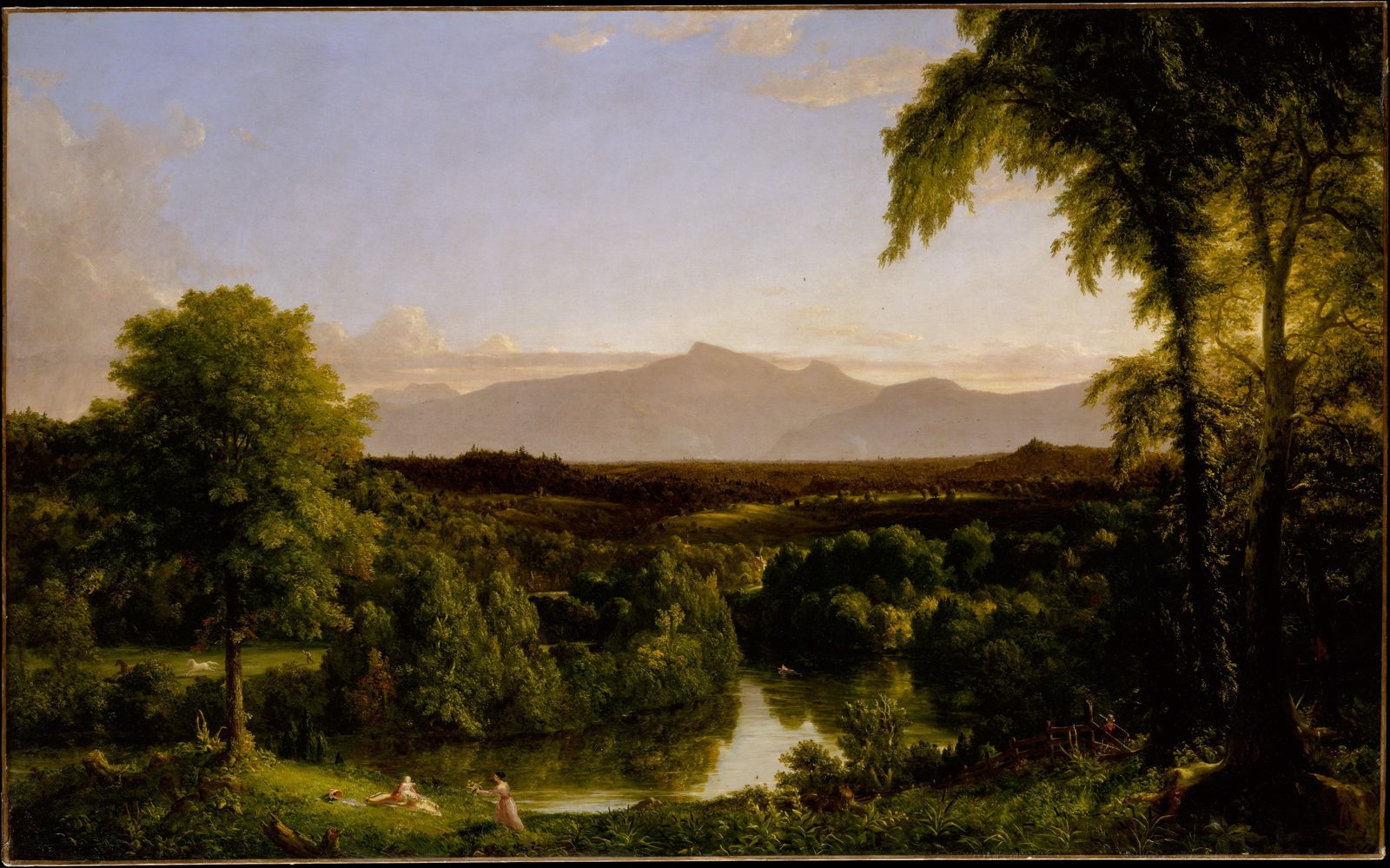
A study against the weather record
Thomas Cole
View on the Catskill—Early Autumn
Cole painted “early autumn” in the winter of 1836–37. What had the autumn just been like?
“Harsh and cruel climate” partially agreesSeason painted unknown
The Nephos method
How this study was read
The method in fullWhat is written
Painted in the studio at Catskill in the winter of 1836–37, from memory and earlier drawings, of a valley whose woods had been felled that spring.
In the winter I painted four pictures : A View on the Catskill, for Mr. Sturges
Cole, journal, 14 May 1837, in Noble (1853), p. 238remember it is a view
Cole to Jonathan Sturges, 24 February 1837, transcribed in the Metropolitan Museum Journal 43 (2008)The foliage is now falling in mournful showers. What a harsh and cruel climate!
Cole, journal, 6 October 1837, in Noble (1853), p. 243
Records of those days
- Watervliet Arsenal registerThermometer at 7 a.m., 2 p.m. and 9 p.m. and daily rain, kept by the Army on the Hudson, 56 km up-river from Cole’s house. Compared only with its own years 1826–1840, read at the same hours.
- Hudson Correctional Facility, 1991–2020Today’s median first frost, 6 km from Cole’s house across the river: 18 October.
Not found or not yet searched
- No weather observer worked at Catskill in 1836.
- The New York academies’ registers for 1836 survive only as half-month means in print; their daily sheets were not read.
- Cole wrote nothing about the weather of autumn 1836 that has been found.
Each claim tested
- “Early Autumn”, the season in the title. The canvas was painted in winter from memory, of the valley before its woods were cut in spring 1836; it does not show a particular autumn, so no season’s record can be tested against it.
- “the banks were in flames of splendour”, Cole’s biographer on the Hudson in late October 1836. No one recorded the leaves. By 29 October Watervliet had had 14 mornings at or below freezing, the coldest October of 1826–1840.
- “What a harsh and cruel climate!”, Cole on 6 October 1837, a year after the painting season. At Watervliet the 7 a.m. reading fell from 58 °F on 4 October 1837 to 28 °F on 5 October, the autumn’s first freezing morning, the day before he wrote.
Verdict
Cole painted a golden early autumn in the winter after the coldest of the 15 complete Octobers compared at Watervliet, 1826–1840, and of a valley that no longer looked like that.
- Unknown“Early Autumn” A remembered view, not a dated one; no autumn can be matched to it.
- Partially agrees“a harsh and cruel climate” A 30 °F drop to the first hard frost, the day before he wrote, 56 km up-river; “harsh and cruel” is his judgment.
- Unknown“flames of splendour” A biographer’s account written in 1853; leaves were not recorded.
What this cannot tell you. Watervliet is 56 km from Catskill, beside the Hudson. The 1836 values are readings at fixed hours, not daily highs and lows, and are compared only with the same station’s own years. The painting is a view from memory; the records describe the autumn around its making, not the scene it shows.
Step 2 · Records of those days
Sixty-one days at Watervliet
No weather observer worked at Catskill in 1836. The nearest daily record was kept by the Army at Watervliet Arsenal, on the Hudson 56 km up-river from Cole’s house: a thermometer read at 7 a.m., 2 p.m. and 9 p.m., and a rain gauge. These are the last two months of the autumn Cole had just lived through when he sat down that winter to paint “early autumn”.
- 16
- October mornings at or below freezing; no other October of 1826–1840 had more than 10
- 41.9
- °F, the October mean; the next coldest, 1834, was 46.2
- 16
- °F at 7 a.m. on 31 October
- 62.1
- °F, the September mean, an ordinary September
Every day, the three readings and the rain gauge
| 1836 | 7 a.m., °F | 2 p.m., °F | 9 p.m., °F | Rain, in |
|---|---|---|---|---|
| 1 September | 64 | 67 | 56 | 0.08 |
| 2 September | 46 | 54 | 65 | |
| 3 September | 55 | 66 | 60 | 0.03 |
| 4 September | 60 | 78 | 72 | |
| 5 September | 64 | 67 | 52 | |
| 6 September | 42 | 60 | 52 | 0.00 |
| 7 September | 43 | 66 | 53 | |
| 8 September | 42 | 70 | 60 | |
| 9 September | 57 | 82 | 56 | 0.04 |
| 10 September | 48 | 56 | 53 | |
| 11 September | 54 | 70 | 63 | 0.30 |
| 12 September | 62 | 78 | 69 | 0.07 |
| 13 September | 67 | 82 | 72 | |
| 14 September | 72 | 84 | 70 | 0.18 |
| 15 September | 62 | 84 | 61 | |
| 16 September | 54 | 75 | 65 | |
| 17 September | 64 | 68 | 64 | 0.45 |
| 18 September | 67 | 78 | 67 | |
| 19 September | 70 | 88 | 76 | |
| 20 September | 73 | 80 | 65 | |
| 21 September | 54 | 76 | 56 | |
| 22 September | 51 | 74 | 65 | |
| 23 September | 63 | 80 | 67 | 0.26 |
| 24 September | 64 | 78 | 72 | |
| 25 September | 54 | 61 | 50 | |
| 26 September | 57 | 62 | 51 | |
| 27 September | 51 | 67 | 46 | 0.04 |
| 28 September | 40 | 51 | 44 | 0.02 |
| 29 September | 40 | 56 | 46 | 0.02 |
| 30 September | 36 | 61 | 47 | |
| 1 October | 49 | 66 | 56 | 0.00 |
| 2 October | 60 | 71 | 50 | 0.50 |
| 3 October | 38 | 58 | 41 | 0.00 |
| 4 October | 44 | 60 | 48 | 0.02 |
| 5 October | 38 | 42 | 44 | 0.95 |
| 6 October | 38 | 46 | 43 | 0.23 |
| 7 October | 42 | 56 | 44 | 0.00 |
| 8 October | 41 | 58 | 44 | 0.00 |
| 9 October | 31 | 56 | 40 | 0.00 |
| 10 October | 26 | 48 | 36 | 0.00 |
| 11 October | 24 | 50 | 43 | 0.00 |
| 12 October | 32 | 37 | 34 | 1.25 |
| 13 October | 32 | 52 | 44 | 0.18 |
| 14 October | 49 | 58 | 51 | 0.32 |
| 15 October | 43 | 56 | 37 | 0.00 |
| 16 October | 30 | 52 | 43 | 0.05 |
| 17 October | 35 | 54 | 36 | 0.00 |
| 18 October | 36 | 48 | 31 | 0.00 |
| 19 October | 32 | 52 | 58 | 0.00 |
| 20 October | 62 | 44 | 31 | 0.60 |
| 21 October | 34 | 40 | 30 | 0.00 |
| 22 October | 28 | 48 | 32 | 0.00 |
| 23 October | 32 | 58 | 52 | 0.00 |
| 24 October | 44 | 65 | 51 | 0.05 |
| 25 October | 28 | 38 | 30 | 0.00 |
| 26 October | 22 | 36 | 38 | 0.00 |
| 27 October | 24 | 48 | 29 | 0.00 |
| 28 October | 19 | 50 | 43 | 0.00 |
| 29 October | 32 | 42 | 36 | 0.00 |
| 30 October | 32 | 36 | 22 | 0.00 |
| 31 October | 16 | 39 | 22 | 0.00 |
Step 3 · The claims tested
Against every October read at the same hours
October 1836 is the coldest of the 15 Octobers the arsenal read at 7 a.m., 2 p.m. and 9 p.m., from 1826 to 1840, by more than four degrees. Its first freezing morning, 9 October, was not unusually early; three other years froze sooner. What was unusual was that the cold stayed. Today the median first frost 6 km from Cole’s house comes on 18 October.
“The Season has been highly inauspicious to the farmer, and to the country. The hopes, feeble as they were, of tolerable fall crops, have, in many districts, been already blasted by the early frosts.”
The Cultivator (Albany), vol. 3, no. 8, October 1836, p. 125
“There is one season when the American forest surpasses all the world in gorgeousness — that is the autumnal”
Cole, “Essay on American Scenery”, American Monthly Magazine, January 1836
“The foliage is now falling in mournful showers. What a harsh and cruel climate!”
Cole, journal, 6 October 1837, a year later, in Noble 1853, p. 243. At Watervliet, 58 °F at 7 a.m. on 4 October 1837, then 28 °F on the 5th.
Step 4 · Why the verdict stops at the season
A view from memory
Cole painted the canvas that winter from earlier drawings and from memory, of a valley whose woods had been cut the spring before. He told the buyer so. The records describe the autumn around the painting’s making; they cannot test the scene it shows, and the title’s season stays unknown.
“They are cutting down all the trees in the beautiful valley on which I have looked so often with a loving eye.”
Cole to Luman Reed, Catskill, 26 March 1836, in L. L. Noble, The Course of Empire, Voyage of Life and Other Pictures of Thomas Cole (1853), p. 217
“In the winter I painted four pictures : A View on the Catskill, for Mr. Sturges”
Cole, journal, 14 May 1837, in Noble 1853, p. 238
“my picture may for years to come—tell what the Valley of the Catskill was before what is called “improvement” blasted the scene—I hope you will not anticipate too much in this picture—remember it is a view”
Cole to Jonathan Sturges, 24 February 1837, as transcribed by Christine I. Oaklander, Metropolitan Museum Journal 43 (2008), p. 176
Sources
Every source on this page
Each file was downloaded and given a fingerprint (its sha256). The page is rebuilt from these files and will not build if a fingerprint changes, so every number above comes from them rather than being typed in.
- Watervliet Arsenal daily register, 1825–1892: NOAA Climate Database Modernization Program, keyed and checked by the Midwestern Regional Climate Center
sha256 39dc7c82ebdd658bd601be43f125069d818b766ed0a86266f63a8c87eea3b487 - Watervliet Arsenal station metadata (MRCC)
sha256 bef28cae431a241b63f8940e5c884b395c9ff697188bed47a500fe102418cc99 - NOAA NCEI 1991–2020 annual and seasonal normals, Hudson Correctional Facility, New York (USC00304025)
sha256 aebdc2694f4e33a9a43be7d1e6b3ce79fdadd01774e20e422dccadb5050c35e1 - Louis Legrand Noble, The Course of Empire, Voyage of Life and Other Pictures of Thomas Cole (New York, 1853)
sha256 c90e60284123221a31524a545c1db6c52677b42a018a5732496c4ed85bd3affc - Thomas Cole, “Essay on American Scenery”, American Monthly Magazine, January 1836
sha256 3f9b19985c260e4be7012a933a95b52ff0f8b4c82343d17d6f3828c6bfeb023d - The Cultivator (Albany), vol. 3, 1836–37
sha256 0f80c7d59c0268b093c3952e3609a8890099e49d03932f5038883e0d734b854c - Christine I. Oaklander, “Jonathan Sturges, W. H. Osborn, and William Church Osborn: A Chapter in American Art Patronage”, Metropolitan Museum Journal 43 (2008)
sha256 fc85477c1f1654b7d1c11aa0a5b8805de294cc161e63d1ef94d449a97298878d - The Metropolitan Museum of Art, View on the Catskill—Early Autumn, 95.13.3 (Open Access record)
sha256 90186460b07a85f075269a8a8603c3e764972ede6e367f6b9be7a9433fc99d54