A study against the weather record
Thomas Cole
Kaaterskill Falls
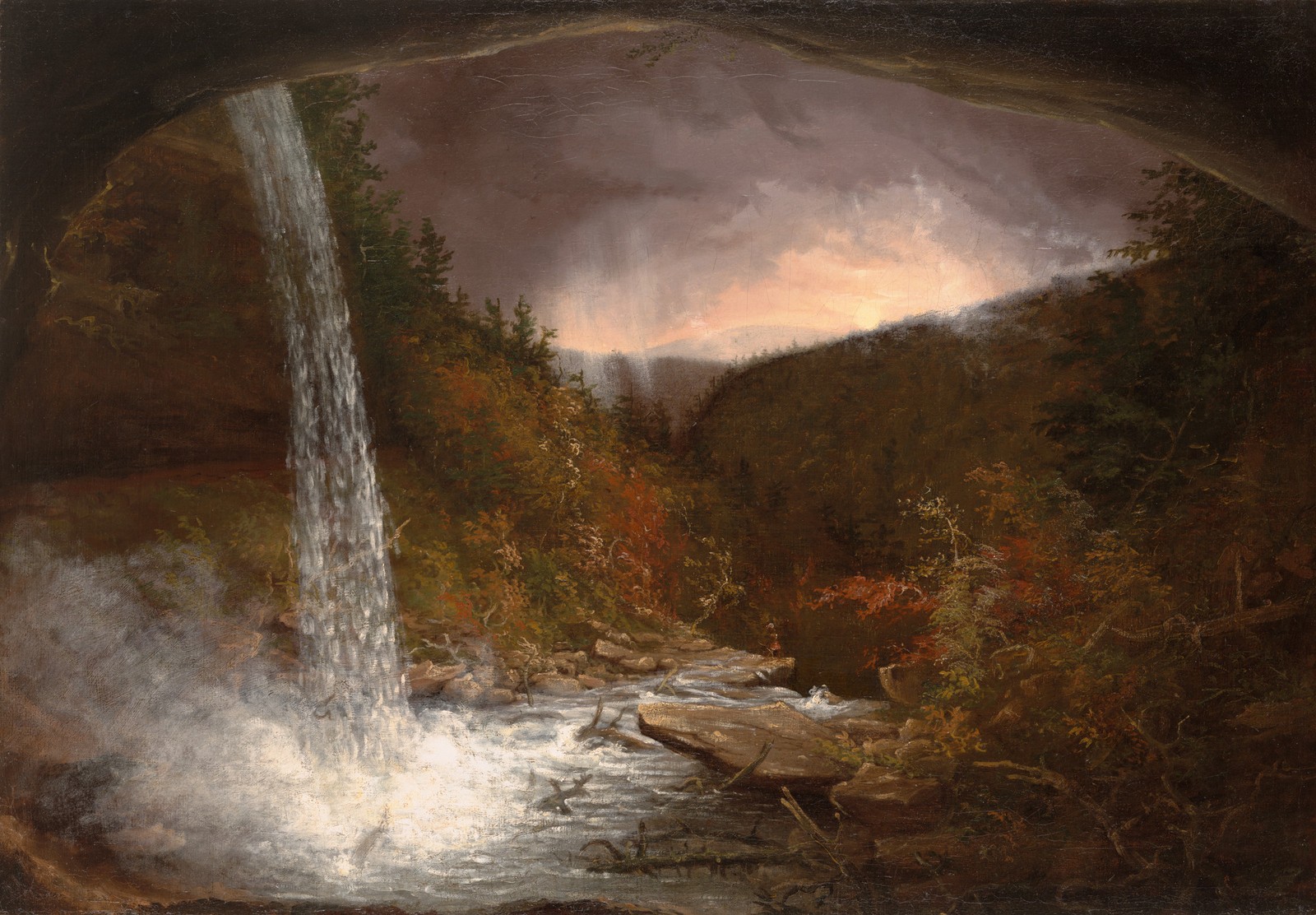
A first encounter in 1825, a return in 1826, then a studio canvas. The falls run in full force. Was the spring and early summer of Cole’s return wet or dry?
Water at the falls unknownPainted day unknown
The Nephos method
How this study was read
The method in fullWhat is written
First encounter in 1825, a return to the Catskills and Lake George in 1826, then a studio painting for Daniel Wadsworth. Noble says autumn for the first trip; the Met chronology says summer. The 1826 return, approximately 6 May–6 July, is the weather window.
for the last month or two
Cole to Daniel Wadsworth, 6 July 1826, transcribed in Shannon Vittoria’s chronology, Thomas Cole’s Journey (Met, 2018), p. 248; note 7 cites Watkinson and McNulty, p. 1.I cannot paint a view twice and do justice to it.
Cole to Daniel Wadsworth, 20 November 1826, quoted by Michael Gaudio, Art History 33:3 (2010), p. 451 and note 8, p. 464 (McNulty, p. 4).
Records of those days
- Albany Academy rainfall, published by Hough in 1855Whole-month rainfall for May and June, 1826–1849; manually transcribed from the scans. Regional Hudson-valley evidence.
- Watervliet Arsenal daily thermometer, NOAA/CDMP and MRCC65.4 km from the falls. All 186 readings at 07/14/21 h survive in the 62 days, 6 May–6 July 1826. Twelve complete unflagged windows between 1826 and 1840 qualify for comparison.
- Cole’s letters and the Met chronologyPublished transcriptions of the letters dated 6 July and 20 November 1826; the original manuscripts were not inspected.
Not found or not yet searched
- The exact dates of either visit to the falls are unknown. The July letter also covers Lake George.
- No verified rainfall amount or flow measurement at the falls has been established. Albany’s calendar months cannot supply rainfall for the exact visit envelope.
- The 1825 trip’s season is disputed. Watervliet begins in August, and September 1825 needs checking; no 1825 weather figures are published.
Each claim tested
- Was the spring and early summer of the return wet or dry? At Albany, May 1826 had 0.76 inches, driest of 24 Mays (1826–1849); June had 6.22 inches, fourth wettest of 24 Junes. The regional record changes between months. Rainfall and discharge at the falls remain unknown.
- Temperature as context for the return journey. The fixed-hour mean at Watervliet was 69.5 °F, second warmest of 12 accepted windows. Temperature does not establish the falls’ flow.
- Can the painted torrent be tied to a weather event? No. The canvas repeats an earlier view, with renewed sketching associated with 1826, and no painted day or exact falls visit is documented.
Verdict
A dry May followed by a wet June at Albany, during a warm return season at Watervliet. These regional records put Cole’s travels in context; the water at Kaaterskill Falls and the day in the canvas remain unknown.
- UnknownWater at the falls during Cole’s return Regional monthly rain is measurable; catchment rainfall, visit dates and discharge are not established.
- UnknownA painted day in 1826 A studio picture, repeating the 1825 view; no document fixes the depicted weather to a day.

What this cannot tell you. The canvas’s autumn colours differ from the May–early July 1826 return; the records cannot decide whether they recall the 1825 trip described by Noble or are a pictorial choice. May includes 1–5 May before the approximate window; June is wholly inside it. No total for 1–6 July has been established. Rainfall ranks describe Hough’s published table. Historical gauge practice changed; this is not a homogenized modern series. Greenville’s nearer 1826 register has unresolved gauge figures and fractional rain-day counts; no rainfall amount is used. Watervliet ranks use 1826, 1827, 1828, 1830, 1831, 1833, 1835, 1836, 1837, 1838, 1839 and 1840. The other three windows have missing or flagged readings.
Step 1 · The picture’s history
First encounter, return, studio
Cole first travelled up the Hudson in 1825. His first painting of Kaaterskill Falls, bought by John Trumbull, is now lost. Noble’s 1853 biography places the journey in autumn; the Met’s 2018 chronology places it in summer. The bookstore display that October–November and Trumbull’s letter of 14 November 1825 put the first canvas before that date; they do not settle the season of the trip.
The Wadsworth picture belongs to the following year. On 6 July 1826, Cole wrote to Daniel Wadsworth of sketching around Lake George and the Catskills during the preceding month or two. The Met chronology connects those new sketches to this canvas, its figure 146, accession 1848.15. In November, Cole told Wadsworth how difficult it was to repeat a view. The painting was made in the studio; no painted day is documented.
The foliage is painted in autumn colours. Gaudio calls this an “autumnal landscape view” (p. 457). That autumn does not match the May–early July 1826 return window. It is consistent with Noble’s autumn account of the first trip in 1825, or with a pictorial choice; the records cannot decide between them. Gaudio also describes a “clearing sky” in the distance (p. 453). These descriptions concern the painted scene. The weather window covers Cole’s return, not the season or weather depicted.
We use 6 May–6 July 1826, 62 days inclusive, as an approximate reading of the July letter. It is a window for the return journey, including Lake George, not an itinerary at the falls. No 1825 weather figures are shown: Watervliet begins on 1 August, and its September readings need further checking.
“for the last month or two”
Cole to Daniel Wadsworth, 6 July 1826, transcribed in Shannon Vittoria’s chronology, Thomas Cole’s Journey (Met, 2018), p. 248; note 7 cites Watkinson and McNulty, p. 1.
“I cannot paint a view twice and do justice to it.”
Cole to Daniel Wadsworth, 20 November 1826, quoted by Michael Gaudio, Art History 33:3 (2010), p. 451 and note 8, p. 464 (McNulty, p. 4).
Step 2 · The water question
A dry May, then a wet June—at Albany
The fall pours past the cavern opening and breaks into mist. Michael Gaudio’s account of this painting places us behind the upper fall, looking out towards the mountains. Was the spring and early summer of Cole’s return wet or dry?
Albany Academy’s register, kept by T. Romeyn Beck and published by Franklin B. Hough, gives 0.76 inches in May 1826, the driest May of its 24 years, 1826–1849. June has 6.22 inches, fourth wettest among the same 24 Junes. The Hudson-valley record changes direction between the two months; it does not support calling the whole return uniformly wet or dry.
These are whole calendar months. May includes five days before our approximate window; June falls wholly within it. We have no verified rainfall total for the first six days of July, or for the falls’ catchment. The monthly figures cannot tell us when rain fell during Cole’s travels.
The rainfall transcription: every May and June, 1826–1849
| Year | May, inches | June, inches |
|---|---|---|
| 1826 | 0.76 | 6.22 |
| 1827 | 3.43 | 3.75 |
| 1828 | 4.48 | 2.87 |
| 1829 | 2.68 | 3.90 |
| 1830 | 4.63 | 7.58 |
| 1831 | 2.88 | 4.04 |
| 1832 | 2.69 | 3.57 |
| 1833 | 8.47 | 2.36 |
| 1834 | 3.70 | 2.32 |
| 1835 | 2.70 | 6.48 |
| 1836 | 3.86 | 5.67 |
| 1837 | 7.34 | 5.06 |
| 1838 | 7.45 | 7.60 |
| 1839 | 3.83 | 5.12 |
| 1840 | 2.28 | 3.47 |
| 1841 | 2.24 | 2.10 |
| 1842 | 1.44 | 4.44 |
| 1843 | 2.07 | 5.54 |
| 1844 | 5.94 | 4.60 |
| 1845 | 3.92 | 3.42 |
| 1846 | 3.45 | 3.84 |
| 1847 | 2.25 | 5.06 |
| 1848 | 8.11 | 4.72 |
| 1849 | 5.40 | 4.45 |
Step 3 · Context for the return
A warm start to summer
At Watervliet Arsenal, 65.4 km from the falls in a straight line, the thermometer was read at 7 a.m., 2 p.m. and 9 p.m. All 186 readings survive for the 62-day window in 1826. Their mean is 69.5 °F, second warmest of 12 complete, unflagged windows in the 1826–1840 period with that same schedule. This describes warmth in the region during the return; temperature does not answer the water question.
The comparison years are 1826, 1827, 1828, 1830, 1831, 1833, 1835, 1836, 1837, 1838, 1839, 1840. Windows in 1829, 1832 and 1834 have missing or flagged readings and are excluded. These are fixed-hour means, not means of daily highs and lows. Watervliet’s rain cells are blank in this window; blank does not mean dry.
The same 62 days in each accepted comparison year
| Year | Mean of 07/14/21 h readings, °F |
|---|---|
| 1826 | 69.5 |
| 1827 | 67.1 |
| 1828 | 70.0 |
| 1830 | 62.3 |
| 1831 | 69.3 |
| 1833 | 59.6 |
| 1835 | 64.5 |
| 1836 | 63.7 |
| 1837 | 63.1 |
| 1838 | 66.3 |
| 1839 | 62.5 |
| 1840 | 65.1 |
Every thermometer reading, 6 May–6 July 1826
| 1826 | 7 a.m., °F | 2 p.m., °F | 9 p.m., °F |
|---|---|---|---|
| 6 May | 51 | 70 | 53 |
| 7 May | 52 | 64 | 55 |
| 8 May | 50 | 63 | 54 |
| 9 May | 51 | 65 | 59 |
| 10 May | 50 | 74 | 58 |
| 11 May | 51 | 78 | 58 |
| 12 May | 51 | 84 | 64 |
| 13 May | 62 | 87 | 70 |
| 14 May | 64 | 86 | 71 |
| 15 May | 69 | 93 | 74 |
| 16 May | 71 | 94 | 74 |
| 17 May | 72 | 92 | 64 |
| 18 May | 59 | 80 | 61 |
| 19 May | 53 | 74 | 64 |
| 20 May | 58 | 84 | 65 |
| 21 May | 61 | 85 | 72 |
| 22 May | 66 | 83 | 72 |
| 23 May | 64 | 82 | 71 |
| 24 May | 65 | 81 | 68 |
| 25 May | 57 | 78 | 66 |
| 26 May | 57 | 78 | 71 |
| 27 May | 66 | 86 | 69 |
| 28 May | 70 | 71 | 63 |
| 29 May | 54 | 67 | 51 |
| 30 May | 53 | 66 | 59 |
| 31 May | 54 | 75 | 69 |
| 1 June | 66 | 79 | 69 |
| 2 June | 66 | 78 | 72 |
| 3 June | 71 | 80 | 73 |
| 4 June | 74 | 84 | 74 |
| 5 June | 63 | 69 | 63 |
| 6 June | 58 | 64 | 62 |
| 7 June | 66 | 77 | 70 |
| 8 June | 70 | 84 | 77 |
| 9 June | 71 | 87 | 69 |
| 10 June | 69 | 86 | 77 |
| 11 June | 74 | 85 | 71 |
| 12 June | 61 | 77 | 68 |
| 13 June | 63 | 77 | 66 |
| 14 June | 62 | 78 | 71 |
| 15 June | 66 | 79 | 70 |
| 16 June | 62 | 71 | 60 |
| 17 June | 61 | 75 | 67 |
| 18 June | 63 | 77 | 67 |
| 19 June | 70 | 73 | 69 |
| 20 June | 64 | 72 | 63 |
| 21 June | 64 | 66 | 62 |
| 22 June | 65 | 72 | 65 |
| 23 June | 62 | 81 | 65 |
| 24 June | 64 | 79 | 69 |
| 25 June | 71 | 84 | 72 |
| 26 June | 72 | 69 | 68 |
| 27 June | 64 | 77 | 65 |
| 28 June | 65 | 80 | 73 |
| 29 June | 72 | 73 | 73 |
| 30 June | 70 | 84 | 73 |
| 1 July | 66 | 81 | 73 |
| 2 July | 69 | 71 | 64 |
| 3 July | 65 | 83 | 71 |
| 4 July | 67 | 80 | 70 |
| 5 July | 70 | 86 | 72 |
| 6 July | 69 | 85 | 73 |
Step 4 · Where the records stop
The water in the canvas remains undated
The records give the return journey a regional setting: a dry May and wetter June at Albany, with warmth at Watervliet. They cannot connect the painted torrent to a particular rainfall event. Neither the date of Cole’s renewed visit to the falls nor a local discharge measurement is established. A studio picture that repeats an earlier view can preserve an encounter without preserving the weather of a single day.
A nearer register at Greenville survives for 1826, but its gauge scale or printing needs resolution and its rain-day columns mix fractional counts and blanks. It supplies no reliable rainfall amount for this study. The gap is evidence about water at the falls, not a reason to let the thermometer stand in for it.
Sources
Every source on this page
Each file was downloaded and given a fingerprint (its sha256). The page is rebuilt from these files and will not build if a fingerprint changes, so every number above comes from them rather than being typed in.
- MRCC, Albany Academy station metadata
sha256 6ad9ec5555cba7426c079e528e593da46c225719bd52bf3cc6e2cf0c6bfaaca6 - Hough (1855), Albany Academy, May 1826–1849
sha256 228f47acbc7738f22eccc881bedc0d328d139252cdd52665311e5c2b3834163f - Hough (1855), Albany Academy, June 1826–1849
sha256 bf2c6c66ad68d074dc4033625dac4bea95eb34d68d6c752556073966956c56f2 - Hough (1855), Albany Academy observers and location
sha256 7fc50410e07c0ec1eab2caa53526b41c6a7a6f2a84084011f7094ab1b960f01a - Hough (1855), Results of a Series of Meteorological Observations
sha256 38fad66f1cf5d2adec33143291036295b11bd6279b0b553545cfc32d9b38f03a - Nephos transcription of Albany rainfall, read from Hough’s scans
sha256 ba14ce45a2de6a4220b49488edde77bc7962cdbc0f63e2044266ad06d22428dc - Shannon Vittoria, chronology in Thomas Cole’s Journey (Met, 2018)
sha256 5e436228922d2f1c1a0fb4412a2cdc495a045abb753620027630da8b3c8eb989 - Text extraction of the Met catalogue
sha256 85225d1f8cb5aa9323429df2034c90113bd6cc2a8437075881168356610f7402 - Michael Gaudio, At the Mouth of the Cave (Art History 33:3, 2010)
sha256 e2b1538aeec87ae777f9aafbbf6876f120bfe72de540a693143b67c64253c2ce - Text extraction of Gaudio’s essay
sha256 e1e6e9a2d597ac775f34033d3aaf98bcc10723c85243bf261b5758f9bad2cf33 - Wadsworth Atheneum, Museum on the Move teachers’ manual
sha256 78ad001c88fb5374f2fffe3a2a156dfbcf9fe3911acf47fda5594975cc05f7a7 - Thomas Cole National Historic Site, COLE 200
sha256 70a8cc607fca9afb97d02629435d78d7737cb878383e3ee64878f36d507e6229 - OpenStreetMap, Kaaterskill Falls
sha256 247a25a7fa514d22c20e524d073481193498ada3ac8ab5b48c24bba0a3122444 - Wikimedia Commons, Cole Thomas Kaaterskill Falls 1826
sha256 6c41f31becd4d24312e441ba5f0c980702fef0d23e776dd12ff2fef057adbaf1 - Thomas Cole, Kaaterskill Falls (1826), Wadsworth 1848.15
sha256 d743a2e86e85362bfddff864d4e0fa307a20748d72858f34e49040410e8cf40f - Watervliet Arsenal daily register, NOAA/CDMP, keyed and checked by MRCC
sha256 39dc7c82ebdd658bd601be43f125069d818b766ed0a86266f63a8c87eea3b487 - Watervliet Arsenal station metadata, MRCC
sha256 bef28cae431a241b63f8940e5c884b395c9ff697188bed47a500fe102418cc99 - L. L. Noble, The Course of Empire (1853), p. 56
sha256 c90e60284123221a31524a545c1db6c52677b42a018a5732496c4ed85bd3affc


