A study against the weather record
Albert Bierstadt
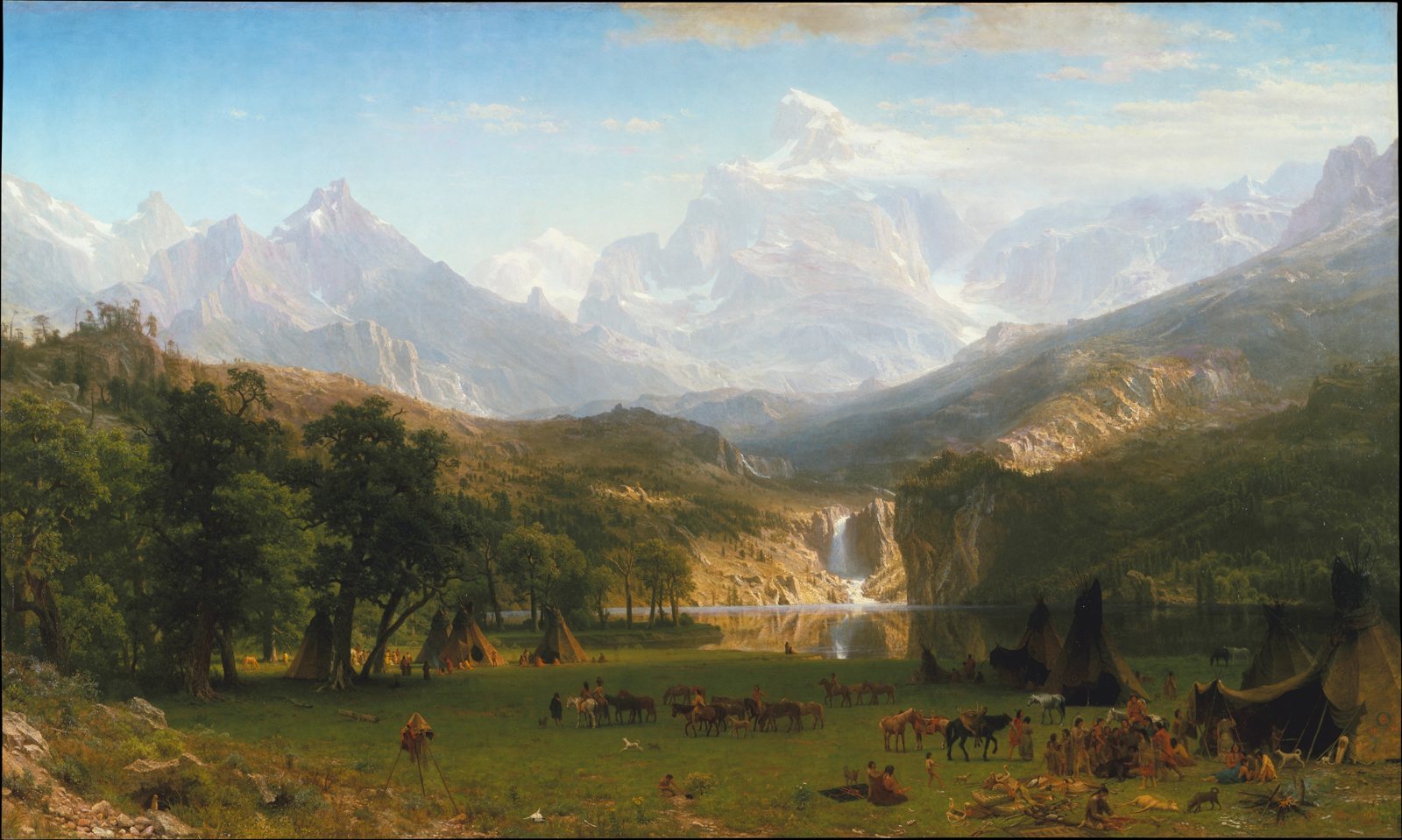
The Rocky Mountains, Lander’s Peak
A critic called its sky “minutely authentic”. What was the summer Bierstadt sketched it actually like?
“Minutely authentic” unknown“Constant rains” partially agrees
The Nephos method
How this study was read
The method in fullWhat is written
Painted in New York and finished early in 1863, from sketches made in the Wind River country with Lander’s road survey in the summer of 1859.
Sky, atmosphere, and foliage, are all, in hue and character, minutely authentic.
Henry T. Tuckerman, Book of the Artists (1867), p. 396their jagged summits, covered with snow and mingling with the clouds, present a scene which every lover of landscape would gaze upon with unqualified delight.
Letter signed “B.”, dated Rocky Mountains, July 10, 1859, The Crayon (September 1859), p. 287The season has been an unusual one; the mountain streams swollen by constant rains, and Green river higher than ever known before in the memory of the oldest mountaineers.
F. W. Lander, report to Congress, 1 March 1860, p. 3
Records of those days
- Fort Bridger post surgeon’s registerRain and three thermometer readings a day, 1858 to 1890, keyed by NOAA and checked against the Army’s printed 1860 tables. 184 to 211 km from the candidate peaks, about 6,000 feet below them.
- The Army’s printed register, July 1859Fort Bridger: 14 fair days, 17 cloudy, 13 days of rain, 1.96 inches.
- Mountain View, Wyoming, 1991–2020The modern July normal, 7 km from the old fort: 1.10 inches.
Not found or not yet searched
- No instrument stood in the Wind River Range or at the camp on the Green River in 1859.
- No sketch from the trip is dated to the day. A second Bierstadt letter, in the New Bedford Daily Mercury of 14 September 1859, has not been read.
- Bierstadt’s printed leaflet for visitors, which claimed firsthand observation, is known here only through a later catalogue’s summary.
Each claim tested
- “minutely authentic”: the painting’s fair sky, which Tuckerman describes as “a pure, blue sky”. At Fort Bridger, June 1859 was the warmest June on its record and nearly rainless, so fair days were common when the party reached South Pass on 24 June. July was the wettest July on its record: 1.96 inches on 13 days, with 17 cloudy days.
- “mingling with the clouds”, Bierstadt’s own description of the summits, written on 10 July. Rain fell at Fort Bridger on every day from 7 to 12 July, 0.92 inches in all, including the day the letter is dated. The summits themselves were never observed.
- “constant rains”, and the Green River “higher than ever known before”, in Lander’s report. The fort’s July rain is the highest of 26 complete Julys, 1858 to 1890, and nearly twice the modern normal. The river’s height was not measured.
- The day and the place painted. The canvas was composed in New York three and a half years later; even the peak is disputed (Frémont Peak or Temple Peak).
Verdict
The fort’s record bears out the reports of a wet summer and also shows fair days; it cannot test an undated sky composed in the studio.
- Unknown“minutely authentic” sky The register includes 14 fair days in July, but a remote gauge cannot test the authenticity of an undated, studio-composed sky.
- Partially agrees“constant rains” The nearest gauge had its wettest July on record, but it stood more than 180 km from the peaks, and the river’s height was not measured.
- UnknownThe day painted A studio composition from undated sketches; no day can be picked.

What this cannot tell you. Fort Bridger is 184 to 211 km from the candidate peaks and about 6,000 feet below them; mountain storms are local. The 1859 temperatures are readings at 7, 14 and 21 hours, not daily highs and lows, and cannot be set against modern averages. A clear morning between storms is entirely possible, so no single painted sky can be called false.
Step 2 · Records of those days
Sixty-one days at Fort Bridger
No instrument stood in the Wind River Range in 1859. The nearest was the post surgeon’s register at Fort Bridger, in the same Green River basin, 184 to 211 km from the peaks the painting may show and about 6,000 feet below them. The surgeon measured rain and read a thermometer at 7 a.m., 2 p.m. and 9 p.m. Each bar is one day’s rain; no day is missing.
- 1.96
- inches of rain in July 1859, on 13 days
- 17
- cloudy days that July in the Army’s printed register
- 0.92
- inches from 7 to 12 July, rain every day
- 0.04
- inches in all of June

Every day, rain and the three thermometer readings
| 1859 | Rain, in | 7 a.m., °F | 2 p.m., °F | 9 p.m., °F |
|---|---|---|---|---|
| 1 June | 0.00 | 41 | 61 | 43 |
| 2 June | 0.00 | 46 | 76 | 62 |
| 3 June | 0.00 | 53 | 81 | 57 |
| 4 June | 0.00 | 65 | 80 | 52 |
| 5 June | 0.00 | 60 | 82 | 60 |
| 6 June | 0.00 | 67 | 77 | 51 |
| 7 June | 0.00 | 56 | 74 | 50 |
| 8 June | 0.00 | 54 | 74 | 55 |
| 9 June | 0.00 | 57 | 75 | 60 |
| 10 June | 0.00 | 57 | 81 | 55 |
| 11 June | 0.00 | 65 | 80 | 52 |
| 12 June | 0.00 | 67 | 77 | 63 |
| 13 June | 0.00 | 59 | 68 | 52 |
| 14 June | 0.00 | 53 | 73 | 52 |
| 15 June | 0.00 | 61 | 75 | 55 |
| 16 June | 0.00 | 70 | 84 | 58 |
| 17 June | 0.00 | 75 | 83 | 59 |
| 18 June | 0.00 | 73 | 84 | 57 |
| 19 June | 0.00 | 73 | 89 | 59 |
| 20 June | 0.00 | 74 | 83 | 56 |
| 21 June | 0.00 | 65 | 79 | 62 |
| 22 June | 0.00 | 62 | 83 | 58 |
| 23 June | 0.00 | 61 | 81 | 61 |
| 24 June | 0.00 | 70 | 77 | 59 |
| 25 June | 0.00 | 66 | 79 | 61 |
| 26 June | 0.04 | 55 | 77 | 63 |
| 27 June | 0.00 | 64 | 82 | 61 |
| 28 June | 0.00 | 68 | 81 | 58 |
| 29 June | 0.00 | 63 | 90 | 65 |
| 30 June | 0.00 | 69 | 87 | 60 |
| 1 July | 0.00 | 68 | 84 | 58 |
| 2 July | 0.00 | 67 | 90 | 67 |
| 3 July | 0.00 | 68 | 88 | 68 |
| 4 July | 0.03 | 79 | 84 | 62 |
| 5 July | 0.00 | 73 | 71 | 61 |
| 6 July | 0.00 | 63 | 85 | 59 |
| 7 July | 0.21 | 62 | 87 | 62 |
| 8 July | 0.13 | 68 | 69 | 52 |
| 9 July | 0.24 | 63 | 89 | 61 |
| 10 July | 0.27 | 62 | 67 | 55 |
| 11 July | 0.03 | 65 | 66 | 55 |
| 12 July | 0.04 | 59 | 71 | 59 |
| 13 July | 0.00 | 69 | 79 | 59 |
| 14 July | 0.00 | 66 | 82 | 60 |
| 15 July | 0.00 | 72 | 84 | 60 |
| 16 July | 0.00 | 70 | 80 | 58 |
| 17 July | 0.00 | 64 | 82 | 58 |
| 18 July | 0.00 | 64 | 82 | 74 |
| 19 July | 0.77 | 72 | 79 | 62 |
| 20 July | 0.00 | 62 | 66 | 64 |
| 21 July | 0.05 | 61 | 73 | 61 |
| 22 July | 0.07 | 64 | 74 | 58 |
| 23 July | 0.00 | 61 | 78 | 62 |
| 24 July | 0.06 | 59 | 60 | 56 |
| 25 July | 0.02 | 58 | 69 | 59 |
| 26 July | 0.00 | 65 | 82 | 63 |
| 27 July | 0.00 | 61 | 79 | 60 |
| 28 July | 0.04 | 66 | 68 | 61 |
| 29 July | 0.00 | 66 | 78 | 62 |
| 30 July | 0.00 | 65 | 83 | 66 |
| 31 July | 0.00 | 57 | 77 | 59 |
Step 3 · The claims tested
1859 against every July on record
July 1859 is the wettest of the 26 Julys the fort recorded day by day between 1858 and 1890; the next is 1860, with 1.80 inches. A normal July at Mountain View, 7 km from the old fort, now brings 1.10. June had been the opposite: 0.04 inches, and the warmest of 21 Junes by the mean of the three daily readings.
“their jagged summits, covered with snow and mingling with the clouds, present a scene which every lover of landscape would gaze upon with unqualified delight.”
Bierstadt, letter dated Rocky Mountains, 10 July 1859, The Crayon, p. 287
“We are about to turn our faces homeward again, the season being a short one here, and to avoid the fall deluge on the plains, which renders the roads almost impassable.”
The same letter
“The season has been an unusual one; the mountain streams swollen by constant rains, and Green river higher than ever known before in the memory of the oldest mountaineers.”
F. W. Lander, report to Congress, 1 March 1860, p. 3
Step 4 · Why the verdict stops at the season
The picture was made in New York
Bierstadt finished the canvas early in 1863, three and a half years after the trip, from sketches, oil studies and stereographs. Tuckerman praised the truth of its sky; Jarves, writing in the same years, judged that such pictures got the details right and the whole wrong. A gauge more than 180 km away cannot say that any one painted sky was false, only that fair weather was not the whole of that summer.
“Sky, atmosphere, and foliage, are all, in hue and character, minutely authentic.”
Henry T. Tuckerman, Book of the Artists, 1867, p. 396
“Far above and away, the snow-clad peaks rising into a pure, blue sky, and flecked with sun-tinted vapor”
The same, p. 395
“With singular inconsistency of mind they idealize in composition and materialize in execution, so that, though the details of the scenery are substantially correct, the scene as a whole often is false.”
James Jackson Jarves, The Art-Idea, on Church and Bierstadt, 1866 printing, p. 234
Sources
Every source on this page
Each file was downloaded and given a fingerprint (its sha256). The page is rebuilt from these files and will not build if a fingerprint changes, so every number above comes from them rather than being typed in.
- Fort Bridger daily register, 1858–1890: NOAA Climate Database Modernization Program, keyed and checked by the Midwestern Regional Climate Center
sha256 c7e99251275e0bc1b6e401f597ff0a86d2048a378b6da040ee923b5d43b9356e - Fort Bridger station metadata (MRCC)
sha256 58c637069bc34fca313c6b39e6f54c8ef6eed6994c35889efc9faa8fb151d582 - Statistical Report on the Sickness and Mortality in the Army of the United States, 1855–1860 (Washington, 1860): Meteorological Register, July 1859
sha256 15f7d5f74d75fb49106f9f2b1d20763ab5b937faa570bcfc0e65ac91cd75414a - NOAA NCEI 1991–2020 monthly normals, Mountain View, Wyoming (USC00486555)
sha256 b736e2690594214a9ec96125970ba761cadd0fefc114391dc3f4ca5dd083954a - The Crayon, vol. 6, September 1859, “Sketchings”
sha256 05393689c88998eab884d40ea3e1765b58d1b75f9e93f4a50198d7ec83497ab9 - F. W. Lander and others, Fort Kearney, South Pass and Honey Lake wagon road, report of 1 March 1860 (U.S. Serial Set 1100)
sha256 3876b95fbd02fee85d7ef416942274bf377848147ec004486425fa02fd0632c5 - Henry T. Tuckerman, Book of the Artists (1867), p. 396
sha256 c9fe367b75d6f32abfabe2cc3d51f56e510caa1748d5bf15016a14d91973a443 - Henry T. Tuckerman, Book of the Artists (1867), p. 395
sha256 12552a1981bf2582ce4dbfe3ce09898f05510df02e5c0aa6dbf192ba5fb92d2c - James Jackson Jarves, The Art-Idea (1866 printing), p. 234
sha256 56b7b8298426892f1c65df18ab94dbf7fe3a6d38b2e7191f6d65f6b7d4e4efab - The Metropolitan Museum of Art, The Rocky Mountains, Lander’s Peak, 07.123 (Open Access record)
sha256 becad0be297a732e0956d9f0b982f77ba850511c9797eff9f7d8ab24bccf0541