The painting is not reproduced here: an open image licence has not been established. Smith treats website reproduction as publication requiring permission.
A study against the weather record
Theresa Bernstein
Armistice Day Parade: The Altar of Liberty
Smith’s object label points to the 1918 parade; its 2018 essay implies the 1919 anniversary. What can the newspapers, the monument and the weather resolve?
Event year unresolvedPainted day unknown
The Nephos method
How this study was read
The method in fullWhat is written
The canvas is signed 1919. Smith’s current object label names a 1918 parade; its 2018 essay places Bernstein there a year after the armistice. These are competing accounts of the occasion, not alternative dates for the canvas.
1918 Armistice Day parade
Smith College Museum of Art, current object label, SC 2015.42One year later, Bernstein watched the Armistice Day parade
Danielle Carrabino, Smith essay, 9 November 2018
Records of those days
- Central Park daily observationsDaily minimum, maximum and precipitation for each candidate day, from the station then at the Arsenal. Neither hour nor cloud cover is established.
- New York Times, 12 November 1918 and 1919Next-day accounts of the celebrations and separate local Weather Bureau office temperatures. Selected passages transcribed from the scans.
- Altar dedication, 28 September 1918A next-day newspaper report places the dedication in Madison Square; a verified removal date remains missing.
Not found or not yet searched
- The original journal and its date have not been checked; Smith’s excerpt is undated.
- No execution day or outdoor painting session is established.
- The altar’s removal date and independently witnessed presence on either candidate day are unresolved.
Each claim tested
- The object label’s 1918 event attribution The newspaper reports celebrations up and down Fifth Avenue on that day. This fits the proposed setting but does not identify the painting.
- The essay’s implied 1919 event attribution The anniversary report describes memorial gatherings and a Brooklyn military parade. It neither establishes nor excludes a parade at this altar.
- Weather can distinguish the pictured occasion The daily records differ, but no dated weather claim connects either record to the painted sky.
Verdict
The checked context favours the 1918 attribution, without resolving the conflicting museum accounts. The signed date remains 1919. Smith documents Bernstein simplifying the monument’s map into colour; the records establish no corresponding change to the sky.
- Partially agrees1918 parade context The newspaper places celebrations on Fifth Avenue, but does not identify this composition.
- UnknownWhich Armistice Day the painting shows Neither the selected newspapers, the incomplete monument history nor the weather settles the conflicting accounts.
- UnknownWeather of the painted sky No painted hour, dated sky claim or on-site cloud observation is established.
What this cannot tell you. Central Park and the newspaper’s high-level office thermometer are separate records, not averaged together. A dry daily gauge is not proof of clear sky; a precipitation total does not date a shower to a parade. Newspaper OCR omissions are unknowns, not evidence that an event did not occur. Research and transcription checking were solo; no independent checker is claimed.
Step 1 · The picture and its dates
A signed year, two accounts of the occasion
Theresa Bernstein’s canvas is dated 1919. Smith’s object record transcribes its signature as “T.BERNSTEIN 19”. That dates the work to a year; it does not date the parade or establish when Bernstein observed it.
The temporary Altar of Liberty dominates the composition, with troops, spectators and flags gathered before it. Smith’s acquisition account, printed p. 54, identifies the tower of Madison Square Garden at the left and the Appellate Courthouse at the right. It also explains a pictorial change: the altar’s central map of battlefield countries becomes “broad areas of color”. This is a documented act of simplification. No checked source gives us a painted day, an outdoor painting session, or a claim that Bernstein copied a particular sky.
Smith’s current object label identifies the parade with 1918. Its essay published on 9 November 2018 places Bernstein’s attendance a year after the 1918 armistice, implying 1919. We retain both accounts and compare 11 November 1918 and 11 November 1919 as candidate occasions. The canvas stays dated 1919.
“1918 Armistice Day parade”
Smith, current object label, SC 2015.42
“One year later, Bernstein watched the Armistice Day parade”
Danielle Carrabino, Smith essay, 9 November 2018
The object label also quotes Bernstein’s journal: “People were happy.” The excerpt is undated and the original journal has not been inspected here. It cannot independently resolve the disagreement.
Step 2 · The daily weather
Cooler and dry in 1918; warmer with precipitation in 1919
Both candidate days have complete daily high, low and precipitation entries in the Central Park record. None of these six entries carries a NOAA quality warning. The observation site was then the Arsenal, on Fifth Avenue near 64th Street. The official move to Belvedere Castle came on 1 January 1920.
| Measurement | 11 November 1918 | 11 November 1919 |
|---|---|---|
| Minimum temperature | 3.3 °C | 8.9 °C |
| Maximum temperature | 9.4 °C | 13.3 °C |
| Precipitation | 0.0 mm | 1.3 mm |
The mapped Arsenal building and Madison Square Park centres are 3.2 km apart. This is a reference distance, not the distance between a verified instrument position and Bernstein’s viewpoint. The daily totals describe the nearby station, not the weather beneath the flags.
No recorded precipitation in 1918 does not mean a cloudless sky. The 1919 total does not tell us whether rain fell during a parade. These are the dates assigned by the daily archive; its exact historical observation-day boundaries and the weather at the painted hour have not been established. Neither day can be chosen by matching the canvas to a rain total.
Step 3 · Read the witnesses
Celebration on the avenue; remembrance across the city
These next-day accounts describe each candidate occasion. The quotations were transcribed from the page images; the archive’s machine text misses parts of the anniversary report.
“swept up and down Fifth Avenue”
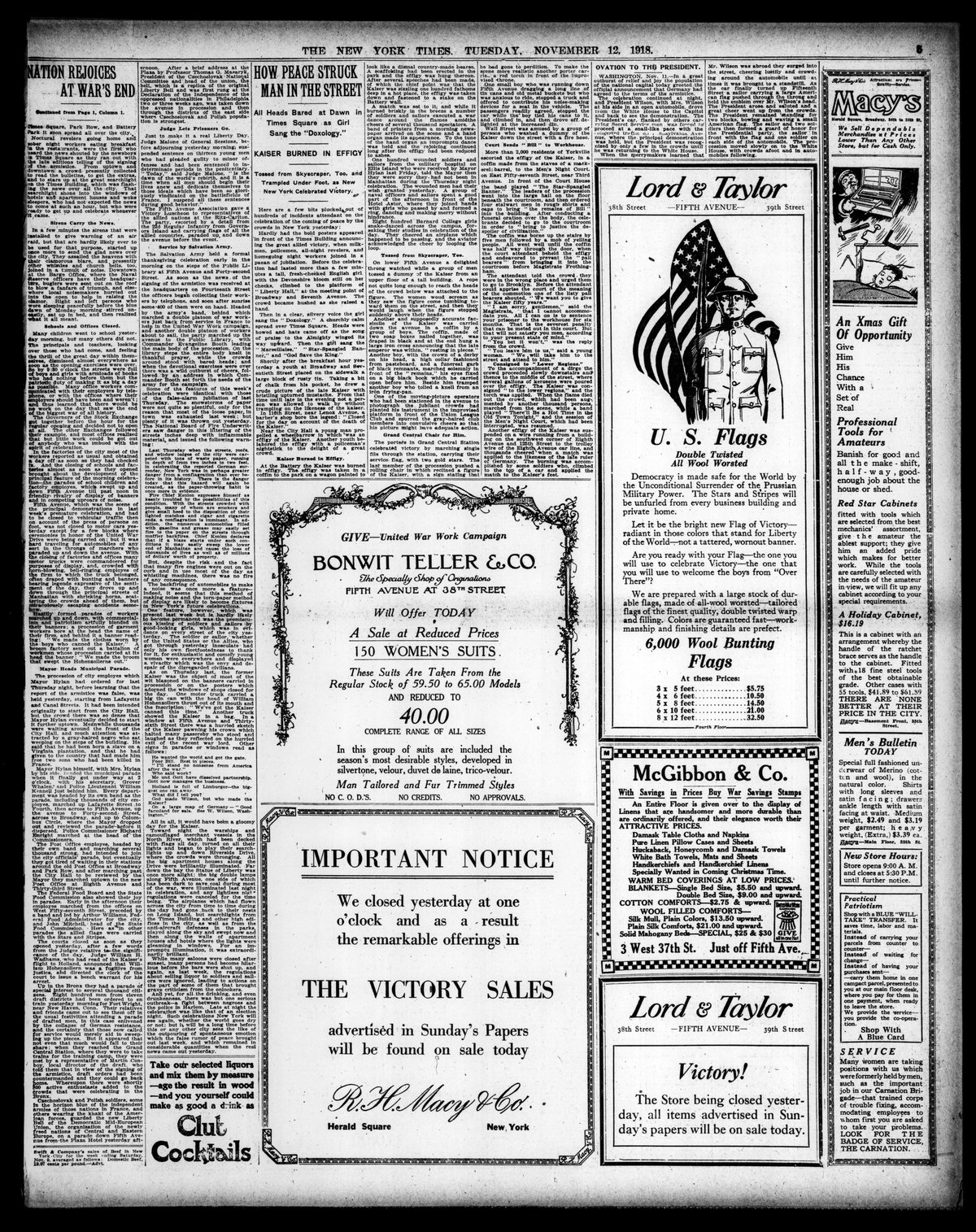
The New York Times, 12 November 1918, p. 5
The report describes schoolchildren and factory workers parading along Fifth Avenue beyond noon, with banners and competing noise. It places celebration on the avenue, but does not identify Bernstein or her particular group of soldiers.
The same issue’s weather column reports a local Weather Bureau office low of 38 °F and high of 48 °F, for the twenty-four hours ended at 11 P. M.. Read the thermometer report.
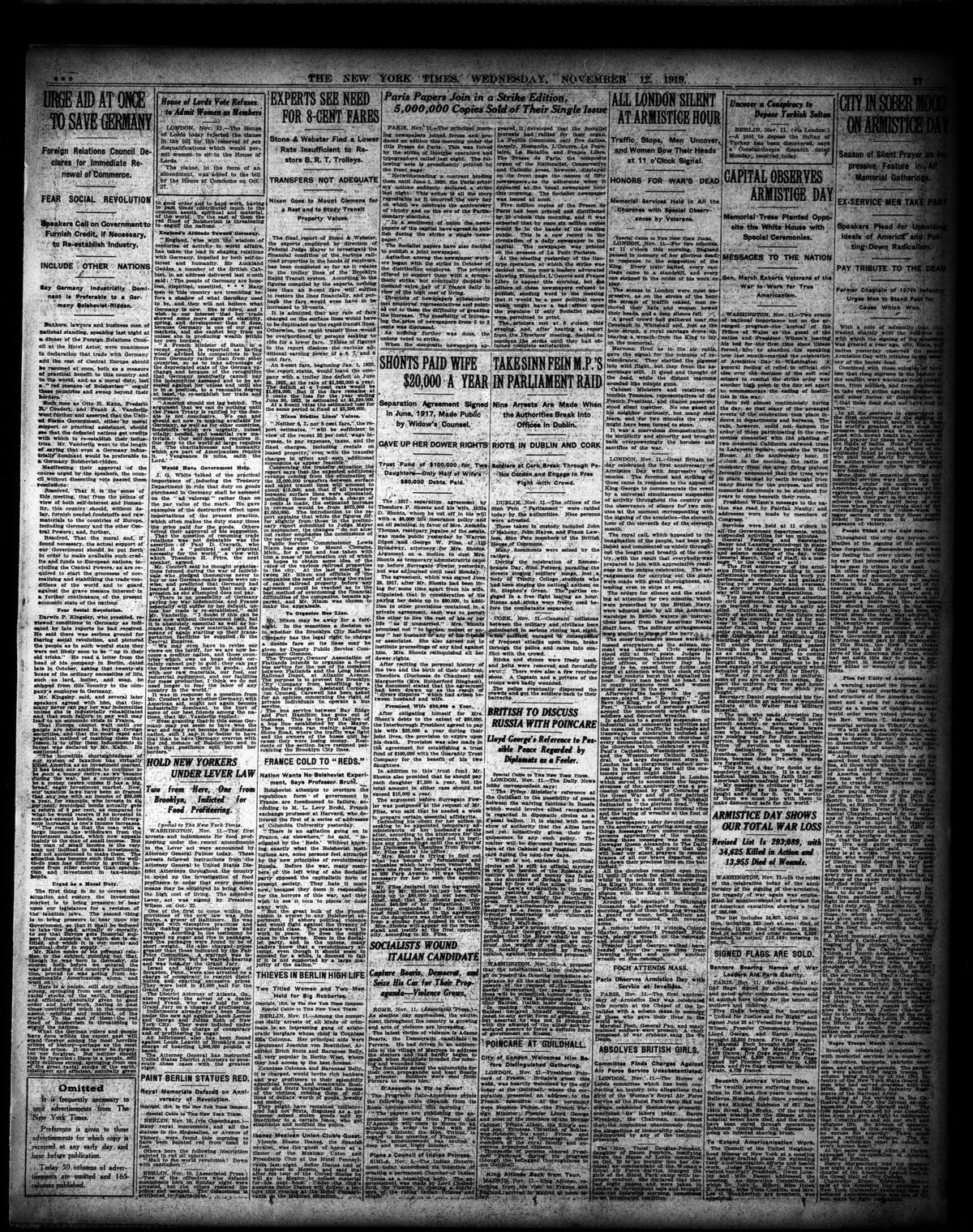
“CITY IN SOBER MOOD ON ARMISTICE DAY”
The New York Times, 12 November 1919, p. 17
The report contrasts the anniversary’s solemnity with the previous year’s joy. It records memorial meetings across the city and a military parade in Brooklyn. It does not establish a parade past this altar, or prove that none occurred.
The same issue’s weather column reports a local Weather Bureau office low of 47 °F and high of 54 °F, for the twenty-four hours ended at midnight. Read the thermometer report.
The newspaper places its thermometer 414 feet above street level. It is a separate office record, with different exposure and reporting periods, not another extraction of Central Park. The two station records are kept separate. No local rain amount or parade-hour sky description is transcribed from these newspaper columns.
Step 4 · Test the attribution
What does the altar settle?
The New York Times of 29 September 1918, p. 1, reports that “the Altar of Liberty was dedicated by Vice President Marshall.” Its account of the previous day places the dedication in Madison Square on 28 September 1918. The structure was therefore erected by that date, before both candidate occasions.
A verified removal date has not been established. Nor have we found an independent, day-specific witness placing this particular altar on the avenue on either candidate day. Its September dedication and Smith’s 1918 attribution make the 1918 setting plausible, but dedication alone does not prove continuing presence. Its presence on 11 November 1919 remains unknown.
The balance of the checked contextual evidence favours 1918, without deciding the event year. The current object label and the newspaper’s Fifth Avenue celebrations point that way. The 1919 account centres on remembrance and locates its military parade in Brooklyn. But these selected articles are not a complete inventory of parades, and neither identifies the composition. Weather supplies two different settings; it cannot settle the conflicting museum accounts.
For a source-criticism exercise, separate three questions: what dates the canvas, what dates the occasion, and what identifies the pictured monument on that day? A dated artist passage tied to this composition, an object-file clarification, or a securely located removal notice could change the result. For now, Bernstein’s simplification of the monument is documented; a change to the sky is not.
Sources
Every source on this page
Each file was downloaded and given a fingerprint (its sha256). The page is rebuilt from these files and will not build if a fingerprint changes, so every number above comes from them rather than being typed in.
- Smith College Museum of Art, SC 2015.42, object record and Label Text
sha256 825af23c8afae755ea64be2422cd787b1cdef39250cb0dd6fc0869cdc1e7f490 - Danielle Carrabino, Theresa Bernstein at the SCMA, 9 November 2018
sha256 35e16ce8d396aeb2e50cb131f2c47fd94cea38bab3023a515034f2a910437174 - SCHEMA 2015–2016, Highlight: Bernstein, printed p. 54 / PDF p. 29
sha256 5fc24d7c7474089099a3a442828fff0b5016c577e88e077cdad5c29a7fb797e9 - Text extracted from SCHEMA with PyMuPDF
sha256 351e1fbdaeeeaf145945a4a9cad55df66e303b50f80c856d94143b507f6147c0 - SCMA, Accessing the Collection: image and copyright policy
sha256 23fb690535f38d306faf5ab0d7b87bda02b882ca7f7ea6628774b6fc4fdb6ed2 - GHCN-Daily, USW00094728, NY CITY CNTRL PARK
sha256 1a818a7247ca0742c6001808a064c9a019b737d356f394644a995be7b5c70078 - GHCN-Daily current station metadata
sha256 428eabc955883187935bce283766d5646e3ed7484b92eb0803874c0e8dd9b342 - GHCN-Daily format and flags, version 3.35
sha256 0e4e6f0e6947cf1add884c328a01760f31c56ef5fb86b85ed57dd5dc4c4aeaa6 - NWS, History of New York City Weather Observations
sha256 d8025ed80528d03d79a58a244cd7a79b2b9cafa5edab542200b0df60c17a2a63 - NWS Cooperative Observer, spring 2019, Central Park history, p. 3
sha256 0c30de29365f4a9b545a7ab0278f4210b44adc3b184dab433a21f2ad46a2cafc - Text extracted from NWS station history with PyMuPDF
sha256 3c222a7d3eb66a84587a1385d3cf6ebb4d7c316ac5b017c0a472add0754df510 - OpenStreetMap / Nominatim: osm-arsenal-building.json
sha256 ea0cc4613306516ec74b3f8167b43c06158a7a800509a8dd9961203b9b683880 - OpenStreetMap / Nominatim: osm-madison.json
sha256 f6293469b0171b60fd47764cf52c1ca7e1540754bd55fc1a485e80122b3b87dc - Library of Congress, World War I Armistice research guide
sha256 c4f72266d6d3490e89a89b85998c61313d9389d85776cdf1d002fb56d81ab26e - Nephos selected newspaper transcriptions, with individual scan locators
sha256 831778164edd14ed2d7279df8e9bf15c4cf10c5a18b27d29e37f6de153e27d38 - The New York Times, 1918-09-29, p. 1: column 1, New York Takes $200,000,000 Bonds First Day of Drive
sha256 9e066c5fe5d3a3d0666dba6a7429a90487d622a507bc771ac09c5be0671ee4d7 - The New York Times, 1918-11-12, p. 5: column 1, Nation Rejoices at War’s End, continued from p. 1
sha256 9b56d7ce59a3477650d45f79d770ce1c4bbadafb4263b51011adf564a823aaf2 - The New York Times, 1919-11-12, p. 17: column 8, City in Sober Mood on Armistice Day
sha256 f2a6b9222e84666c1763df1b5a10ab94d125ddbabc9a479dddfe0b78c98db31e - The New York Times, 1918-11-12, p. 23: column 7, The Weather, local thermometer paragraph
sha256 0429d7f96d636cef02d9eb0e598270dbf93616b2120678454d3d6ca5d2771257 - The New York Times, 1919-11-12, p. 31: column 7, The Weather, local thermometer paragraph
sha256 e081ce423978ea1bc5c6cb5ca53a694e8305c959c510124bf56ecb3d465269b5