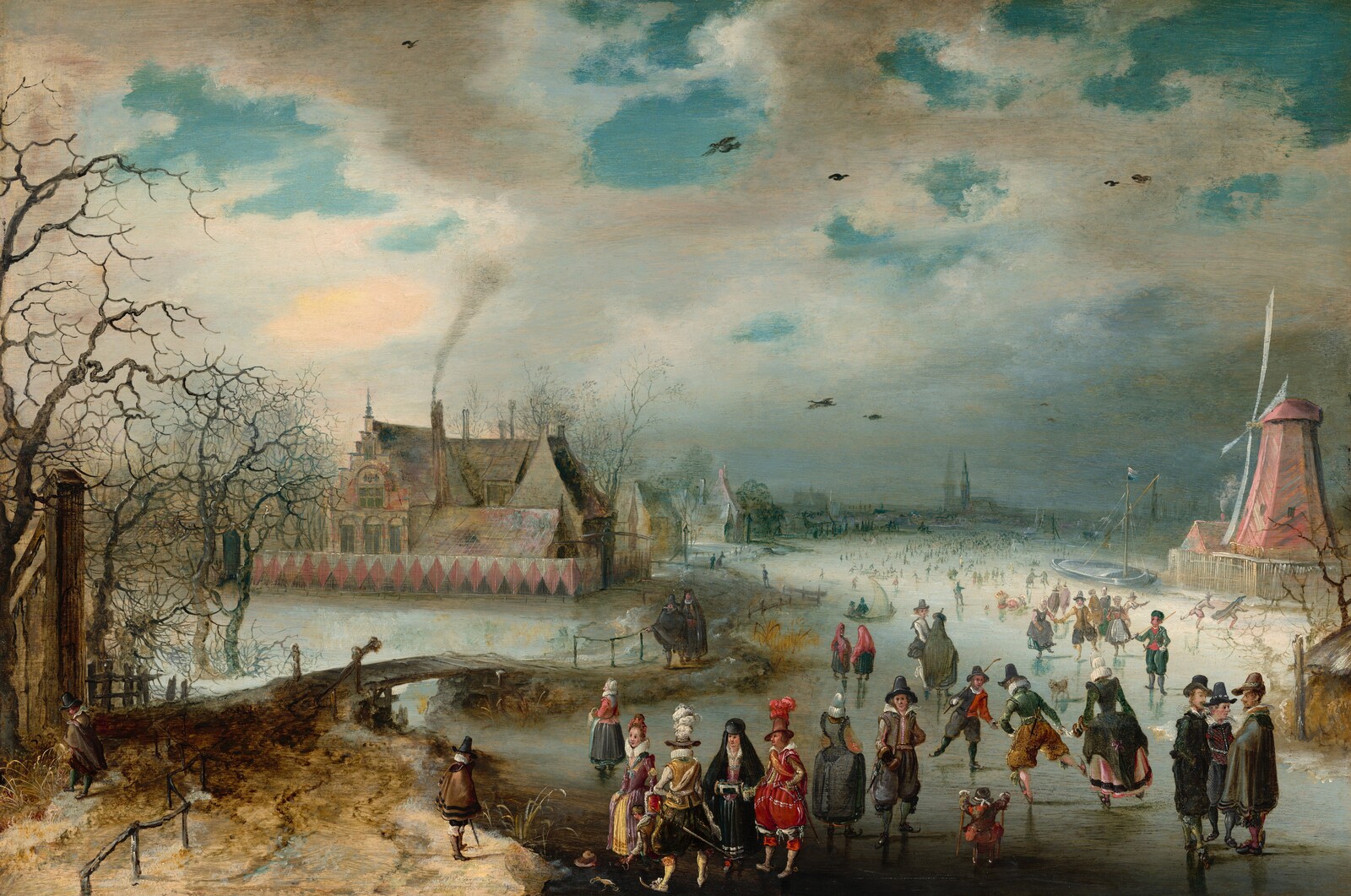
A study against the weather record
Adam van Breen
Skating on the Frozen Amstel River
Van Breen painted “16011”, read as 1611, on the gable of this house portrait on the ice. Do the Low Countries winter records around that year show the severe winters the NGA links to skating scenes?
Chilly winters around 1611Painted day unknown
The Nephos method
How this study was read
The method in fullWhat is written
Dated “16011” on the gable of the house, read by NGA as 1611. The catalogue identifies the Amstel just south of Amsterdam and links skating scenes to severe winters; an NGA article places the panel amid chilly winters. The date fixes the making, not the winter shown.
on gable of manor house: 16011
NGA object record, Inscriptions.likely in part due to a series of severe winters in the Low Countries
Libby (2017), on why skating scenes were popular in the first half of the century.amid a sequence of chilly winters in the Low Countries
Degroot, NGA (2023), on Van Breen’s painting.winter was even colder
Degroot, NGA (2023), on 1646, the year of Van Goyen’s NGA ice scene.
Records of those days
- KNMI winter categories, Low Countries (van Engelen, Buisman and IJnsen)A documentary reconstruction compiled by historians for the November–March season, one category per winter. Regional, not an observation on the Amstel.
- David Fabricius’s diary at Osteel, counted by Lenke (1968)Frost days by month from a written diary about 205 km north-east of Amsterdam. It also fed the KNMI estimates for these years.
Not found or not yet searched
- No thermometer or daily register for Amsterdam in 1610–11 has been found; KNMI’s inventory of Dutch instrumental series starts at the end of the 17th century.
- No source consulted records ice on the Amstel in a particular week of 1610–11, or dates any session on the panel.
- Buisman’s descriptive volume for 1575–1700 and the Landsman articles were not consulted; the NGA systematic catalogue entry was.
Each claim tested
- Were the winters on either side of the date severe? No. KNMI classes 1610–11 and 1611–12 as 6, “Cold”, one step below “Severe”. The last “Very severe” winter before the date was 1607–08.
- Was the panel made amid a sequence of chilly winters? Yes in this classification: 3 consecutive winters, 1609–10 to 1611–12, are category 6 or colder.
- Was 1646 colder still? The winter ending in 1646 is 7, “Severe”, one step above 1610–11. The winter that began late in 1646 returns to 6.
- Did severe winters recur in the first half of the century? 9 of 50 winters in 1601–1650 are “Severe” or harsher, against 16 of 50 in 1651–1700. None in 1601–1650 is milder than “Fairly mild”.
- What did one observer count? Fabricius’s diary gives 58 frost days for 1610–11, rank 12 of 19 winters, most first; January 1611 alone had 22.
Verdict
The reconstruction supports a run of chilly winters around the date, as the NGA article says, and a frost spell from late December 1610 into January 1611 in East Frisia. It does not show a severe winter in 1611, and nothing dates the ice in the picture.
- Partially agreesA sequence of chilly winters around 1611 Three consecutive “Cold” winters in a regional documentary reconstruction; not an observation at Amsterdam.
- Partially agreesA series of severe winters behind skating scenes Severe winters recur in 1601–1650, but more fall in 1651–1700; weather records cannot test why the scenes sold.
- UnknownThe painted day and the Amstel’s ice The date fixes the making of the panel. No record links the scene to a particular winter or week.
What this cannot tell you. KNMI C_win: a nine-step documentary classification of the November–March season for the Low Countries, from 1 (extremely mild) to 9 (extremely severe). It is compiled evidence, not an observation at Amsterdam. The classification divides the 284 instrumental winters of 1707–1990 symmetrically around 5; its printed frequencies are reproduced by the file’s own 1707–1990 rows. The reference period itself lies largely within the Little Ice Age. Fabricius frost days are Lenke’s counts from a written diary, including days inferred within frost spells; they are not thermometer readings. The Lenke pages consulted do not state whether diary dates were converted between calendars. A ten-day Julian offset would move the 23 December–26 January spell to about 2 January–5 February. Lenke counts are from Osteel, East Frisia, about 205 km from Amsterdam, and they contributed to the KNMI estimates for 1591–1613. The NGA entry suggests the Zuiderkerk tower may have been revised after its spire was added in 1614, so work on the panel may not be confined to 1611.
Step 1 · The picture and its making
A house portrait on the ice
Van Breen fills the frozen Amstel with fashionable skaters, a boy on a push sled, an orphan with a colf stick and an iceboat under sail. In the NGA catalogue Alexandra Libby identifies the site: the river just south of Amsterdam, with the Nieuwe Kerk, the Oude Kerk and the new Zuiderkerk on the horizon. The mill at right matches a sawmill on Cornelis Danckertsz de Rij’s 1629 map. The house at left, with its stepped gable and painted fence, is identified as the Borssenburg estate. Its owner, the gunpowder maker Abraham Verbeeck, probably commissioned the picture as a portrait of his house in a festive winter setting.
The entry reads the weather in the panel as part of its subject: a bright winter day, with wind carrying chimney smoke, lifting flags and filling the iceboat’s sail. It also calls the house a character in a “carefully orchestrated composition”. The technical summary records reserves left for sections of the house, the windmill and the bridge, so these were planned before the surrounding paint was laid in. Nephos reads it as a studio composition built around a real place, not a record of one afternoon.
“on gable of manor house: 16011”
NGA object record, Inscriptions
“there is no reason to doubt that the painting’s date is 1611”
Libby (2017), note 3, on the unusual “0” inside the date
What the date fixes. A signature date dates the making of the panel, not the winter it shows. The calendar year 1611 touches two winters: November 1610 to March 1611, and the season that began in November 1611. The scene could also draw on earlier winters, on drawings or on the conventions of the genre. The entry adds a further caution: the blue of the Zuiderkerk tower may be a revision made after the spire was added in 1614. Van Breen also dated a second ice scene 1611, now in the Rijksmuseum, signed on an iceboat’s flag. The study therefore asks about the winters around the date. It does not ask which day is shown.
Step 2 · The Low Countries reconstruction
Cold winters around the date, but not severe ones
The record here is KNMI’s winter series for the Low Countries, gathered by J. Buisman and described by A. F. V. van Engelen, Buisman and F. IJnsen. It is compiled evidence, not an observation on the Amstel. Their 2001 chapter explains how each November–March season was scored on three aspects (temperature, duration and intensity of frost) from historical descriptions, then placed in one of nine categories. The categories are defined from the 284 instrumental winters of 1707–1990. For 1591–1613 the chapter lists Fabricius’s East Frisian frost counts among the contributing series.
The winter of 1610–11 is category 6, “Cold”, one step below “Severe”. So is 1611–12. Together with 1609–10 they make 3 consecutive “Cold” winters. The last “Very severe” winter before the date was 1607–08; the next “Severe” one came in 1617–18.
Testing the NGA’s statements. Dagomar Degroot’s 2023 NGA article says Van Breen painted “amid a sequence of chilly winters in the Low Countries”. The reconstruction supports that wording: the run of “Cold” winters is there. He adds that in 1646, when Van Goyen painted his NGA ice scene, “winter was even colder”. The Van Goyen panel is dated 1646 on a boat. The winter ending in 1646 is category 7, “Severe”, one step colder; the season that began late in 1646 returns to 6.
The catalogue entry explains the popularity of skating scenes as “likely in part due to a series of severe winters in the Low Countries”. Severe winters did recur: 9 of the 50 winters in 1601–1650 are “Severe” or harsher, and none is milder than “Fairly mild”. But the next half-century has more: 16 of 50. If the genre was strongest in the first half of the century, its popularity did not simply follow the count of severe winters. Weather records cannot test why buyers wanted these pictures.
| Winters | Basis | Count | Severe or harsher | Cold (6) | Mild or milder | Mean category |
|---|---|---|---|---|---|---|
| 1551–1600 | Documents | 50 | 11 | 15 | 2 | 5.62 |
| 1601–1650 | Documents | 50 | 9 | 16 | 0 | 5.50 |
| 1651–1700 | Documents | 50 | 16 | 13 | 4 | 5.72 |
| 1707–1990 | Thermometers | 284 | 44 | 62 | 45 | 5.00 |
| 1951–2000 | Thermometers | 50 | 5 | 9 | 16 | 4.34 |
The 1707–1990 row is the classification’s own reference. Its counts reproduce the chapter’s printed frequencies, a check on how the file is read. That reference period is itself largely within the Little Ice Age, so “Normal” here is not a modern normal. Rows before 1707 rest on documents; later rows rest on thermometer-based frost indices. The change of evidence is a limit on every comparison across 1700.
Every winter in the chart, with the line as stored in the KNMI file
| Winter | Category | Definition | KNMI file line (year, winter, summer, winter °C, summer °C, year °C) |
|---|---|---|---|
| 1594–95 | 8 | Very severe | 1595, 8, 5, -16, 160, 75 |
| 1595–96 | 5 | Normal | 1596, 5, 4, 20, 156, 88 |
| 1596–97 | 5 | Normal | 1597, 5, 3, 20, 153, 86 |
| 1597–98 | 6 | Cold | 1598, 6, 5, 16, 163, 89 |
| 1598–99 | 6 | Cold | 1599, 6, 6, 12, 167, 90 |
| 1599–00 | 7 | Severe | 1600, 7, 3, 1, 151, 77 |
| 1600–01 | 7 | Severe | 1601, 7, 4, -14, 155, 74 |
| 1601–02 | 6 | Cold | 1602, 6, 5, 12, 163, 88 |
| 1602–03 | 6 | Cold | 1603, 6, 6, 8, 166, 88 |
| 1603–04 | 5 | Normal | 1604, 5, 6, 20, 168, 94 |
| 1604–05 | 4 | Fairly mild | 1605, 4, 5, 29, 160, 93 |
| 1605–06 | 5 | Normal | 1606, 5, 4, 23, 155, 89 |
| 1606–07 | 4 | Fairly mild | 1607, 4, 5, 38, 162, 98 |
| 1607–08 | 8 | Very severe | 1608, 8, 4, -20, 159, 73 |
| 1608–09 | 4 | Fairly mild | 1609, 4, 5, 38, 160, 97 |
| 1609–10 | 6 | Cold | 1610, 6, 5, 14, 164, 89 |
| 1610–11 | 6 | Cold | 1611, 6, 5, 14, 162, 88 |
| 1611–12 | 6 | Cold | 1612, 6, 5, 7, 164, 86 |
| 1612–13 | 4 | Fairly mild | 1613, 4, 5, 30, 161, 94 |
| 1613–14 | 6 | Cold | 1614, 6, 3, 12, 150, 81 |
| 1614–15 | 6 | Cold | 1615, 6, 6, 12, 169, 91 |
| 1615–16 | 6 | Cold | 1616, 6, 7, 11, 173, 93 |
| 1616–17 | 4 | Fairly mild | 1617, 4, 3, 38, 152, 93 |
| 1617–18 | 7 | Severe | 1618, 7, 3, 1, 150, 77 |
| 1618–19 | 5 | Normal | 1619, 5, 5, 26, 161, 92 |
| 1619–20 | 7 | Severe | 1620, 7, 5, 2, 160, 82 |
| 1620–21 | 8 | Very severe | 1621, 8, 2, -18, 145, 67 |
| 1621–22 | 6 | Cold | 1622, 6, 4, 12, 158, 85 |
| 1622–23 | 5 | Normal | 1623, 5, 6, 18, 166, 92 |
| 1623–24 | 7 | Severe | 1624, 7, 7, 2, 172, 88 |
| 1624–25 | 5 | Normal | 1625, 5, 4, 18, 158, 87 |
| 1625–26 | 5 | Normal | 1626, 5, 4, 23, 159, 90 |
| 1626–27 | 6 | Cold | 1627, 6, 3, 15, 148, 82 |
| 1627–28 | 5 | Normal | 1628, 5, 1, 19, 140, 79 |
| 1628–29 | 4 | Fairly mild | 1629, 4, 7, 29, 173, 100 |
| 1629–30 | 4 | Fairly mild | 1630, 4, 6, 36, 169, 101 |
| 1630–31 | 5 | Normal | 1631, 5, 7, 24, 173, 98 |
| 1631–32 | 4 | Fairly mild | 1632, 4, 4, 36, 158, 95 |
| 1632–33 | 4 | Fairly mild | 1633, 4, 4, 30, 154, 91 |
| 1633–34 | 6 | Cold | 1634, 6, 5, 5, 160, 84 |
| 1634–35 | 7 | Severe | 1635, 7, 6, -2, 167, 84 |
| 1635–36 | 5 | Normal | 1636, 5, 7, 21, 172, 96 |
| 1636–37 | 5 | Normal | 1637, 5, 7, 27, 175, 100 |
| 1637–38 | 6 | Cold | 1638, 6, 6, 10, 169, 90 |
| 1638–39 | 5 | Normal | 1639, 5, 5, 28, 162, 94 |
| 1639–40 | 5 | Normal | 1640, 5, 5, 17, 162, 89 |
| 1640–41 | 6 | Cold | 1641, 6, 5, 15, 161, 88 |
| 1641–42 | 4 | Fairly mild | 1642, 4, 4, 28, 158, 92 |
| 1642–43 | 5 | Normal | 1643, 5, 5, 26, 164, 94 |
| 1643–44 | 6 | Cold | 1644, 6, 6, 12, 169, 91 |
| 1644–45 | 6 | Cold | 1645, 6, 6, 16, 169, 92 |
| 1645–46 | 7 | Severe | 1646, 7, 7, 1, 171, 87 |
| 1646–47 | 6 | Cold | 1647, 6, 5, 12, 164, 88 |
| 1647–48 | 4 | Fairly mild | 1648, 4, 4, 35, 155, 93 |
| 1648–49 | 7 | Severe | 1649, 7, 3, 3, 152, 79 |
| 1649–50 | 5 | Normal | 1650, 5, 4, 26, 154, 89 |
The temperature columns are the reconstruction’s estimates, stored without a decimal point; they are not used on this page.
Step 3 · One observer’s winter
A month of frost in East Frisia
The daily weather notes used here are not Dutch. The pastor and astronomer David Fabricius kept a diary at Osteel in East Frisia, about 205 km north-east of Amsterdam. Walter Lenke’s 1968 study for the German weather service counted its frost days month by month. These counts come from written remarks, including days Lenke judged frosty within a frost spell. They are not thermometer readings.
Lenke’s account of the diary has frost from 23 December 1610 to 26 January 1611, broken only by rain on 3 January and 12–14 January, with snow several times. January 1611 has 22 frost days, against a 1593–1612 January mean of 13.3. Only January 1608 has more; 1599 has the same. Milder weather set in on 27 January, and February has 6, fewer than 17 of the 20 Februaries.
“das seit dem 23. XII. andauernde Frostwetter”
the frost weather lasting since 23 December
Lenke (1968), p. 27, on January 1611 in Fabricius’s diary. Translation by Nephos.
Over the whole winter the diary gives 58 frost days, rank 12 of 19 winters, most first, tied with 1601–02. The median is 69. The winter after the date had 80; 1607–08 had 96. So the diary shows a hard January inside an otherwise moderate winter.
| Winter | Fabricius frost days | Pilgram | Easton | KNMI |
|---|---|---|---|---|
| 1607–08 | 96 | 1608 ungemein kalter Winter | Grand Hiver | 8 · Very severe |
| 1609–10 | 70 | — | normal pl. froid | 6 · Cold |
| 1610–11 | 58 | 1611 kalter Winter | tiède | 6 · Cold |
| 1611–12 | 80 | 1612 kalter Winter | normal pl. froid | 6 · Cold |
The compilations do not agree on 1610–11. Pilgram calls 1611 a cold winter, Easton “tiède” (lukewarm), and KNMI “Cold”. KNMI used Fabricius’s counts for these years, so the diary is not an independent check on its category.
All 19 winters in Lenke’s table
| Winter | Frost days | Pilgram | Easton | KNMI |
|---|---|---|---|---|
| 1593–94 | 47 | 1594 sehr kalter Winter (1595?) | normal | 5 · Normal |
| 1594–95 | 88 | — | très rigoureux | 8 · Very severe |
| 1595–96 | 53 | — | tiède | 5 · Normal |
| 1596–97 | 60 | — | normal | 5 · Normal |
| 1597–98 | 72 | — | normal pl. froid | 6 · Cold |
| 1598–99 | 69 | 1599 kalter Winter (1600?) | normal | 6 · Cold |
| 1599–00 | 86 | — | froid | 7 · Severe |
| 1600–01 | 99 | 1601 große Kälte | normal (!!) | 7 · Severe |
| 1601–02 | 58 | — | tiède | 6 · Cold |
| 1602–03 | 79 | 1603 große Kälte | froid | 6 · Cold |
| 1603–04 | 75 | 1604 langer und strenger Winter | tiède | 5 · Normal |
| 1604–05 | 47 | — | normal | 4 · Fairly mild |
| 1605–06 | 55 | 1606 kalter Winter | froid | 5 · Normal |
| 1606–07 | 35 | — | tiède | 4 · Fairly mild |
| 1607–08 | 96 | 1608 ungemein kalter Winter | Grand Hiver | 8 · Very severe |
| 1608–09 | 38 | — | doux | 4 · Fairly mild |
| 1609–10 | 70 | — | normal pl. froid | 6 · Cold |
| 1610–11 | 58 | 1611 kalter Winter | tiède | 6 · Cold |
| 1611–12 | 80 | 1612 kalter Winter | normal pl. froid | 6 · Cold |
Each printed winter total equals the October–May cells of Lenke’s monthly table. One monthly row, 1594, sums to 71 against a printed 72; that year is not used here.
Step 4 · Where the records stop
Cold winters around the date; no day on the ice
The records support part of what the NGA has written. Around 1611 the Low Countries reconstruction has a run of “Cold” winters, as Degroot says. One observer in East Frisia logged a month of frost from late December 1610. Neither source shows a severe winter in 1610–11, and neither can say when the Amstel froze, how long the ice held, or what the sky was like over Borssenburg.
No instrumental record reaches back this far. KNMI’s inventory of early Dutch observations begins with a Leiden series of 1697–1698, and its first long series runs from 1706. No daily register for Amsterdam in 1610–11 was found. The next sources to read are Buisman’s descriptive volume for 1575–1700, cited by KNMI, and Rozemarijn Landsman’s 2011 article on Borssenburg. Neither was consulted for this study.
The panel’s bright day and brisk wind remain the painter’s choices within a commissioned composition. The records establish the kind of winters Van Breen lived through. They do not show that he painted any one of them.
Sources
Every source on this page
Winter categories are read from the KNMI file and frost-day counts from a scan-checked transcription of Lenke’s tables, both tied to sha256 fingerprints. The NGA pages were saved as served inside a browser session, because direct requests return 403. Quoted phrases are checked against these texts. A fingerprint preserves the version used; it does not independently validate the historical interpretation.
- Alexandra Libby, “Skating on the Frozen Amstel River, 1611,” Dutch Paintings of the Seventeenth Century, NGA online edition (2017)
sha256 c99c4560879c4e66db820a5a8d926bf372d5758b1d765e26e11b2d4173ffd19d - National Gallery of Art, 2010.20.1: object record
sha256 eb1371e4bbb3d54e4bb5e4ce7c7a2d59264a135e4b978e2b07c7c209ec4308b7 - National Gallery of Art, Open Access Policy
sha256 1f93fe7ce9cb282d15da0dc3473b69abfa47b0df8bf337d3f71896b050b0b7a0 - NGA, Skating on the Frozen Amstel River, 2010.20.1, 1600-pixel image
sha256 94b509721e8cfb809c42cb066d4842d89624fd9fc32d1fc4c56e86a01d2cbb55 - Dagomar Degroot, “Painting Climate Change in the 17th Century,” NGA, 10 April 2023
sha256 df2c0497eef52a007afcc1a31cb374de034ede6636cf8a0228b3cbfd4c4f5371 - National Gallery of Art, 2014.35.1: Jan van Goyen, Ice Scene near a Wooden Observation Tower
sha256 760909555469011717bc2f2cf6303fb628e472511d6baffe9a887cb128a9a3b8 - Rijksmuseum, SK-A-2510: Adam van Breen, Landscape with Frozen Canal, Skaters and an Ice-Boat
sha256 17f206c49329335802c085029f38ad95b082e1f513829544316416c6c4c283e6 - KNMI, Nederland winter-zomer 751–2000 (data gathered by J. Buisman; described by A. F. V. van Engelen, J. Buisman and F. IJnsen)
sha256 a5d97caee7d66ce417a41e50e763f203acb007b5774ff9c82fc55d7c2e934e03 - KNMI, Klimatologie: Antieke waarnemingen
sha256 c6b0efdf7a398600cac08e4e80a113355ae3c1e10a7835c6e74a98e7ad604835 - van Engelen, Buisman and IJnsen, “A Millennium of Weather, Winds and Water in the Low Countries” (2001), KNMI copy
sha256 4e5f9fa5283870f5e289bd49cc89640f6382ce2b5830c637354bad57e70403f8 - Nephos transcription of Table 2 and method passages from the 2001 chapter
sha256 f274faad65f1533716f2b2c65af51078fe782db3081d90bf058e744142432b1f - KNMI publication record for the 2001 chapter
sha256 1ece1b42a2b4b3c04dfd0db90499b6191c72899765e048717cc299706c9503b4 - Walter Lenke, Das Klima Ende des 16. und Anfang des 17. Jahrhunderts … David Fabricius in Ostfriesland, Berichte des Deutschen Wetterdienstes 110 (1968)
sha256 3132f4239795a1bc2fa26de96dad20e0292c91200c452b8f6f391a121f90941d - Lenke (1968), p. 27, text layer extracted with pdftotext 26.04.0
sha256 baabd7dd819836ca1bfa50a4a958b4a82782f29605f00b4c2bcc8d95b008a31f - Lenke (1968), pp. 7–12, text layer extracted with pdftotext 26.04.0
sha256 36d9edcbbefebb5c771772dc635df4158b15c3ac1129a7e64bfeb1e40ac97211 - Nephos transcription of Lenke’s Tab. 5 c and 5 d and the 1610–11 narrative
sha256 4f651f3082a657ebbcaf54f72da966c54430161152d27bb83d7dabcb5372b4fe - OpenStreetMap, Osteel (village boundary point)
sha256 90159f80837d14a3cac2ac6a38f5d4d5723a097a2e41d1235a2eabe5f1d95c71 - OpenStreetMap, Amsterdam (city point)
sha256 a586872e21d51288d421bf3b8f4cf83b1d646a9175cae061e1d3c6ad132048e2
