A study against the weather record
Abbott Handerson Thayer
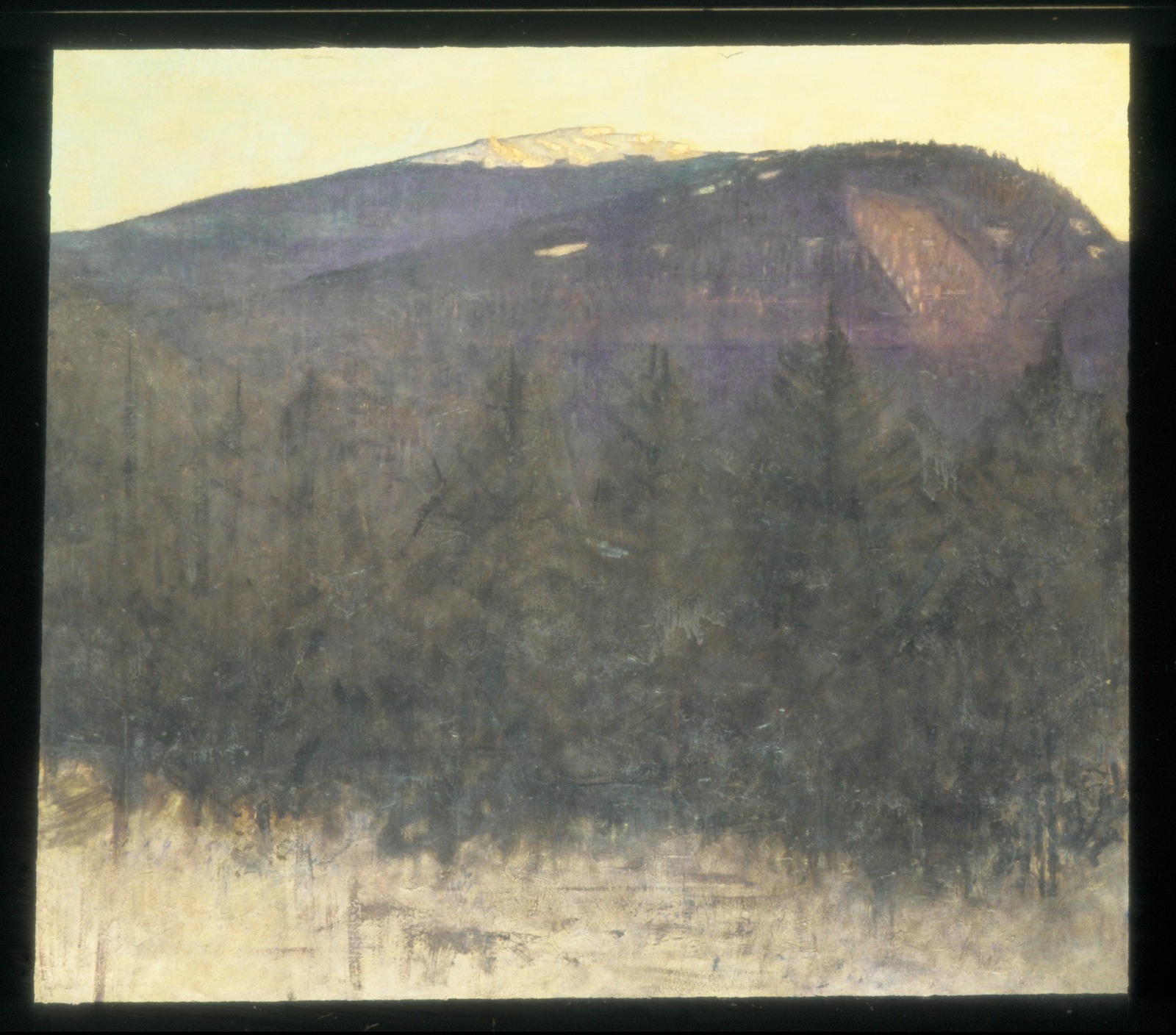
Winter Sunrise, Monadnock
A winter sunrise, completed in October. What can the records say about the scene—and what belongs to a repeated studio subject?
Execution week documentedPainted morning unknown
The Nephos method
How this study was read
The method in fullWhat is written
The Met dates this version to the third week of October 1917 from Emma Thayer’s letter. The study interprets that as 15–21 October: a window for execution, not a dated winter sunrise.
Records of those days
- Keene daily high and low temperaturesAll 7 days present, quality flags blank; checked against the 1917 printed table. Daily extrema are not sunrise readings.
- New England climatological report, October 1917Keene reports 0 inches of snowfall for the whole month. The regional summary reports snow farther north on 12 October; Monadnock is not named.
- Daily weather maps and a computed sunriseAlbany and Boston sky symbols at 8 a.m. EST; Dublin sunrise computes to 06:01–06:08 EST. Different places and times.
Not found or not yet searched
- No verified summit snow or local sunrise cloud record.
- Dublin and Peterborough files contain no 1917 rows.
- The exact easel site, depicted day and horizon are unknown.
Each claim tested
- Does October rule out a winter subject? No. The catalogue documents a recurring theme and studio variants. Execution and depicted season need not coincide.
- Do the temperatures prove snow? No. Keene reaches 22 °F, but frost temperatures do not establish snowfall or snow cover on Monadnock.
- Can a clear sunrise be identified? No. Clear symbols occur at both selected regional stations on 16, 17, 21 October, at a later hour. The mountain sky remains unknown.
Verdict
The week includes cold minima and clear regional mornings, but the records do not identify the painted sunrise or establish snow on Monadnock. The strongest explanation of the October/winter distinction is the documented history of a repeated subject.
- UnknownSnow on Monadnock in the execution week Keene’s snowfall and regional snow reports do not measure the summit.
- UnknownThe painted sunrise No depicted day, local sky observation or verified easel bearing.
What this cannot tell you. The third week is interpreted as 15–21 October; the letter’s full wording has not been checked in the archive. The cold daily minima may precede the reporting date and are not timed observations of dawn. Solar times assume a level horizon; the mountain and intervening terrain can delay visible sunlight. A 1980 catalogue illustration is horizontally reversed relative to the current Met image. The current image is retained without flipping; no compass direction is inferred from it.
Step 1 · The picture and its making
A winter subject, an October canvas
A pale sky, a blue-violet mountain and dark evergreen branches: Nephos’s visual reading of the Met’s current reproduction. Snow appears across the foreground and mountain. These painted forms are the subject to investigate; they are not measurements of snow depth or cloud cover.
The Met identifies the work as Winter Sunrise, Monadnock, 1917. The 1980 collection catalogue records Thayer’s move to Dublin in 1892 and his repeated treatment of the mountain. It quotes his letter to George de Forest Brush, dated 6 January 1917, calling the subject my old theme
. The letter expresses a wish for flatter colour and fewer half-tones, with Japanese prints as a comparison.
Emma Thayer’s letter to John Gellatly of 26 November 1917 supplies the date basis: third week of October 1917
, in the catalogue’s account. This study uses 15–21 October as a calendar interpretation. The original letter has not been inspected. The week concerns this version’s execution; it does not date the sunrise represented.
The catalogue connects this painting with studio variants dated 1918 and 1919 and describes its comparatively reduced forms. It also records older catalogues that misdated this work to 1918. The current 1917 date has the stronger documentary basis. The title and execution month therefore need not describe the same season of observation.
Step 2 · The nearby thermometer
Cold minima, without proof of mountain snow
Keene’s daily record reaches a low of 22 °F and a high of 68 °F during the selected week. The minima fall below freezing on 17 and 21 October. The chart shows each date separately. These are daily extrema, not readings at the moment of sunrise.
All high and low values are present with blank archive quality flags. The whole-degree Fahrenheit figures reproduce the printed Keene row after conversion from NOAA’s tenths of a degree Celsius. The exact historical instrument site and exposure have not been established; Keene cannot stand in for the mountain.
| Date | Minimum | Maximum |
|---|---|---|
| 15 October | 37 °F | 61 °F |
| 16 October | 32 °F | 62 °F |
| 17 October | 25 °F | 57 °F |
| 18 October | 38 °F | 59 °F |
| 19 October | 50 °F | 68 °F |
| 20 October | 40 °F | 66 °F |
| 21 October | 22 °F | 57 °F |
The printed monthly report gives Keene 0 inches of snowfall for all of October. That is a station snowfall report, not a mountain snow-depth measurement. The GHCN daily file has no snow entries for this month; those missing entries remain unknown. The monthly zero comes from the separate printed table.
The same report documents snow in northern New Hampshire, northern Maine and mountain areas of northeastern Vermont on 12 October, before the selected week. Monadnock is not named. Early snow occurred in the wider region, but neither that report nor Keene’s cold minima establish snow on Monadnock.
Step 3 · The regional sky and computed sun
A later clear symbol cannot recover a dawn
The daily weather maps record conditions at 8 a.m., 75th-meridian time, or Eastern Standard Time. At Albany and Boston, the station rings indicate clear skies on 16, 17, 21 October. Both are regional stations; neither observes the view from Dublin. The other sampled mornings carry cloudy symbols at both stations.
For a Dublin locality proxy, computed sunrise moves from 06:01 to 06:08 EST. The map observations are therefore about 112–119 minutes later. Cloud could differ between places and change between those hours.
| Date | Albany | Boston | Sunrise, EST | Sunrise azimuth |
|---|---|---|---|---|
| 15 October | Cloudy | Cloudy | 06:01 | 100.7° |
| 16 October | Clear | Clear | 06:02 | 101.2° |
| 17 October | Clear | Clear | 06:03 | 101.7° |
| 18 October | Cloudy | Cloudy | 06:05 | 102.2° |
| 19 October | Cloudy | Cloudy | 06:06 | 102.7° |
| 20 October | Cloudy | Cloudy | 06:07 | 103.2° |
| 21 October | Clear | Clear | 06:08 | 103.7° |
The calculation uses 42.9167° N, 72.0667° W from the Dublin station inventory solely as a locality reference. NOAA/Meeus equations use a solar-centre altitude of −0.833°, standard refraction and a level, unobstructed horizon. Azimuth is clockwise from true north; times are rounded to a minute and angles to a tenth of a degree. Terrain and clouds are not modelled. No easel location or view bearing is established, so this does not reconstruct the canvas’s illumination.
Step 4 · What the comparison changes
The repeated subject matters more than a matching day
The records make a cold October morning unsurprising and identify clear conditions elsewhere in the region. They do not select a day for Thayer or prove that snow covered Monadnock. The letters as published by the Met offer firmer evidence about the picture: a subject already familiar to Thayer, revisited on several canvases and deliberately simplified.
That history leaves open observation, memory and studio revision in different proportions. It does not establish which snowy morning, if any, supplied this version. The October execution date can stand alongside the winter title without turning either into a claim that the canvas records a particular October sunrise.
A direct reading of Emma Thayer’s letter and a dated local account of snow on Monadnock would be the most useful next evidence. The checked Dublin and Peterborough daily files have no 1917 rows. The current Met image is used as supplied; the catalogue’s reversed illustration is not used to infer a compass direction.
Sources
Every source on this page
Weather values use fingerprinted NOAA files and scan-checked transcriptions. Receipts distinguish original downloads, saved browser text, transcriptions and calculation assumptions. The source scans were read visually; hashes preserve the evidence used and do not independently validate it. The original Thayer letters were not inspected.
- The Met, Winter Sunrise, Monadnock, 17.180.1
sha256 7a807c7199bc2c6c0da0610d8c5a1fe60ad6028e8a5323b2a833b030b4b0f81d - The Met Collection API, object 12786
sha256 e87ee5c513bd55f5c9ebec571f57b3ce91a596e2e839cf3770a1a203cf1527dc - The Met, Open Access policy
sha256 62fd042beeb4ac84531a049b4840d8c91b0caf3a922c1201ee82d78dbf6c3286 - The Met, full-resolution open image
sha256 4a21a3f6d952a855933ef23d971b5deebc1e6dd4d009e32df7b5db3875095241 - Doreen Bolger Burke, American Paintings, vol. III (Met, 1980)
sha256 bc71c2f6761f8930eeee0daa9b9962147e1a9955137db08d06aa9e10f7b735ca - US Weather Bureau, Climatological Data: New England, October 1917
sha256 b611950058b020d42b03463f4042c76f7d3b22a3adc853d882e28544d265da22 - NOAA GHCN-Daily station inventory
sha256 428eabc955883187935bce283766d5646e3ed7484b92eb0803874c0e8dd9b342 - NOAA GHCN-Daily format and flag definitions
sha256 0e4e6f0e6947cf1add884c328a01760f31c56ef5fb86b85ed57dd5dc4c4aeaa6 - NOAA GHCN-Daily, Keene (USC00274399)
sha256 ec824d45d4c4aebc8222afba29fe27fbbae211faf455f9fe7546ba4bf578cb3b - NOAA GHCN-Daily, Dublin (USC00272136)
sha256 99a915117a40ef9ec5a5d379b5ce59f19ddb4c5450ba0d7043efeb440569364e - NOAA GHCN-Daily, Peterborough (USC00276697)
sha256 f69e0302a324f8d8fb50ac8e5b626594f8f55f741c4269dd441a5ae4509edb3b - US Weather Bureau daily map, 15 October 1917
sha256 fa0b3e5017862a9fbb980f3e054ed6e57a854ba024e4a237bc82e860ee701ec9 - US Weather Bureau daily map, 16 October 1917
sha256 90c2c731a9328d7b8779f3542c767d0b9e13882d4c80ef320f79617aa2f28e80 - US Weather Bureau daily map, 17 October 1917
sha256 10e2ba4115fbe40009d52c5cd4650383d7507f0d517e548113a2612a00a1348f - US Weather Bureau daily map, 18 October 1917
sha256 e28f856f943708d44258dd69f961653ca45988fe799830c1f9ffd15e1b245fe4 - US Weather Bureau daily map, 19 October 1917
sha256 f5970d15d879161b4ee1c965c539369b0604341b64f4029d602673334a0a0b5f - US Weather Bureau daily map, 20 October 1917
sha256 3f48b2f9bc10b932e6098ebdf9a3f33ba58777b79ec2738496a0e22938feb95b - US Weather Bureau daily map, 21 October 1917
sha256 505c204d205959927e1a1169515ef774b32767d130d36c86b2ad08bf30d6997b - Nephos scan-checked source transcription
sha256 86f40a01e167bfb11219cbe0fd5294ce606645cb39f82794efcc812fba015868 - Nephos calculation assumptions
sha256 5db235994424c6341ed695217391e306aaaafb44df0f2cd2deb09f4123a0f23a - NOAA Solar Calculator equations
sha256 3832956f24724eafacf9e18173b9299b1554d6252bed0784d9c9aca6d9f54856 - NOAA Solar Calculator method and limitations
sha256 3da7e18c6d2a9e4b0070214cdda1ab3d6fa02c3e700f0b4964982e355ce891ef
