A study against the weather record
Maurice Brazil Prendergast
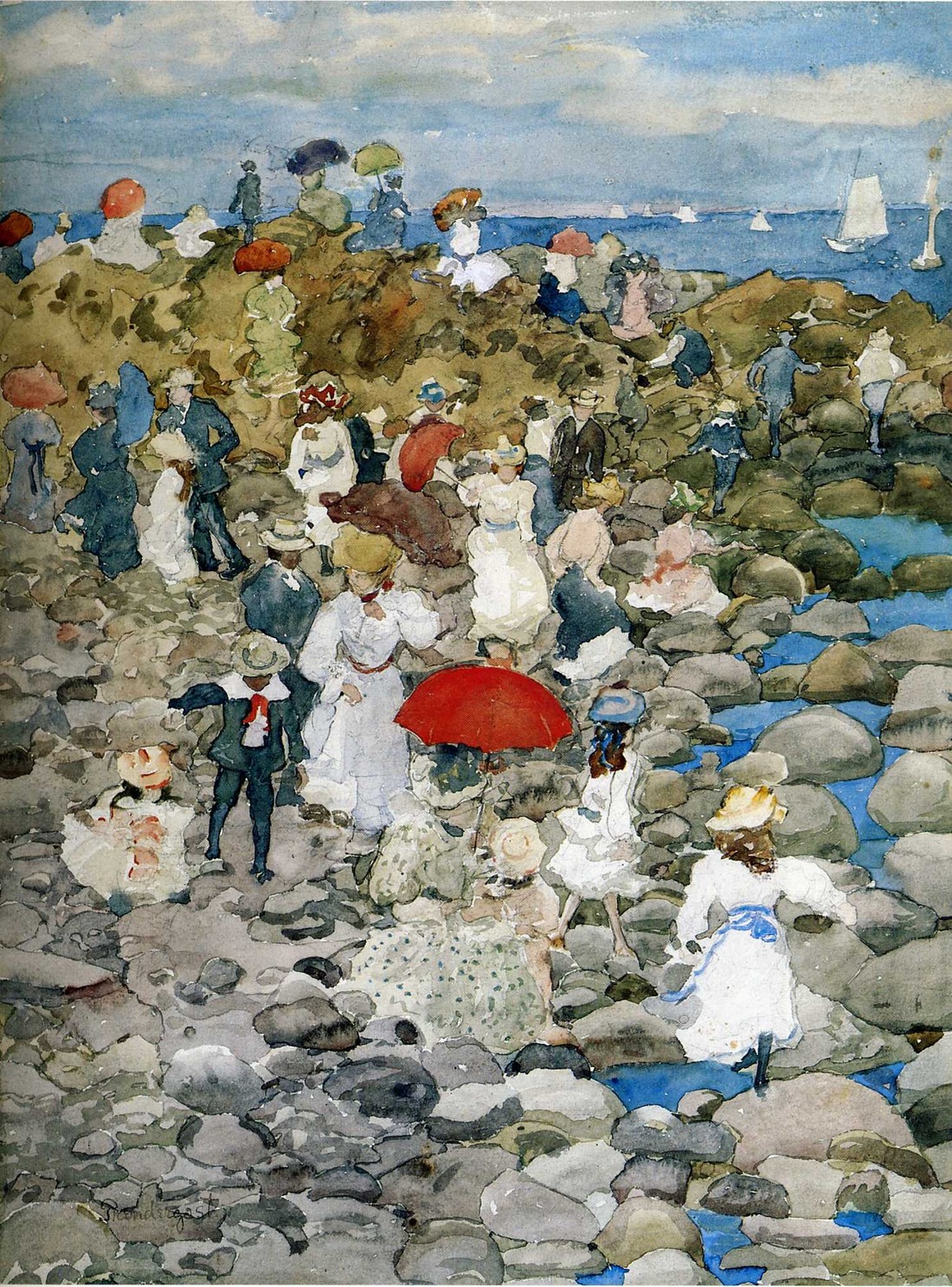
Rocky Shore, Nantasket
A sunny summer beach, alive with parasols, children and sails. How often did the region offer a day like this?
Summer sky testedPainted day unknown
The Nephos method
How this study was read
The method in fullWhat is written
Nephos reads the light clothes, parasols, children, sails, blue sea and bright sky as a fair, sunny summer beach day. This is Nephos’s visual reading, not a museum statement. WCMA dates the watercolor approximately 1896–1897; the signature carries no date.
Smiling skies, the brightest blue old ocean ever wore
Weymouth Gazette, 1896-07-03, Woman’s Relief Corps at Nantasketevery succeeding train handled a succeeding crowd of humanity
Weymouth Gazette, 1897-07-09, Brief Items / East Weymouth
Records of those days
- Blue Hill Observatory, Harvard Annals 42Published clear/fair/cloudy counts and monthly sunshine; 184 daily 2 p.m. whole-sky cloud observations. Inland summit, not Nantasket.
- Boston, Monthly Weather ReviewSeparate monthly sunshine percentages and published day classifications in both summers; reporting practices not harmonized with Blue Hill.
- Modern Blue Hill, NOAA USW00014753 TSUN14 complete June–August seasons in 2009–2024. Incomplete 2017 and 2020 excluded.
Not found or not yet searched
- No source inspected links this sheet to a particular Nantasket visit or painting session; June–August tests its depicted summer subject, not its execution date.
- The published historical tables give monthly sunshine duration. The daily strip is cloud amount at 2 p.m., not reconstructed sunshine hours.
- Modern archive coverage does not support a 1991–2020 sunshine normal. Instrument comparability is unresolved.
Each claim tested
- How often did these summers offer a largely clear sky at Blue Hill? 20 of 92 days in 1896 and 16 of 92 in 1897 were classified clear. Including the much broader fair category gives 59 and 51; these are not counts of sunny beach visits.
- How do the recorded sunshine totals compare with a modern run? 722.1 and 660.3 hours, versus 805.0 hours averaged over the 14 complete modern summers. A descriptive archive comparison, not a climate trend.
- Do contemporary reports put crowds at Nantasket in these seasons? Yes: a June 1896 reunion under smiling skies, and heavy train traffic on Monday 5 July 1897. Blue Hill recorded 3/10 cloud at 2 p.m. on the latter date; neither witness names Prendergast.
Verdict
A sunny seaside scene fits a recurring opportunity in both summers, though a largely clear day was a minority condition at Blue Hill: 20 and 16 days. Local reporting places crowds at Nantasket in the same seasons.
- Partially agreesNephos’s sunny-summer reading against the regional records Clear conditions recurred in both summers and contemporary reports describe Nantasket outings; these do not verify conditions at the painted rocks.
- UnknownThe painted day and actual weather at the rocks No dated session or linked beach observation.
What this cannot tell you. Blue Hill and Boston are regional stations. Neither is the painted scene, and their records are never pooled. Cloud amount, sunshine duration and a clear-day classification measure different things; none defines every pleasant beach day. The older sunshine recorder’s glass sphere was reported injured and replaced in January 1898; no bias correction or modern sensor harmonization is attempted. The composition source supports repeated colours and overlapping figures, not an alteration of observed weather or a documented outdoor/studio sequence. The underlying catalogue raisonné entry and archival object file were not inspected; they may narrow the date.
Step 1 · Read the picture
A fair, sunny summer day at the beach
This is Nephos’s reading of the picture, not a museum statement. Crowds wear light summer dress; open parasols include a bright red one. Children occupy the rocks, sailboats cross a blue sea, and a bright sky with fair-weather clouds sets the scene in strong light. Together these visible choices suggest a fair, sunny summer beach day, with some cloud rather than an empty sky.
That reading makes a test possible: how often did the surrounding region offer a largely clear sky during the two summers around the catalogue date? Cloud observations test the availability of such conditions; sunshine duration tells us how much bright sun those seasons received.
WCMA dates this watercolor to ca. 1896–1897, accession M.2004.13.1. Its recorded inscription is a signature without a date. We compare 1 June–31 August in each year separately: a conventional summer window chosen for the depicted subject, not a claim about when Prendergast worked. Neither a month nor an hour is assigned to the picture, and “ca.” leaves the outer dates approximate.
Step 2 · Test the summer sky
A recurring opportunity, not the everyday sky
Blue Hill Observatory classified 20 of 92 days in summer 1896 and 16 of 92 in 1897 as clear—22% and 17% of the season. A largely clear day was a minority condition in both summers, but there were repeated opportunities for one. The painting’s bright seaside scene belongs within that recurring range of conditions.
The observatory’s broader clear or fair categories include 59 and 51 days. “Fair” here allows appreciable cloud. The published classes use mean hourly cloud observations from 7 a.m. to 8 p.m.: 0–2 tenths clear, 3–7 fair, 8–10 cloudy. These are station classifications, not counts of picture-perfect beach days. A sunny interval can occur on a day that fails the clear-day test. 1896 observations · 1897 observations.
| Summer | Clear | Fair | Cloudy | Clear share |
|---|---|---|---|---|
| 1896 | 20 | 39 | 33 | 21.7% |
| 1897 | 16 | 35 | 41 | 17.4% |
The inspected Annals publish monthly sunshine duration, not a daily duration series. The daily strip therefore shows the cloud observations that can actually be recovered from these tables. We have not converted open sky into hours of sunshine: a cloud’s position relative to the sun matters as well as its size.
Every afternoon observation behind the strip
Whole-sky cloud in tenths at the printed 2 p.m. observation. This hour supplies a consistent daytime sample; it is not an inferred painting hour. All selected cells were checked on the scans; none carries the tables’ small-type interpolation marker.
| Date | Cloud, tenths | Annals locator |
|---|---|---|
| 1896-06-01 | 8 | Table VI, p. 22 |
| 1896-06-02 | 8 | Table VI, p. 22 |
| 1896-06-03 | 0 | Table VI, p. 22 |
| 1896-06-04 | 6 | Table VI, p. 22 |
| 1896-06-05 | 1 | Table VI, p. 22 |
| 1896-06-06 | 9 | Table VI, p. 22 |
| 1896-06-07 | 10 | Table VI, p. 22 |
| 1896-06-08 | 10 | Table VI, p. 22 |
| 1896-06-09 | 6 | Table VI, p. 22 |
| 1896-06-10 | 10 | Table VI, p. 22 |
| 1896-06-11 | 6 | Table VI, p. 22 |
| 1896-06-12 | 8 | Table VI, p. 22 |
| 1896-06-13 | 5 | Table VI, p. 22 |
| 1896-06-14 | 10 | Table VI, p. 22 |
| 1896-06-15 | 10 | Table VI, p. 22 |
| 1896-06-16 | 8 | Table VI, p. 22 |
| 1896-06-17 | 8 | Table VI, p. 22 |
| 1896-06-18 | 6 | Table VI, p. 22 |
| 1896-06-19 | 2 | Table VI, p. 22 |
| 1896-06-20 | 2 | Table VI, p. 22 |
| 1896-06-21 | 4 | Table VI, p. 22 |
| 1896-06-22 | 5 | Table VI, p. 22 |
| 1896-06-23 | 2 | Table VI, p. 22 |
| 1896-06-24 | 10 | Table VI, p. 22 |
| 1896-06-25 | 9 | Table VI, p. 22 |
| 1896-06-26 | 10 | Table VI, p. 22 |
| 1896-06-27 | 8 | Table VI, p. 22 |
| 1896-06-28 | 10 | Table VI, p. 22 |
| 1896-06-29 | 8 | Table VI, p. 22 |
| 1896-06-30 | 0 | Table VI, p. 22 |
| 1896-07-01 | 0 | Table VI, p. 22 |
| 1896-07-02 | 4 | Table VI, p. 23 |
| 1896-07-03 | 10 | Table VI, p. 23 |
| 1896-07-04 | 10 | Table VI, p. 23 |
| 1896-07-05 | 10 | Table VI, p. 23 |
| 1896-07-06 | 10 | Table VI, p. 23 |
| 1896-07-07 | 10 | Table VI, p. 23 |
| 1896-07-08 | 9 | Table VI, p. 23 |
| 1896-07-09 | 9 | Table VI, p. 23 |
| 1896-07-10 | 3 | Table VI, p. 23 |
| 1896-07-11 | 5 | Table VI, p. 23 |
| 1896-07-12 | 4 | Table VI, p. 23 |
| 1896-07-13 | 7 | Table VI, p. 23 |
| 1896-07-14 | 10 | Table VI, p. 23 |
| 1896-07-15 | 10 | Table VI, p. 23 |
| 1896-07-16 | 4 | Table VI, p. 23 |
| 1896-07-17 | 5 | Table VI, p. 23 |
| 1896-07-18 | 0 | Table VI, p. 23 |
| 1896-07-19 | 8 | Table VI, p. 23 |
| 1896-07-20 | 9 | Table VI, p. 23 |
| 1896-07-21 | 9 | Table VI, p. 23 |
| 1896-07-22 | 9 | Table VI, p. 23 |
| 1896-07-23 | 3 | Table VI, p. 23 |
| 1896-07-24 | 10 | Table VI, p. 23 |
| 1896-07-25 | 4 | Table VI, p. 23 |
| 1896-07-26 | 0 | Table VI, p. 23 |
| 1896-07-27 | 10 | Table VI, p. 23 |
| 1896-07-28 | 0 | Table VI, p. 23 |
| 1896-07-29 | 4 | Table VI, p. 23 |
| 1896-07-30 | 7 | Table VI, p. 23 |
| 1896-07-31 | 0 | Table VI, p. 23 |
| 1896-08-01 | 3 | Table VI, p. 23 |
| 1896-08-02 | 10 | Table VI, p. 23 |
| 1896-08-03 | 6 | Table VI, p. 23 |
| 1896-08-04 | 2 | Table VI, p. 23 |
| 1896-08-05 | 8 | Table VI, p. 23 |
| 1896-08-06 | 10 | Table VI, p. 23 |
| 1896-08-07 | 7 | Table VI, p. 23 |
| 1896-08-08 | 1 | Table VI, p. 23 |
| 1896-08-09 | 7 | Table VI, p. 23 |
| 1896-08-10 | 0 | Table VI, p. 23 |
| 1896-08-11 | 3 | Table VI, p. 23 |
| 1896-08-12 | 7 | Table VI, p. 23 |
| 1896-08-13 | 8 | Table VI, p. 23 |
| 1896-08-14 | 10 | Table VI, p. 23 |
| 1896-08-15 | 10 | Table VI, p. 23 |
| 1896-08-16 | 6 | Table VI, p. 23 |
| 1896-08-17 | 4 | Table VI, p. 23 |
| 1896-08-18 | 7 | Table VI, p. 24 |
| 1896-08-19 | 8 | Table VI, p. 24 |
| 1896-08-20 | 7 | Table VI, p. 24 |
| 1896-08-21 | 5 | Table VI, p. 24 |
| 1896-08-22 | 10 | Table VI, p. 24 |
| 1896-08-23 | 10 | Table VI, p. 24 |
| 1896-08-24 | 7 | Table VI, p. 24 |
| 1896-08-25 | 3 | Table VI, p. 24 |
| 1896-08-26 | 6 | Table VI, p. 24 |
| 1896-08-27 | 10 | Table VI, p. 24 |
| 1896-08-28 | 5 | Table VI, p. 24 |
| 1896-08-29 | 7 | Table VI, p. 24 |
| 1896-08-30 | 3 | Table VI, p. 24 |
| 1896-08-31 | 10 | Table VI, p. 24 |
| 1897-06-01 | 9 | Table VI, p. 160 |
| 1897-06-02 | 3 | Table VI, p. 160 |
| 1897-06-03 | 9 | Table VI, p. 160 |
| 1897-06-04 | 8 | Table VI, p. 160 |
| 1897-06-05 | 10 | Table VI, p. 160 |
| 1897-06-06 | 10 | Table VI, p. 160 |
| 1897-06-07 | 8 | Table VI, p. 160 |
| 1897-06-08 | 9 | Table VI, p. 160 |
| 1897-06-09 | 10 | Table VI, p. 160 |
| 1897-06-10 | 10 | Table VI, p. 160 |
| 1897-06-11 | 3 | Table VI, p. 160 |
| 1897-06-12 | 9 | Table VI, p. 160 |
| 1897-06-13 | 10 | Table VI, p. 160 |
| 1897-06-14 | 9 | Table VI, p. 160 |
| 1897-06-15 | 7 | Table VI, p. 160 |
| 1897-06-16 | 7 | Table VI, p. 160 |
| 1897-06-17 | 9 | Table VI, p. 160 |
| 1897-06-18 | 4 | Table VI, p. 160 |
| 1897-06-19 | 7 | Table VI, p. 160 |
| 1897-06-20 | 10 | Table VI, p. 160 |
| 1897-06-21 | 7 | Table VI, p. 160 |
| 1897-06-22 | 1 | Table VI, p. 160 |
| 1897-06-23 | 6 | Table VI, p. 160 |
| 1897-06-24 | 3 | Table VI, p. 160 |
| 1897-06-25 | 7 | Table VI, p. 160 |
| 1897-06-26 | 5 | Table VI, p. 160 |
| 1897-06-27 | 7 | Table VI, p. 160 |
| 1897-06-28 | 0 | Table VI, p. 160 |
| 1897-06-29 | 10 | Table VI, p. 160 |
| 1897-06-30 | 7 | Table VI, p. 160 |
| 1897-07-01 | 4 | Table VI, p. 160 |
| 1897-07-02 | 10 | Table VI, p. 160 |
| 1897-07-03 | 3 | Table VI, p. 160 |
| 1897-07-04 | 8 | Table VI, p. 160 |
| 1897-07-05 | 3 | Table VI, p. 161 |
| 1897-07-06 | 4 | Table VI, p. 161 |
| 1897-07-07 | 9 | Table VI, p. 161 |
| 1897-07-08 | 2 | Table VI, p. 161 |
| 1897-07-09 | 4 | Table VI, p. 161 |
| 1897-07-10 | 9 | Table VI, p. 161 |
| 1897-07-11 | 10 | Table VI, p. 161 |
| 1897-07-12 | 8 | Table VI, p. 161 |
| 1897-07-13 | 10 | Table VI, p. 161 |
| 1897-07-14 | 10 | Table VI, p. 161 |
| 1897-07-15 | 6 | Table VI, p. 161 |
| 1897-07-16 | 4 | Table VI, p. 161 |
| 1897-07-17 | 8 | Table VI, p. 161 |
| 1897-07-18 | 10 | Table VI, p. 161 |
| 1897-07-19 | 9 | Table VI, p. 161 |
| 1897-07-20 | 8 | Table VI, p. 161 |
| 1897-07-21 | 9 | Table VI, p. 161 |
| 1897-07-22 | 10 | Table VI, p. 161 |
| 1897-07-23 | 7 | Table VI, p. 161 |
| 1897-07-24 | 9 | Table VI, p. 161 |
| 1897-07-25 | 8 | Table VI, p. 161 |
| 1897-07-26 | 8 | Table VI, p. 161 |
| 1897-07-27 | 8 | Table VI, p. 161 |
| 1897-07-28 | 10 | Table VI, p. 161 |
| 1897-07-29 | 10 | Table VI, p. 161 |
| 1897-07-30 | 8 | Table VI, p. 161 |
| 1897-07-31 | 9 | Table VI, p. 161 |
| 1897-08-01 | 7 | Table VI, p. 161 |
| 1897-08-02 | 9 | Table VI, p. 161 |
| 1897-08-03 | 5 | Table VI, p. 161 |
| 1897-08-04 | 7 | Table VI, p. 161 |
| 1897-08-05 | 7 | Table VI, p. 161 |
| 1897-08-06 | 7 | Table VI, p. 161 |
| 1897-08-07 | 5 | Table VI, p. 161 |
| 1897-08-08 | 6 | Table VI, p. 161 |
| 1897-08-09 | 8 | Table VI, p. 161 |
| 1897-08-10 | 10 | Table VI, p. 161 |
| 1897-08-11 | 8 | Table VI, p. 161 |
| 1897-08-12 | 4 | Table VI, p. 161 |
| 1897-08-13 | 3 | Table VI, p. 161 |
| 1897-08-14 | 2 | Table VI, p. 161 |
| 1897-08-15 | 10 | Table VI, p. 161 |
| 1897-08-16 | 10 | Table VI, p. 161 |
| 1897-08-17 | 6 | Table VI, p. 161 |
| 1897-08-18 | 8 | Table VI, p. 161 |
| 1897-08-19 | 10 | Table VI, p. 161 |
| 1897-08-20 | 5 | Table VI, p. 161 |
| 1897-08-21 | 3 | Table VI, p. 162 |
| 1897-08-22 | 9 | Table VI, p. 162 |
| 1897-08-23 | 9 | Table VI, p. 162 |
| 1897-08-24 | 10 | Table VI, p. 162 |
| 1897-08-25 | 3 | Table VI, p. 162 |
| 1897-08-26 | 3 | Table VI, p. 162 |
| 1897-08-27 | 6 | Table VI, p. 162 |
| 1897-08-28 | 5 | Table VI, p. 162 |
| 1897-08-29 | 0 | Table VI, p. 162 |
| 1897-08-30 | 8 | Table VI, p. 162 |
| 1897-08-31 | 1 | Table VI, p. 162 |
Step 3 · Sunshine and a second station
July gave less sunshine than August in both years
Blue Hill recorded 722.1 hours of bright sunshine in summer 1896 and 660.3 in 1897. In both years July had less recorded sunshine than August, even though July had more possible daylight. Boston’s separate recorder gives the same July-to-August ordering.
Boston also reported 36 clear days in 1896 and 31 in 1897, with its own cloud classifications. Those counts remain separate: the reporting schedules and thresholds have not been harmonized with Blue Hill’s. They cannot be averaged into a Nantasket count. Monthly Weather Review, 1896 · 1897.
| Month | Blue Hill sun, hours | Blue Hill sun, % possible | Boston sun, % possible | Boston clear / partly cloudy / cloudy days |
|---|---|---|---|---|
| June 1896 | 250.6 | 57% | 57% | 13 / 8 / 9 |
| July 1896 | 215.4 | 48% | 51% | 11 / 9 / 11 |
| August 1896 | 256.1 | 62% | 61% | 12 / 13 / 6 |
| June 1897 | 216.6 | 49% | 56% | 10 / 7 / 13 |
| July 1897 | 195.7 | 44% | 48% | 7 / 8 / 16 |
| August 1897 | 248.0 | 60% | 63% | 14 / 8 / 9 |
The percentages retain each publication’s method. Blue Hill deducted half an hour per day from possible sunshine to allow for weak low-angle sun; the Weather Bureau supplemented low-sun gaps with visual observations. Boston used a thermal recorder, Blue Hill a Campbell–Stokes burning-glass recorder. The percentages give seasonal context within each series, not an exact comparison of the two instruments.
Step 4 · People actually went to the beach
Smiling skies, boats and crowded holiday trains
A nearby newspaper supplies what a summit instrument cannot: people at Nantasket. On 3 July 1896 the Weymouth Gazette described the Massachusetts Woman’s Relief Corps reunion there during June. It reported a south wind tempering the sun, boats bringing hundreds from the city and electric cars bringing crowds from inland.
“Smiling skies, the brightest blue old ocean ever wore”
Weymouth Gazette, 3 July, Woman’s Relief Corps at Nantasket
The article calls the weather a perfect June day, but the exact outing date has not been established here. It is a contemporary witness to a sunny, crowded Nantasket outing in the season, not a proposed date for the watercolor.
“every succeeding train handled a succeeding crowd of humanity”
Weymouth Gazette, 9 July, Brief Items / East Weymouth
In its 9 July 1897 issue, the paper reported exceptionally heavy travel on Monday, 5 July, with trains every fifteen minutes from East Weymouth to Nantasket and Pemberton. Blue Hill’s separate observation that afternoon recorded 3 tenths of the sky covered by cloud at 2 p.m. The mean of its 14 hourly observations from 7 a.m. to 8 p.m. was 1.6 tenths, within its clear-day band. That is the red mark in the chart: a documented holiday crowd alongside a regional observation of relatively open sky. The report does not name Prendergast, and the station does not establish the weather at the rocks.
Step 5 · Then and now
Less than the modern average, within its observed range
For a modern comparison, NOAA’s Blue Hill sunshine series supplies 14 complete summers within 2009–2024, averaging 805.0 hours. The two historical totals are 82.9 and 144.7 hours below that average. Both still fall within the modern summers’ recorded range of 632.7–922.8 hours.
This is a comparison of recorded totals, not a climate trend or a 1991–2020 normal. NOAA’s archived sunshine coverage is too incomplete for that thirty-year normal. The comparison uses the sustained run beginning in 2009; 2017 and 2020 each lack one day and are excluded without filling the gaps. NOAA source · TSUN units and flags.
| Season or reference | Hours |
|---|---|
| 1896 | 722.1 |
| 1897 | 660.3 |
| Mean of 14 complete summers, 2009–2024 | 805.0 |
There is also an instrument warning in the historical source itself: the old recorder’s glass sphere had become injured and was replaced in January 1898. The size of any earlier bias is unquantified here, and the modern sensor record has not been harmonized with it. The difference in totals cannot be attributed wholly to a change in climate.
The modern summers, including the exclusions
| Summer | Sunshine, hours | Coverage |
|---|---|---|
| 2009 | 632.7 | 92/92 |
| 2010 | 813.8 | 92/92 |
| 2011 | 806.0 | 92/92 |
| 2012 | 837.9 | 92/92 |
| 2013 | 771.4 | 92/92 |
| 2014 | 897.2 | 92/92 |
| 2015 | 812.1 | 92/92 |
| 2016 | 922.8 | 92/92 |
| 2017 | Excluded | Missing 2017-06-11 |
| 2018 | 803.4 | 92/92 |
| 2019 | 845.8 | 92/92 |
| 2020 | Excluded | Missing 2020-07-04 |
| 2021 | 699.8 | 92/92 |
| 2022 | 898.0 | 92/92 |
| 2023 | 712.3 | 92/92 |
| 2024 | 817.2 | 92/92 |
Step 6 · What Prendergast chose
The weather is plausible; the picture is composed
The NBMAA exhibition discussion explicitly considers this sheet alongside Low Tide, Nantasket. It describes overlapping figures and repeated colours that lead the eye through the crowd. The effect it calls “momentary and ephemeral” is therefore also a matter of arrangement. The bright red parasol is both a visible sign of beachgoing and an accent within that pattern.
The records make the summer subject more tangible: largely clear skies recurred, sunshine was uneven across the months, and local reporting puts excursion crowds at Nantasket. Prendergast’s sunlit scene selects a recognizable part of seaside life. No source inspected shows that he changed the weather he saw.
Blue Hill is an inland summit about 21.6 km from the Nantasket locality reference; Boston is another distinct setting. Neither station’s reading is a beach observation. Cloud cover, sunshine and the whole experience of a comfortable beach day are different quantities: temperature, wind and local conditions also matter.
The picture’s day, exact viewpoint and working sequence remain unestablished. The WCMA-linked chronology provides Boston addresses, not a dated Nantasket session; the catalogue raisonné entry and museum object file have not been inspected. Those limits constrain a date claim, while leaving the seasonal test useful. The earlier Hingham and Blue Hill rain extracts remain in the linked data, with presumed zeros and other flags intact; they are not used to infer sunshine.
Sources
Every source on this page
Weather values are rebuilt from NOAA files and scan transcriptions checked against their sha256 fingerprints. Newspaper quotations were read on the scans and are checked against the pinned transcription; museum quotations use cached text. Original scans, transcriptions and downloaded data have separate receipts. A fingerprint preserves the version used; it does not independently validate the historical interpretation. These checks do not constitute an independent source review.
- WCMA open collection data, object 4216, accession M.2004.13.1
sha256 610e85bd50b1aa962bf8dee2d4c3388c0acf90cbf93ca2c367e48e920bd4ab9a - WCMA collection-data licence and image-use distinction
sha256 0b17cffed587e888cba6ad463ea0526aea139e2fa6a5c86555f3e7204a581999 - WCMA-linked Prendergast Chronology, based on the catalogue raisonné
sha256 93e0d51f0d2d91964f2c0ce731933d32f052e4fdcf19ce51ea87e1546ba6e071 - Searchable text extracted from the WCMA-linked chronology
sha256 45a0d0a68119925a21791af83c665aba54ee23c026725d57dd70f277688a66aa - NBMAA, Rocky Shore, Nantasket, object caption
sha256 9ab6a765716c2458be23109280b6e5f3cd7a2c908e63626763117c30a058afe8 - NBMAA, Low Tide, Nantasket: discussion explicitly covering Rocky Shore and Low Tide
sha256 41b5789ff3c35cfb808c6f8ab6f304425a6bb56915c6b82dea36fb0e63ad40ca - Searchable text extracted from the NBMAA discussion
sha256 f452611b93c6e3ef8a55d8a1fc038bebf33c6279e8b96cd15126fc23d1df9ebe - WikiArt, Rocky Shore, Nantasket, public-domain statement
sha256 e944291f6c8ff827a99890aa7cd2756ae7594956fdd454d0c47a2bab441ec9ee - Maurice Prendergast, Rocky Shore, Nantasket, reproduction via WikiArt
sha256 3db6f7267156b846dfab044b42f9f68a31272c3feda24583158f3ba1e03bbf36 - NOAA NCEI, GHCN-Daily v3.35, format, units and flags
sha256 0e4e6f0e6947cf1add884c328a01760f31c56ef5fb86b85ed57dd5dc4c4aeaa6 - NOAA NCEI, GHCN-Daily station metadata
sha256 428eabc955883187935bce283766d5646e3ed7484b92eb0803874c0e8dd9b342 - NOAA NCEI, GHCN-Daily element and year inventory
sha256 f060753ed9cbd34ed0b92f3924f10ac0065b8a45d402c18c74cba21b7bfea49e - NOAA NCEI, GHCN-Daily dataset description and use constraints
sha256 da4ff150820c7f3ff2687bc922295bcfeb5c18a9b7c54a45f20a451e8ec23971 - NOAA GHCN-Daily, BLUE HILL COOP, USC00190736
sha256 ce49b9a5d0e91d2f0193f4621f7df6438fe2089993706827d36b86df2235dd07 - NOAA GHCN-Daily, HINGHAM (1), USC00193625
sha256 5cffaeef1090043a99468ed728d4b2cc2109cb25a1d467ead1ea4e42f8d4a0a7 - NOAA GHCN-Daily, BOSTON CITY WSO, USW00094701: coverage candidate
sha256 4c96f520b5a50c43c4ebd106cbd8a47a3d69cc97064516ef34b8a1e26cc1045f - NOAA GHCN-Daily, BOSTON, USC00190768: incomplete rainfall candidate
sha256 e87749ae22a1e0d45f61209eecb4c410065ab1fd7b9fc94b12276ea057afd6bc - NOAA GHCN-Daily, MILTON, USC00194795: incomplete rainfall candidate
sha256 fb5354fd8e6b89ba3945eef0b3708774c8f3fccbd7650dd11f855cfe23cc6bc4 - Blue Hill Observatory historical timeline
sha256 7ede7f43fabff0fc191a1383cea90c592c5f9d017c1e89af07647a6acd189377 - OpenStreetMap Nominatim, Nantasket Beach locality node 158854516
sha256 f5e08afb83685cb669e405728485f30dd1ac8becb46ba353df74a405e5382b1e - A. Lawrence Rotch, Blue Hill observations for 1896, Harvard Annals 42, part I (1897)
sha256 1457e1e163150329c3938fcfd41fb27ffa82d45368858d2f21ee2085c99881c1 - A. Lawrence Rotch, Blue Hill observations for 1897–1898, Harvard Annals 42, part II (1900)
sha256 06c8460c5991f599476fa162e096b4c7ebd8934b735c22cab5118bf574e022d6 - US Weather Bureau, Monthly Weather Review, 1896-06: Boston cloud and sunshine
sha256 5c09fd39f03772b996943e94542a307f7209bd8e7ab6bcb4548757243713e274 - US Weather Bureau, Monthly Weather Review, 1896-07: Boston cloud and sunshine
sha256 6ec805f5dae3966f79df8f0283ac28b4a9e373b5b324e7521375508cb589b5ec - US Weather Bureau, Monthly Weather Review, 1896-08: Boston cloud and sunshine
sha256 d5e543dd63ea412103ebed6ba07b97be45e808f7ac4c07b5dc5309e727b2b706 - US Weather Bureau, Monthly Weather Review, 1897-06: Boston cloud and sunshine
sha256 0cda78a8cc69af9bf8d9ccaebfb482167d591d9efae038374db30f3d56975152 - US Weather Bureau, Monthly Weather Review, 1897-07: Boston cloud and sunshine
sha256 4d4f4b1310ba855f4b106f6b91c2880e0c289dfdef4f71feffcc067c8c1bcdc5 - US Weather Bureau, Monthly Weather Review, 1897-08: Boston cloud and sunshine
sha256 aa85ab192eb52b3e6fd9d1356d8ab6181977ca9a14a81bc232a4ab74ff64ab0a - Weymouth Gazette, July 1896: contemporary Nantasket outings
sha256 4b7d9e1ae6c211809550fab9ff54bf43b2957db00255fbccfa69a42095be8697 - Weymouth Gazette, July 1897: contemporary Nantasket outings
sha256 1da6c135c541b60df04bf9db7d782cdf371ec091d0b52d8a85e769e50e321011 - NOAA GHCN-Daily, Blue Hill Observatory USW00014753, TSUN
sha256 37f68324f155c94a842a45cbb1503ce3fb053b2f1b8c4a07f763488278f9ee2b - Nephos scan transcription: sun-cloud-transcription
sha256 c71d317986dccd77aefb5a6ba8e92754184d5a098e2b915e86d1e7701f5e2a72 - Nephos scan transcription: boston-transcription
sha256 a5b5a5431405fc0b6a8c45260b8f5dba00bab80f0ca92e9cd5c2d7e587a96c1a - Nephos scan transcription: witness-transcription
sha256 ec94a4d129dec46ce13262245dbd543afbbefd561b003f3180bfd75b6dfaf119 - Blue Hill Observatory: current climate-data access and licence
sha256 b91bb411e44c076783685b2a7274092dd3998521279f3e2b8cb9015eed9e035c
