A study against the weather record
Ernest Lawson
Impressionist Landscape
Green foliage and foreground flowers suggest a growing season. How warm were the May–September seasons around the museum’s approximate date?
Season visually inferredPainted day unknown
The Nephos method
How this study was read
The method in fullWhat is written
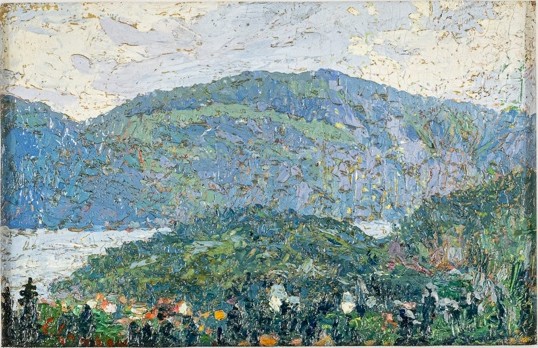
Huntsville dates this Westchester landscape only to about 1909 and names no season. Nephos reads the visible green foliage and foreground flowers as growing-season imagery and uses May–September as a broad comparison window, not a documented date.
ca. 1909, oil on board
Huntsville Museum of Art, caption for 1985.09In 1898 he settled in Washington Heights
National Gallery of Art, Annual Report 2016, p. 15; general artist context
Records of those days
- Scarsdale, USC00307497Daily high and low temperatures for May–September in 1908, 1909 and 1910. Complete months are shown; each full season has quality-flagged gaps and remains unranked.
- Mount Hope, USC00305540Three complete May–September seasons around the approximate date, each compared separately with all complete seasons in this station’s file. No years or stations are pooled.
Not found or not yet searched
- No documented painting day, exact month, precise site, or object-specific account of how it was made. The May–September window is Nephos’s visual interpretation.
- Historical instrument exposures have not been verified. The stations are regional context.
- Some thermometer readings are missing or quality flagged; many precipitation zeros are marked as missing presumed zero.
Each claim tested
- Does the picture suggest a growing season? Nephos reads the foliage and flowers that way. The museum gives no season; the image does not establish a month or a dated outdoor session.
- How do the three nearby years compare with the station’s longer record? At Mount Hope, 1909 is coolest among the complete May–September seasons retained from the file. Both neighbouring years are warmer. Scarsdale’s three target seasons have gaps and cannot be ranked.
- Does this test the painted sky or reveal Lawson’s changes? No. Thermometer records and a broad visual season do not identify a day, verify the sky, or document alterations.
Verdict
A visually inferred growing season beside the regional thermometer record. A green landscape need not imply an unusually warm season; the picture’s weather remains untested.
- UnknownThe painted sky and day A broad visual season and approximate catalogue year do not connect the painted sky to a station observation.
- UnknownWhat Lawson changed No object-specific making evidence has been established.
What this cannot tell you. May–September is Nephos’s visual interpretation of foliage and flowers, not a museum statement or a plant-based date. 1908, 1909 and 1910 are considered separately because they surround the approximate catalogue date; they are not documentary bounds on the picture. Ranks use only complete same-station seasons. Historical instrument exposure and comparability have not been verified. Missing readings remain missing, stations and years are not pooled, and no complete rainfall total or wetness rank is published.
Step 1 · The picture and its painter
A small board, an approximate date
Ernest Lawson’s Impressionist Landscape (Westchester County, New York) is a small oil on board, 6 × 8¾ inches, recorded as a Huntsville Museum Association Purchase, accession 1985.09. The museum catalogues it as about 1909. Its public entry names no season, exact site or painting day, and does not explain the basis of the approximate date.
Lawson settled in Washington Heights in 1898. The National Gallery of Art describes his next two decades of landscapes incorporating the buildings and bridges of an expanding New York. The Westchester place-name on this board belongs beside that wider interest in the region; it does not document a visit in any particular month.
Huntsville presents the work in its American Impressionism collection, whose introduction emphasizes light, colour and expressive brushwork. The Smithsonian’s biography describes Lawson’s heavy impasto, or thickly applied paint, and his preference for winter scenes along the Hudson and Harlem Rivers. The green foliage and flowers in this picture are worth noticing against that general preference.
Nephos’s visual reading, not a museum statement: the museum reproduction shows dense green foliage, white, orange-red and yellow foreground flowers, blue-green wooded hills and a river. These support a broad growing-season reading. This study uses May–September as its comparison window, without claiming a particular month. The window is an interpretation of the visible foliage and flowers, not an inscription, a plant identification or a documented visit.
The three seasons considered are 1908, 1909 and 1910, kept separate. They surround the museum’s approximate date; they do not define its earliest and latest possible years. No object-specific evidence establishes an outdoor session or later studio changes.
Step 2 · The seasonal comparison
A cool growing season at Mount Hope in 1909
At Mount Hope, May–September 1909 averaged 65.3 °F (18.5 °C). It is the coolest of the 15 complete May–September seasons retained from this station’s file. Both neighbouring years were warmer. This comparison puts the approximate date beside a measured growing season; it does not establish that Lawson painted during that season or that the scene records its temperatures.
Each seasonal mean uses all 153 days, taking the midpoint between each day’s high and low before averaging. The search covers the file’s 1896–1929 span. The 15 qualifying seasons run from 1897 to 1923, with gaps between years. The rank describes these archived readings; instrument exposure and long-term comparability have not been verified.
| Year | Mount Hope mean | Coolest rank | Scarsdale |
|---|---|---|---|
| 1908 | 67.2 °F / 19.6 °C | 10 of 15 | Incomplete: 152/153 days |
| 1909 | 65.3 °F / 18.5 °C | 1 of 15 | Incomplete: 148/153 days |
| 1910 | 65.9 °F / 18.9 °C | 3 of 15 | Incomplete: 151/153 days |
Every complete Mount Hope season used for the comparison
| Year | May–September mean |
|---|---|
| 1897 | 66.5 °F / 19.2 °C |
| 1898 | 67.3 °F / 19.6 °C |
| 1899 | 67.0 °F / 19.4 °C |
| 1900 | 68.7 °F / 20.4 °C |
| 1905 | 66.3 °F / 19.1 °C |
| 1906 | 68.1 °F / 20.0 °C |
| 1908 | 67.2 °F / 19.6 °C |
| 1909 | 65.3 °F / 18.5 °C |
| 1910 | 65.9 °F / 18.9 °C |
| 1911 | 69.7 °F / 20.9 °C |
| 1912 | 67.6 °F / 19.8 °C |
| 1920 | 65.5 °F / 18.6 °C |
| 1921 | 67.0 °F / 19.5 °C |
| 1922 | 67.2 °F / 19.6 °C |
| 1923 | 66.0 °F / 18.9 °C |
Step 3 · Check the months and gaps
Two stations, with different limits
The daily files from Scarsdale and Mount Hope contain thermometer readings from Westchester. Each line below belongs to one station. Their locations and instrument surroundings differ; neither is established as the site Lawson painted.
Both high and low readings must be present and pass the archive’s quality checks on every calendar day. A single missing or rejected reading leaves the monthly mean blank; no neighbouring station fills the gap.
Scarsdale supplies 11 of the 15 monthly means, but none of the three full seasons qualifies. Only 6 complete seasons qualify anywhere in its 1904–1991 file; the incomplete 1908–1910 seasons cannot be ranked against them. The linked data retain the excluded dates and source flags. Fahrenheit is converted before rounding.
The precipitation columns need a different caution. Many zero entries carry NOAA’s flag for a missing amount presumed to be zero. They do not prove a measured dry day. This page therefore publishes no complete rainfall totals or wetness rankings. NOAA’s format guide explains these flags; the data file keeps them visible.
Every selected month: temperature values and gaps
| Month | Scarsdale | Mount Hope |
|---|---|---|
| May 1908 | Incomplete: 30/31 days | 59.8 °F / 15.4 °C |
| June 1908 | 67.2 °F / 19.6 °C | 68.1 °F / 20.1 °C |
| July 1908 | 72.8 °F / 22.7 °C | 75.3 °F / 24.1 °C |
| August 1908 | 67.4 °F / 19.7 °C | 69.0 °F / 20.6 °C |
| September 1908 | 62.5 °F / 16.9 °C | 63.9 °F / 17.7 °C |
| May 1909 | 57.6 °F / 14.2 °C | 58.2 °F / 14.6 °C |
| June 1909 | Incomplete: 27/30 days | 67.7 °F / 19.8 °C |
| July 1909 | Incomplete: 29/31 days | 69.8 °F / 21.0 °C |
| August 1909 | 68.2 °F / 20.1 °C | 68.4 °F / 20.2 °C |
| September 1909 | 61.8 °F / 16.6 °C | 62.3 °F / 16.8 °C |
| May 1910 | 58.0 °F / 14.4 °C | 57.9 °F / 14.4 °C |
| June 1910 | Incomplete: 28/30 days | 64.9 °F / 18.3 °C |
| July 1910 | 74.2 °F / 23.4 °C | 74.3 °F / 23.5 °C |
| August 1910 | 67.8 °F / 19.9 °C | 68.5 °F / 20.3 °C |
| September 1910 | 64.2 °F / 17.9 °C | 64.0 °F / 17.8 °C |
Step 4 · What a visitor can take away
Context for looking, no test of the painted sky
The foliage and flowers suggest a growing season; the comparison shows that such a season need not have been especially warm. That is context for looking, not a confirmation of the depicted weather. The records cannot identify Lawson’s day, show whether the painted sky was observed or remembered, or say what he changed. An account of his thick paint is not a weather measurement, and an appealing match to one month would not date the board.
For discussion: what does the museum’s label establish, what does the thermometer measure, and what remains a question about the picture? The exact month, precise place, and making history remain open. The broad seasonal reading remains Nephos’s interpretation.
Sources
Every source on this page
The daily weather files, station inventory and documentary captures have fingerprints (sha256), checked before rebuilding. The source notes distinguish original downloads from browser text captures and a PDF text extraction. All temperature summaries on this page come from the daily files.
- Huntsville Museum of Art, reproduction of 1985.09, inspected for the seasonal reading
sha256 abc94c53d6685c4941c9de5d5245e3915d9acc9407947a7f1f4c6e654b9f9130 - NOAA/NCEI GHCN-Daily, Scarsdale, USC00307497
sha256 ec77a43ad8c5dea269ba9e764d00e7da32c2fc77134b939283d4575d58f295a2 - NOAA/NCEI GHCN-Daily, Mount Hope, USC00305540
sha256 746706f0103a9d2c20d81ea69ea918632bf8d884c09cb591e1a6118281e5bbcd - NOAA/NCEI GHCN-Daily station inventory
sha256 14c6467fcce6cce8dc0786eba8bbceed51a2f1c1056b0e221b573157559fc824 - GHCN-Daily format and flags, version 3.35
sha256 0e4e6f0e6947cf1add884c328a01760f31c56ef5fb86b85ed57dd5dc4c4aeaa6 - Huntsville Museum of Art, American Impressionism, caption for 1985.09
sha256 cab7d82d68b6f925e9033f4c6fed21e46e926ec7f71ce20334e3a25ffb489b66 - Smithsonian American Art Museum, Ernest Lawson, biography citing Joan Stahl (1995)
sha256 017aa69d1ea9a870903bca6940ffa793367a7f127c9d4f428b95e7d7ae4f0197 - National Gallery of Art, Annual Report 2016
sha256 c1085e7a3ec734219dc0e35fc319ccb2d4f9d1862e06e39ff077c7f9fec1a8ff - Text extraction of the National Gallery report, p. 15
sha256 d60f201b2e5f8eb1ed86524a369b1701486ab73d36a70e528a6c379a2d73c903
