A study against the weather record
Winslow Homer
Sparrow Hall
Bare forearms, open doors and warm sunlight. How often did warmth and sustained sunshine coincide during Homer’s Cullercoats stay?
Warm sunshine testedPainted day unknown
The Nephos method
How this study was read
The method in fullWhat is written
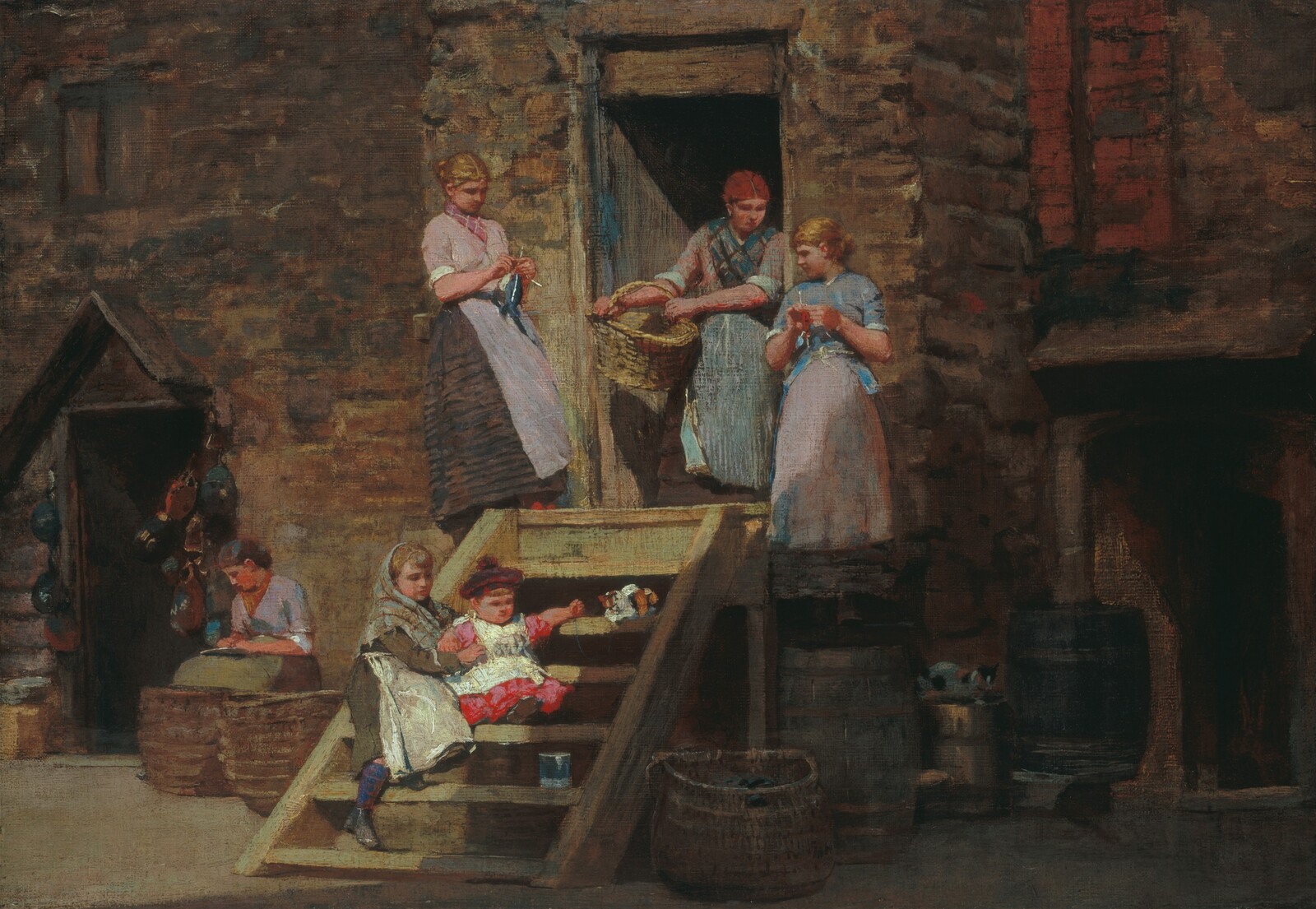
Nephos’s reading of the picture, not a museum statement: a warm, sunny day in Cullercoats. Women have bare forearms and aprons; children sit on the steps beside open doorways; strong, warm light crosses the masonry wall and stair, with crisp shadows. The warmth is an interpretation of these cues, not a measured air temperature; work dress and a sheltered doorway can also suit cooler weather.
Favoured by exceptionally fine weather the crowds that visited the Moor were fully as large as could be anticipated
The Consett Guardian, 30 June 1882, printed p. 5, first full column, Town Moor paragraphstudying, reworking and planning
Martha Tedeschi, quoted in Robert M. Poole, Smithsonian, May 2008; general watercolor practice
Records of those days
- Durham Observatory: daily maximum temperature and bright sunshineProvider-adjusted Glaisher-stand maxima and Campbell–Stokes sunshine. 31.2 km inland from Cullercoats; source dates align but observing periods differ.
- Shields: 1–7 July 1882 afternoon reportsSix dry-bulb temperatures and weather codes, plus a blank Sunday return. Read under Yesterday’s 2 P.M.; not daily maxima or sunshine durations. January morning week also retained.
- The Consett Guardian, 30 June 1882, p. 5Fine-weather witness at Newcastle Town Moor. A regional report, not weather at the cottage; publication date does not date each gala day.
- NGA catalogue, Milwaukee–Worcester chronology and curatorial account of working practiceResidence, catalogue date, possible completion abroad and studio reworking are distinguished from a documented sitting for this oil.
Not found or not yet searched
- 1881 daily sunshine is missing; a whole-stay joint frequency cannot be calculated.
- One sunshine cell is a dot (5 May 1882). It stays null; its temperature is below all tested thresholds.
- No dated working session, local thermometer, or verified full Tynemouth/North Shields sunshine-duration series is established.
- No openly inspectable Shields Daily Gazette weather passage was recovered; this does not mean none survives.
- Completion in England and meteorological alteration remain unresolved.
Each claim tested
- Was warmth with sustained sunshine available during the stay? At Durham, 38 of 303 paired days in January–October 1882 reached 18°C with at least six sunshine hours; 28 were in July and August. That combination occurred on 33 of 92 summer days: seasonal, but no rarity within summer.
- Does the result depend on the threshold? Yes in magnitude. At 20°C and six sunshine hours, 18 days qualify, all in July–August; the 16°C/six-hour and 18°C/four-hour alternatives are also published.
- How does the same summer season compare with later records? June–August 1882 has 33 qualifying days versus a 1961–1990 mean of 27.4. Its mean daily maximum is 18.2°C, versus 19.4°C across 28 complete summers within 1991–2020.
- Does that identify the painted day or prove Homer changed the weather? No. It tests the regional availability of an explicitly defined weather combination, not a working session or a before-and-after change.
Verdict
At Durham, 38 of 303 paired days in January–October 1882 reached 18°C with at least six sunshine hours; 28 were in July and August. That combination occurred on 33 of 92 summer days: seasonal, but no rarity within summer.
- Partially agreesNephos’s warm-sun reading: regional availability The explicit joint test finds 38 days, concentrated in the warm season. Durham is inland and is not the cottage.
- UnknownPainted date, local temperature and altered weather No dated working-session document or local observation connects the composition to a measured day.
What this cannot tell you. Warmth is a visual interpretation, not a museum statement or a measured temperature. Thresholds are Nephos choices with sensitivity tests. The daily maximum and total sunshine are not proof of same-hour warmth and sun. Historical exposure corrections and changed observing periods limit precision. The 1991–2020 comparison is the mean of 28 complete summers, not an official 30-year normal. Summer 2005 and 2016 are excluded whole. Comparable daily sunshine ends in 1999. The joint reference uses 1961–1990, and the recent comparison uses temperature only. A newspaper passage and a station week are witnesses, not representative seasonal samples. Studio practice does not establish this oil’s execution sequence. The owner reread the sources and scans. No independent transcription check is claimed.
Step 1 · Read the picture
Warm light, work and an open door
Nephos’s reading of the picture, not a museum statement: a warm, sunny day in Cullercoats. Women have bare forearms and aprons; children sit on the steps beside open doorways; strong, warm light crosses the masonry wall and stair, with crisp shadows. The warmth is an interpretation of these cues, not a measured air temperature; work dress and a sheltered doorway can also suit cooler weather.
The lit forearms, apron folds and stair edges register a direct beam of sunlight against dark interiors. The wall is masonry, with a red brick passage at the right; the children and domestic work make the warmth feel inhabited. This reading agrees with Franklin Kelly’s narrower description of the women as “apparently enjoying the sunshine.” But clothing alone cannot tell us the temperature, and a sunny interval need not fill a whole day.
The test: how often did a nearby regional station record warmth and sustained sunshine together? We count days with a maximum of at least 18°C and at least 6 hours of bright sunshine. These are stated Nephos thresholds, not a standard index or quantities measured from the painting. Alternative thresholds below show how much the answer depends on them.
The Milwaukee–Worcester exhibition chronology, co-curated by Elizabeth Athens, places Homer in Cullercoats from May 1881 to November 1882. The NGA dates this unsigned oil to c. 1881–1882. Neither gives a working day. The chart follows that residence envelope; the count uses January–October 1882, the complete months with surviving daily sunshine before his November departure. No season is assigned to the picture.
Step 2 · Test the warmth and sunshine together
Seasonal, but no rarity within summer
At Durham Observatory, 38 of 303 paired days (12.5%) meet the test in January–October 1882. 28 fall in July and August. In June–August as a whole, 33 of 92 days qualify (35.9%). Warm sunshine was concentrated in the warmer months, but it was an ordinary possibility within summer.
Durham is 31.2 km inland from the Cullercoats place marker. The record tests regional availability, not conditions at the doorway. A daily maximum and a daily sunshine total also do not prove that the warmth and sunshine occurred at exactly the same hour.
With the warmer threshold of 20°C, 18 days still qualify, all in July and August. The exact frequency changes with the definition; the summer concentration remains. The 33 qualifying summer days compare with a mean of 27.4 in the complete 1961–1990 summers. 9 of those 30 summers had at least as many qualifying days. This compares seasons at Durham; it assigns no rarity score to the painting.
Monthly counts, coverage and threshold sensitivity
| 1882 | Warm + sunny days | Paired / calendar days | 1961–1990 mean days |
|---|---|---|---|
| January | 0 | 31/31 | 0.0 |
| February | 0 | 28/28 | 0.0 |
| March | 0 | 31/31 | 0.0 |
| April | 0 | 30/30 | 0.9 |
| May | 4 | 30/31 | 3.3 |
| June | 5 | 30/30 | 7.7 |
| July | 16 | 31/31 | 9.6 |
| August | 12 | 31/31 | 10.1 |
| September | 1 | 30/30 | 4.0 |
| October | 0 | 31/31 | 0.4 |
| Alternative definition | Days, January–October 1882 | Share of paired days |
|---|---|---|
| ≥16°C and ≥6 h | 61 | 20.1% |
| ≥18°C and ≥4 h | 46 | 15.2% |
| ≥18°C and ≥6 h | 38 | 12.5% |
| ≥20°C and ≥6 h | 18 | 5.9% |
The source’s dot for 5 May 1882 remains unknown. That day’s maximum is below every temperature threshold tested, so it cannot add a qualifying day. It is nevertheless excluded from the paired-day denominator. All daily values, source cells and reference-year counts are in the study data.
Step 3 · Contemporary witnesses
Fine weather inland; changing afternoons at Shields
A regional newspaper gives the measurements a social setting. Reporting on the Newcastle Town Moor temperance gala, the Consett Guardian of 30 June 1882 wrote:
“Favoured by exceptionally fine weather the crowds that visited the Moor were fully as large as could be anticipated”
The Consett Guardian, p. 5, first full column
This is a contemporary report of people spending time outdoors in fine weather in the Newcastle area. It describes Town Moor, not Cullercoats; the publication date is not a dated observation at Sparrow Hall. An openly inspectable weather item in the Shields Daily Gazette was not recovered in this search. That is an access and search limit, not a claim that no such report survives.
The original Shields station reports provide a separate coastal-area check. The first seven days of July were selected before their values were read. These are 2 p.m. dry-bulb temperatures and verbatim weather letters, printed in the following day’s report. They are neither daily maxima nor sunshine durations.
| Observation date · 1882 | 2 p.m. temperature | Weather as printed and decoded |
|---|---|---|
| 1 July | 58°F / 14.4°C | c · detached clouds |
| 2 July | No return | No afternoon return (Sunday) |
| 3 July | 67°F / 19.4°C | o · overcast |
| 4 July | 63°F / 17.2°C | o · overcast |
| 5 July | 63°F / 17.2°C | r · rain |
| 6 July | 65°F / 18.3°C | c · detached clouds |
| 7 July | 57°F / 13.9°C | r · rain |
Warmth and cloud could coexist. The week includes overcast and rainy afternoons as well as detached clouds; the Sunday afternoon row is blank, as the printed reporting rule permits. The exact historical observing site remains unresolved, so these entries are not relabelled as a verified Tynemouth or North Shields sunshine series. No coastal frequency for the whole stay is claimed.
The earlier January witness: seven morning weather reports
This first week of January 1882 is retained as a winter contrast. These are 8 a.m. codes, not the July afternoon series.
Step 4 · Then and now
A cooler summer could still offer warm sunshine
June–August supplies the same fixed season in each comparison; it is not a proposed date for the painting. Durham’s average daily maximum was lower in both of Homer’s summers than in the complete summers available within 1991–2020. The comparison is between seasonal averages, not the temperature on the painted doorstep.
| June–August · Durham | Mean daily maximum | Days reaching ≥18°C | Also ≥6 h sunshine |
|---|---|---|---|
| 1881 | 18.0°C | 47 | Unknown: sunshine missing |
| 1882 | 18.2°C | 51 | 33 |
| 1991–2020 · 28 complete summers | 19.4°C | 62.5 per summer | Unavailable for this period |
This is a comparison with 28 complete summers, not an official 30-year normal. The workbook has missing maxima in summer 2005 and 2016; both summers are excluded whole. Historic temperatures are the provider’s Glaisher-stand values corrected toward Stevenson-screen equivalents. Exposure, instruments and observing periods changed, so this is a qualified station comparison, not a precise estimate of local climate change.
The matching sunshine instrument series ended in 1999. Later monthly sunshine estimates use a regional adjustment and cannot recover daily warm-and-sunny coincidences. The joint comparison therefore uses 1961–1990; the 1991–2020 comparison uses temperature alone. The records are never pooled across stations.
Step 5 · What Homer chose
A sunlit domestic world, deliberately composed
Kelly’s painting-specific account emphasizes the women’s calm dignity and the unusual absence of the sea. Baskets, floats and work preserve the fishing livelihood inside a domestic composition. Nephos reads the warm light as part of that choice: the women and children inhabit a convincing interval of ease, not an illustrated average of North Sea weather.
In Robert M. Poole’s account of the Art Institute’s research, curator Martha Tedeschi describes Homer’s watercolor practice as “studying, reworking and planning”. Poole describes Cullercoats sketches reworked in the studio and sometimes finished outdoors with a model when suitable light returned. That is evidence about his working practice; it does not establish how this particular oil was assembled.
Kelly calls Sparrow Hall “possibly completed during his stay abroad.” His catalogue records its New York exhibition on 7 April 1883. A continuous outdoor sitting, a particular month, and a change from observed bad weather to painted sun remain unproved.
The finding: the combined warmth-and-sunshine reading has a stronger seasonal basis than sunlight alone. The regional record makes it intelligible as a recurring warm-season opportunity. It does not select a day, authenticate the light at the cottage or prove that Homer painted it from a single observation.
Limits that matter to using this study
- Neither bare forearms nor warm pigment measures air temperature. The threshold test is explicitly conditional on Nephos’s visual reading.
- Durham is inland; the Shields site is unresolved. Neither is the scene, and neither series dates the canvas.
- The early temperature maximum was read in the evening; sunshine covers the civil day. Their source dates align, but their observation periods and hours do not coincide exactly.
- Missing 1881 sunshine prevents a whole-stay joint frequency. November is omitted rather than counted beyond the documented departure.
- The Newcastle newspaper and Shields week are witnesses, not representative samples of a season. Transcriptions were reread by one reader; no independent transcription check is claimed.
Sources
Every source on this page
Each file was downloaded and given a fingerprint (its sha256). The page is rebuilt from these files and will not build if a fingerprint changes, so every number above comes from them rather than being typed in.
- NGA, Sparrow Hall, 2025.89.10
sha256 ed8911e7b2cf60c5059f4f4747a2adecb4ef35249490e296f38c36de83a40a44 - Franklin Kelly, Sparrow Hall, American Masters (NGA, 2004)
sha256 d87cb325afb499f366a37cceb47bf5a5b00f44b50015fd3a68b028a8e101de17 - Text extraction of the NGA catalogue
sha256 fc813d780355fa0a282ecb1c7f359745e2ce6ff4235d91b94e56f1b7db1ddb1a - Milwaukee Art Museum, Coming Away: About Winslow Homer
sha256 2d8b8d823e2358309cab519c9dfcedd7e7c82f8d93fcff0c7bf301941f58604a - Durham Observatory daily climatological dataset, Stephen Burt and Tim Burt
sha256 1c48f4aab93e822e90059ad0d7d2e9a3fc4cfac290c8d88d94829e191110a608 - Burt and Burt, Durham daily dataset documentation (May 2022)
sha256 7b2ca30d5473a0a044168b6d18cc8b0a1870d688480c00401a21c1039a365d2e - Durham University, open access datasets and attribution terms
sha256 cbeca25069cdaa65f756abc02a2c262d03d50a075e16aaa92010b75ab6045caa - Met Office, Durham historical station metadata
sha256 d2c9ff2a443b8502957ce88fe8bfdbbd0d5ac111208eab0842bc574d4d4306f9 - OpenStreetMap, Cullercoats place node 9384166767
sha256 176d32615db420039a2f0735e2d607d8651706e98f1b0b08aa833146a427f21a - Met Office, Daily Weather Reports, January 1882
sha256 3f579756a4699755763cecdf92b2044d7c0dae59d7b977c03f807d7fc53fb0d2 - Met Office, Daily Weather Report 1881–1890 catalogue
sha256 e5a2c70eb185550d2d656cf3052e7dadf13ea312005f252998e9a2eae04cd6bd - Nephos transcription of seven consecutive Shields morning reports
sha256 b5b0946f124fe64215be1175d86b720dc6f01c3118903e9907de2a21e78275b0 - Winslow Homer, Sparrow Hall, NGA 2025.89.10
sha256 29757264e908dd8b15805bc62076600cbdc8e00f4185f63b8ccdc6444c6824c9 - Met Office Daily Weather Report, July 1882
sha256 0e974244d856d70babcc719e163c8c5a0b232f5e74e2ef33e86c9e3efbad21a9 - Nephos transcription: Shields afternoon temperature and weather, 1–7 July 1882
sha256 ca20481c6dc87e5aef4877442cf9325fd4d1797d1584bf175b8467ca8ebe05f3 - The Consett Guardian, 30 June 1882, p. 5: Newcastle Town Moor gala
sha256 44a7b42ede00aedc252cf8cc623bc7fddeb3066a006001b3e5241a608cc42984 - Nephos scan-checked transcription of the Town Moor weather passage
sha256 a46b4166578d4528bb0cdfa48c2fe4bd565beeb06568acbd9bf1dcd25f73da69 - Robert M. Poole, Hidden Depths, Smithsonian, May 2008; Martha Tedeschi on Homer’s working practice
sha256 41a462b240abaf9cf6ea5437a78a2b25fad18ac727f93e9b9669871fe07ade6e
