View the painting in the Eiteljorg Museum’s collection.
A study against the weather record
Grafton Tyler Brown
Castle Geyser, Yellowstone
Brown sketched the geyser on 6 September 1890 and finished the canvas in 1891. Does a documented field date make a studio painting a record of that day’s weather?
Weather at the geyser unknownStudio changes unknown
The Nephos method
How this study was read
The method in fullWhat is written
The Eiteljorg dates the on-site sketch to 6 September 1890 and completion to Brown’s Helena studio in 1891. These are two stages of making, not two competing dates.
on-site on September 6, 1890
Eiteljorg Museum, Artist Spotlightat his Helena, Montana, studio
Eiteljorg Museum, Artist Spotlight
Records of those days
- Mammoth Hot Springs Army register, September 1890All 30 daily thermometer maxima and minima, checked against the 1891 superintendent report. Two versions of one station record.
- Superintendent report, printed pages 14–15The sketch-date row includes a snow remark; this is a record at Mammoth, not at the geyser.
Not found or not yet searched
- No local Castle Geyser thermometer, cloud or wind observation for the sketch session has been verified.
- The field sketch and original reverse were not inspected; no hour or eruption is tied to the painting.
- No painting-specific scholarly description found in this research establishes a meteorological reading of this canvas.
Each claim tested
- What happened at Mammoth on the sketch date? On the documented sketch date, Mammoth recorded a high of 45 °F and a low of 28 °F, with snow covering the ground. Its high was the lowest of the 30 daily maxima that month. Weather at Castle Geyser and any change Brown made remain unknown.
- Does the record prove that Brown changed the weather? No. A later studio canvas and an observation in another part of the park cannot establish the weather of the scene or how it was altered.
Verdict
On the documented sketch date, Mammoth recorded a high of 45 °F and a low of 28 °F, with snow covering the ground. Its high was the lowest of the 30 daily maxima that month. Weather at Castle Geyser and any change Brown made remain unknown.
- UnknownWeather in the finished painting A documented field date does not date every element of a later studio composition.
- UnknownSnow at Castle Geyser during the sketch session The surviving observation is at Mammoth; neither the local event nor the sketch hour is established.
What this cannot tell you. Daily maxima and minima are labelled by the original date; the thermometer reset hour is not established. The rain amount has a different date alignment in the manuscript and printed report. It is excluded. The printed snow amount is marked inappreciable; it is not converted to zero or to a measured snow depth. The monthly comparison is not a climate ranking. No modern normal or regional average is used. One owner checked both sources. They are not independent witnesses, and no independent checker ran.
Step 1 · How the picture was made
A dated sketch, a later canvas
The Eiteljorg Museum’s painting is an oil on canvas dated 1891. The museum’s account of its making gives a more precise field date: Brown sketched Castle Geyser on site on 6 September 1890, then completed the canvas in his Helena, Montana, studio in 1891. The dates describe successive stages of work. The weather comparison belongs to the sketch date, not automatically to the sky in the finished painting.
Brown advertised Yellowstone views as “careful studies from nature”, according to the MFA Boston’s transcription of his 1886 brochure. That catalogue concerns a different painting and documents how he presented his Yellowstone work. The Eiteljorg’s object-specific history is the basis of this study.
“on-site on September 6, 1890”
Eiteljorg Museum, Artist Spotlight
“at his Helena, Montana, studio”
Eiteljorg Museum, Artist Spotlight
Step 2 · The observation on that date
Snow at Mammoth Hot Springs
On the row dated 6 September 1890, the Mammoth register records a maximum of 45 °F (7.2 °C) and a minimum of 28 °F (−2.2 °C). The printed superintendent report also records snow covering the ground. The manuscript Army sheet agrees on both temperatures and the snow remark.
This is Mammoth Hot Springs, not Castle Geyser in the Upper Geyser Basin. The manuscript is headed Camp Sheridan; the following year’s printed report labels the series Fort Yellowstone. These are two versions of the same station record, not two independent weather witnesses. The thermometer reset hour is not established, so the extrema remain attached to the source’s date rather than a reconstructed painting session.
“Snow; ground covered.”
1891 superintendent report, September 6 row, printed p. 14
Step 3 · The month around the sketch
The lowest daily high in this month’s register
The sketch-date maximum is the lowest of all 30 daily maxima in Mammoth’s September register. This comparison places the date within that one month. It is not a ranking against other years, a modern climate anomaly, or a measurement of the temperature at the geyser.
Every daily high and low, September 1890
| Date | Maximum, °F | Minimum, °F | Date basis |
|---|---|---|---|
| 1 September | 74 | 47 | |
| 2 September | 69 | 37 | |
| 3 September | 71 | 31 | |
| 4 September | 75 | 36 | |
| 5 September | 70 | 42 | |
| 6 September | 45 | 28 | Documented sketch date |
| 7 September | 57 | 22 | |
| 8 September | 68 | 35 | |
| 9 September | 71 | 30 | |
| 10 September | 72 | 30 | |
| 11 September | 65 | 31 | |
| 12 September | 65 | 20 | |
| 13 September | 69 | 28 | |
| 14 September | 70 | 43 | |
| 15 September | 76 | 37 | |
| 16 September | 77 | 41 | |
| 17 September | 79 | 41 | |
| 18 September | 64 | 38 | |
| 19 September | 72 | 34 | |
| 20 September | 71 | 36 | |
| 21 September | 72 | 31 | |
| 22 September | 71 | 33 | |
| 23 September | 75 | 34 | |
| 24 September | 75 | 34 | |
| 25 September | 71 | 35 | |
| 26 September | 72 | 34 | |
| 27 September | 76 | 36 | |
| 28 September | 79 | 38 | |
| 29 September | 73 | 39 | |
| 30 September | 64 | 46 |
Read the original Army sheet
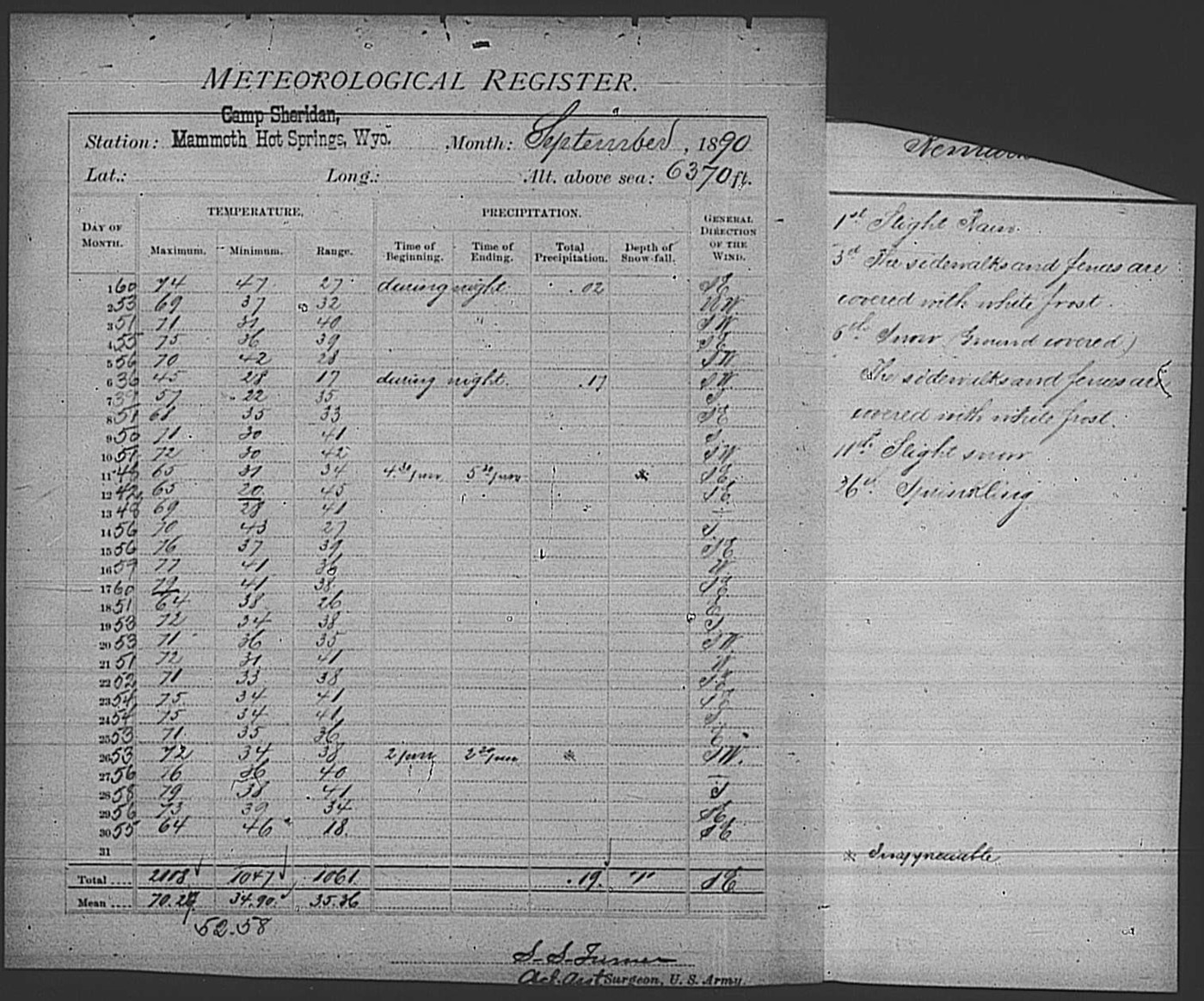
Step 4 · Myth and reality
A real place does not make a canvas a daily log
The documented fieldwork connects this studio painting to an encounter with Castle Geyser. The weather records add a specific fact: snow was recorded elsewhere in the park on the sketch date. They do not establish snow at Brown’s easel, or show that he removed it. No local weather observation or sketch hour has been verified, and the field sketch has not been inspected. We cannot identify which features of the scene he retained, combined or changed in the studio.
Nor can the plume be used here as a thermometer or wind gauge. No local humidity, wind-speed reading or dated eruption log has been connected to the sketch. The National Park Service notes that Castle’s eruption pattern has changed over its recorded history; today’s eruption intervals cannot date an 1890 scene. No painting-specific scholarly description found in this research establishes a cloud type, light condition or weather event for this canvas.
One rain entry falls on different date rows in the manuscript and the printed report; that amount is excluded. The printed snow amount is marked inappreciable, which is not a measured depth or a numerical zero. The original sheet does not supply instrument coordinates, and the archive index substitutes zeros; no precise station-to-geyser distance is claimed. One owner transcribed and rechecked the sources; no independent checker ran. The data retain these exclusions and their reasons.
Sources
Every source on this page
Weather numbers are rebuilt from a transcription tied to the source scans by sha256 fingerprints. Quoted phrases are checked against the cached sources or scan-checked transcription. These checks preserve the evidence used; they are not independent historical validation.
- Eiteljorg Museum, Castle Geyser, Yellowstone, 2017.3.1
sha256 cd148482c9d5be23ba45f33268400c1c923360b6ee68cdba65c6c9076e13c2bd - Eiteljorg Museum, Artist Spotlight on Grafton Tyler Brown
sha256 731f34f192189ebaf498f3ca8bfaa78acbbf7b85cf54d9da31865e4f7075a157 - Bonhams, 11 April 2017, lot 147, Castle Geyser, Yellowstone
sha256 f28f8e75671bfbffe4c201e676f62b01c555e8503c38a07b68334b261a142ad3 - MFA Boston, A Yellowstone Geyser, 2009.4329
sha256 4e1eaaf68832c7546d74896b3b245c55cd8a42758a243ef3e51fcb15983805f1 - Army meteorological register, Camp Sheridan / Mammoth Hot Springs, September 1890
sha256 63e0e65a791ba9a6d39bd04e6de1ed1cf60d326474f7c4984943324f182534e5 - Report of the Superintendent of Yellowstone National Park (1891)
sha256 59329c816af70f721668a35a6275990d9e7b24257a4bb0e0632773982195deb4 - Nephos transcription of September 1890 thermometer readings
sha256 1e3902002acb7db133da5edd1f86a9d2d727b83d48581225d2bdd3e871512d39 - NOAA NCEI pre-Weather Bureau index, Wyoming, September 1890
sha256 4366db1742e213e1c8a6e9341eea445005576943470f97fe930c4043f29f7671 - NOAA/CDMP, Forts data format (March 2010)
sha256 3ade954c6c3f982ce8ab390f776f17cee7dce1b884e33e955a32a780db5a7cdf - National Park Service, Castle Geyser, Old Faithful area tour
sha256 301e53a8de77be6de7423022607f528d3df980c61c19ff6b85d9eebc50cf490f